Root flare check
When planting or inspecting established trees, ensure the root flare (where trunk widens at soil level) is visible and not buried, and gently remove excess soil or mulch from the trunk base to reduce risk of rot and girdling roots.

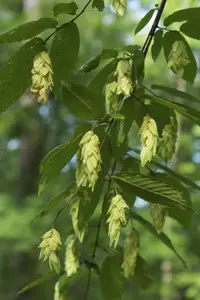
American hophornbeam, Ostrya virginiana, is a slow-growing deciduous tree native to eastern North America. It typically forms a small to medium understory tree with a rounded, airy crown and attractive, hop-like seed clusters that hang beneath the branches. Bark develops a distinctive shredded, flaky texture as the tree matures, adding visual interest in winter. Its dense, hard wood and strong branch structure make it durable in landscapes. This species adapts to a range of soils but prefers well-drained, slightly acidic conditions and moderate moisture. Light shade to sun tolerance and general pest resistance make it relatively straightforward to care for American hophornbeam in suitable climates.

Care Difficulty
Easy Care

Light Preference
Partial Sun

Water Requirements
Moderate Water

Temperature Preference
Cold Hardy

Hardiness Zone
3–9

Soil Texture
Sandy, Loamy, Clay

Soil pH
Acidic (5.5–6.5), Slightly acidic (6.5–7.0)

Soil Drainage
Well-drained

Fertilization
Minimal (feed rarely)
Scan your plant to receive care tips personalized for your specific plant
Available on iOS and Android
This species thrives as a small understory tree with moderate, seasonally shifting light needs.
This tree prefers consistently moist, well-drained soil once established, with brief dry spells tolerated.
This hardy deciduous tree is adapted to temperate climates with cold winters and warm summers.
Humidity is rarely a limiting factor for this species in outdoor landscapes.
This tree prefers stable, moderately moist mineral soils with adequate structure for long-term root support.
This species is generally unsuited to long-term container culture and performs best planted in the ground.
Ostrya virginiana is a slow-growing native tree that usually needs minimal fertilization once established in suitable soil.
Ostrya virginiana benefits from light, well-timed pruning to maintain structure and remove problem wood.
This species is rarely kept long-term in containers; care focuses on transplanting young trees to permanent sites with minimal root disturbance.
Propagation of ostrya virginiana is most commonly done by seed and is considered moderately challenging due to dormancy requirements.
This cold-hardy deciduous tree usually needs little special winter care in the ground across most of its range.

Plant Health Check
Not sure what's wrong with your plant? Check your plant's health inside the app.
The tree produces clusters of papery, bladder-like sacs that resemble hops used in brewing, each sac enclosing a single nut-like seed. These fruit clusters give rise to the common name American hophornbeam and are a useful identification feature in late summer and fall.
It serves as a larval host plant for several moth species, including the understory prominent (Oligocentria minor), whose caterpillars feed primarily on its leaves. This relationship makes the tree an important component of forest food webs that support insectivorous birds.
The wood is exceptionally hard and dense, often ranked among North America’s toughest native hardwoods. Historically, its shock-resistant wood was used for tool handles, wedges, and other applications where resistance to wear and impact was critical.

In natural forest stands, American hophornbeam often functions as a long-lived understory tree, tolerating relatively deep shade for decades and then responding with increased growth when canopy gaps open, which allows it to persist through multiple generations of more light-demanding species.
This species is slow-growing, typically adding about 20–30 cm per year under average landscape conditions. Growth may be slightly faster in deep, well-drained, fertile soil and slower in compacted, dry, or heavily shaded sites.
Keep your plants happy and healthy with plant identification, disease detection, and easy care guidance.