Manage Dormant Bulbs
When foliage dies back, lift the tubers, brush off soil, and store them dry in a labeled paper bag at 50–60°F to keep them viable for replanting next season.

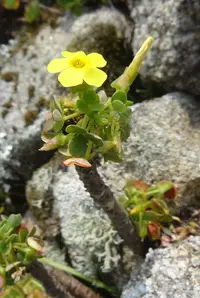
Fleshy yellow-sorrel, Oxalis megalorrhiza, is a perennial herb from South America, often grown as an ornamental curiosity. It forms thick, knobbly underground tubers and compact clumps of clover-like leaves with small yellow flowers. In mild climates it can spread and behave like a groundcover, while in containers it stays manageable and easy to observe. It adapts well to indoor pots or outdoor rock gardens when given bright light and a well-drained, gritty soil mix. Its drought-tolerant tubers and generally forgiving nature make it suitable for beginners learning how to care for fleshy yellow-sorrel.

Care Difficulty
Moderate Care

Light Preference
Partial Sun

Water Requirements
Moderate Water

Temperature Preference
Warm Climate

Hardiness Zone
9–11

Soil Texture
Sandy, Loamy, Organic-rich

Soil pH
Acidic (5.5–6.5), Slightly acidic (6.5–7.0)

Soil Drainage
Well-drained

Fertilization
Minimal (feed rarely)
Scan your plant to receive care tips personalized for your specific plant
Available on iOS and Android
Oxalis megalorrhiza prefers bright, gentle light that supports compact foliage and flowering.
Oxalis megalorrhiza needs evenly moist but not saturated soil, with brief drying between waterings.
This species prefers mild, frost-free conditions for steady growth and healthy foliage.
This species handles typical indoor humidity but benefits from slightly moist air.
Provide light, fast-draining soil that mimics a loose, rocky woodland substrate.
This species is well suited to container growing when drainage and root space are managed carefully.
Oxalis megalorrhiza stays compact and healthy with light feeding during active growth.
Pruning Oxalis megalorrhiza is simple and mainly focused on tidying and renewing growth.
This species tolerates being slightly crowded but benefits from occasional division and fresh soil.
Oxalis megalorrhiza is most commonly propagated by division of its bulbs or thickened roots.
In mild climates this species usually survives winter well with modest protection for underground parts.

Plant Health Check
Not sure what's wrong with your plant? Check your plant's health inside the app.
This species naturally occurs along rocky Pacific coasts of Chile and Peru, where it survives harsh conditions by storing reserves in underground tubers that resprout after stress or seasonal dieback.
The leaf surfaces are covered with tiny, light-scattering cells that give them a somewhat glaucous, slightly bluish-green appearance, an adaptation thought to reduce water loss and excess light in exposed coastal habitats.
In its native range it often grows near sea spray zones, showing notable tolerance to wind and moderate salinity compared with many inland oxalis species.
This species spreads by underground tubers and can form dense patches over time. In mild climates it may behave as a nuisance weed. Contain it in pots or raised beds and remove unwanted offsets promptly.
Keep your plants happy and healthy with plant identification, disease detection, and easy care guidance.