Early staking setup
Install low, discreet peony hoops or short stakes in early spring as shoots emerge, so the fine foliage and heavy flowers are supported before stems elongate and begin to flop in wind or rain.

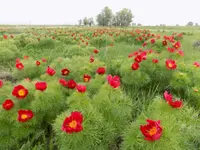
Fern-leaf peony, Paeonia tenuifolia, is a compact, herbaceous perennial valued for its finely divided, feathery foliage and early spring flowers. It forms low, rounded clumps topped with single, usually red blooms.
This species is native to grasslands and rocky slopes in Eastern Europe and western Asia, where it experiences cold winters and relatively dry conditions. Its deep root system and summer dormancy make it long-lived but sensitive to disturbance.
Once established, it is relatively low maintenance, but it dislikes frequent moving or division and needs good drainage to avoid root problems. Understanding how to care for Fern-leaf Peony starts with providing full sun, well-drained soil, and protection from waterlogged sites.

Care Difficulty
Moderate Care

Light Preference
Full Sun

Water Requirements
Moderate Water

Temperature Preference
Cold Hardy

Hardiness Zone
3–8

Soil Texture
Sandy, Loamy, Organic-rich

Soil pH
Acidic (5.5–6.5), Slightly acidic (6.5–7.0)

Soil Drainage
Well-drained

Fertilization
Minimal (feed rarely)
Scan your plant to receive care tips personalized for your specific plant
Available on iOS and Android
This species prefers bright, open conditions to produce strong growth and abundant flowers.
Paeonia tenuifolia prefers evenly moist, well-drained soil rather than frequent, shallow watering.
This cold-hardy peony thrives in climates with cool winters and moderate summers.
Humidity is not a major factor for Paeonia tenuifolia, which thrives in typical outdoor air.
Paeonia tenuifolia prefers deep, loose, well-drained mineral soil that does not stay wet after rain.
This species can be grown in containers outdoors, but long-term performance is better in open ground.
This species benefits from modest feeding but does not need heavy fertilization for good flowering.
Paeonia tenuifolia needs only light, targeted pruning to stay healthy and flower well.
This peony is usually grown in the ground and only needs infrequent transplanting when overcrowded or poorly placed.
Multiplication of this species is best done slowly and carefully, as both division and seed methods require patience.
This hardy species tolerates typical winter conditions in many temperate gardens and needs only modest care.

Plant Health Check
Not sure what's wrong with your plant? Check your plant's health inside the app.
This species has unusually thread-like, dissected leaves that give the plant a fern-like, airy appearance, unlike the broader foliage of most other peonies.
It is among the earliest peonies to flower in spring, often opening its deep red, single blooms before many other garden perennials have started to grow actively.
In the wild it grows in dry, open steppe and rocky slopes in Eastern Europe and western Asia, adapted to cold winters and relatively dry, well-drained soils.

Wild populations of Paeonia tenuifolia have declined in parts of their native range due to habitat loss and over-collection, and in some countries the species is legally protected, making cultivated plants an important way to preserve its genetic diversity.
Lack of flowers usually comes from planting too deep, insufficient sun, or plants that are still immature. Avoid heavy disturbance, divide only every many years, and allow at least 2–3 seasons for strong flowering to establish.
Keep your plants happy and healthy with plant identification, disease detection, and easy care guidance.