Palisota barteri Care

Palisota barteri

About Palisota barteri

Palisota barteri is a tropical understory plant from West and Central Africa, grown mainly for its broad, glossy leaves and bright ornamental berries. It forms low, clumping rosettes that slowly spread, creating a lush, groundcover-like effect in warm, humid conditions.

In cultivation it is usually grown as a shade-loving foliage plant, suitable for containers or sheltered spots outdoors in frost-free climates. It prefers consistently moist, well-drained soil and protection from strong sun and cold drafts.

These preferences make it moderately easy to grow if stable warmth and humidity are available. Understanding how to care for Palisota barteri mainly involves providing soft light, even moisture, and a sheltered position.

Main Plant Requirements

Care Difficulty

Moderate Care

Light Preference

Partial Shade

Water Requirements

Keep Soil Moist

Temperature Preference

Tropical / Frost Sensitive

Hardiness Zone

11–12

Soil Texture

Loamy, Peaty, Organic-rich

Soil pH

Acidic (5.5–6.5)

Soil Drainage

Moist but well-drained

Fertilization

Light (every 4–6 weeks)

Get Personalized Care Plan

Scan your plant to receive care tips personalized for your specific plant

Available on iOS and Android

How to Care for the Palisota barteri

This understory shrub prefers soft, filtered light that mimics a forest floor environment.

  • Provide bright, filtered light or dappled shade, such as under taller plants or 2–4 hours of mild morning sun, avoiding harsh midday and afternoon sun that can scorch leaves.
  • Palisota barteri tolerates partial to deep shade but foliage becomes sparser and stems stretch if light stays too low for many weeks.
  • In summer, protect from direct sun after 10 a.m.; in winter, allow a bit more exposure by thinning overhead shade or moving closer to brighter windows if grown indoors.

This species prefers consistently moist but never waterlogged soil around its fibrous roots.

  • Water when the top 2–3 cm of soil feel dry, aiming for evenly damp soil that is not soggy and allowing excess to drain away fully.
  • Reduce watering slightly in cooler months, but do not let the root zone dry out completely, especially in small containers or shallow beds.
  • Yellowing, soft leaves and a sour smell indicate overwatering or poor drainage; crisp leaf edges, curling, and slow growth point to underwatering or prolonged dryness.

This plant prefers warm, stable conditions similar to a humid tropical forest floor.

  • Aim for 65–80°F (18–27°C) for active growth, as cooler conditions slow metabolism and can reduce new leaf production.
  • Protect from temperatures below 55°F (13°C); short dips to 50°F (10°C) may be survived but can cause leaf damage and increased disease risk.
  • Avoid hot, dry exposures above 90°F (32°C); in heat waves, increase shade, air movement, and soil moisture while avoiding cold drafts from air conditioning vents.

This species prefers moderately humid air and reacts if conditions are too dry for long periods.

  • Aim for 50–70% humidity, as sustained levels below 40% often lead to leaf-edge browning.
  • Dry indoor air causes curling, crisp tips, and slowed growth, especially in heated rooms.
  • Increase humidity with a pebble tray, grouped plants, or a small humidifier placed nearby but not blowing directly on Palisota barteri.

This plant grows best in loose, organic-rich, well-aerated soil that drains quickly but does not dry out immediately.

  • Use a mix of 50–60% peat or coco coir, 20–30% fine compost, and 20–30% perlite or fine bark to balance moisture and air space.
  • Aim for slightly acidic to neutral pH, around 6.0–7.0, to support nutrient availability and healthy root growth.
  • Ensure water drains from the container within a few seconds; mix in more perlite or bark if water lingers on the surface.
  • Avoid heavy clay-based mixes or pure garden soil, which compact, reduce aeration, and increase the risk of root rot in Palisota barteri.

This species is well suited to container growing when moisture and stability are managed carefully.

  • Choose a low, wide pot that accommodates its spreading habit and keeps the plant stable as stems arch outward.
  • Select a pot material that matches your watering style, such as plastic for slower drying or terracotta for faster drying in humid climates.
  • Elevate the container slightly and ensure drainage holes are never blocked so excess water exits quickly after each watering.

This species responds well to light feeding under cultivation, though wild plants often cope with poor soils.

  • Use a balanced liquid fertilizer (for example 10-10-10) at 1/4–1/2 strength every 4–6 weeks in spring and summer.
  • Alternatively, apply a thin layer of compost or a low-dose slow-release fertilizer at the start of the growing season.
  • Always water before and after feeding to limit root burn and salt buildup in the substrate.
  • Stop feeding Palisota barteri in fall and winter when growth slows, especially indoors.

Pruning is minimal but helpful to keep Palisota barteri foliage dense and tidy.

  • Carry out most pruning in late winter or early spring before strong new growth starts.
  • Remove dead, yellowing, or damaged leaves at the base to reduce disease risk and improve appearance.
  • Thin crowded or inward-facing shoots to improve air movement and maintain a compact clumping outline.
  • Use clean, sharp scissors or hand pruners and disinfect blades when cutting diseased tissue.

Container-grown plants benefit from occasional repotting to refresh soil and prevent root binding.

  • Check for roots circling the pot, pushing through drainage holes, or unexplained slow growth as signs it needs attention.
  • Plan to repot every 2–3 years in spring, shifting to a container only 2–5 cm wider with well-drained, organic-rich mix.
  • Remove the plant gently, loosen circling roots with fingers, and trim only broken or rotten sections.
  • Water thoroughly after repotting, keep in bright, indirect light, and maintain stable moisture for 1–2 weeks to reduce stress.

Propagation of Palisota barteri is usually done by division or sometimes from seed under warm conditions.

  • Divide mature clumps in spring, ensuring each section has healthy roots and several shoots.
  • Plant divisions in a moist, free-draining mix, then keep humidity high and light indirect until new growth appears.
  • Sow fresh seed on the surface of a sterile mix at 70–80°F and keep evenly moist, not waterlogged.
  • Provide gentle bottom warmth and cover trays or pots with a vented dome to maintain stable humidity for germination.

This tropical species is not frost tolerant and needs protection in regions with cold winters.

  • In USDA zones colder than 10, grow Palisota barteri in containers so it can be moved indoors for winter.
  • Before first frost, place plants in a bright, frost-free area kept around 60–70°F.
  • For in-ground specimens in mild climates, apply 5–8 cm of organic mulch around the root zone, keeping it off stems.
  • Reduce watering in winter so the soil stays slightly moist, not saturated, to limit root rot in cool conditions.

Care Tips

Surface root mulching

Apply a 1–2 cm layer of fine orchid bark or coco chips over the soil surface to keep shallow rhizomes cool and moist while still allowing good air flow to the roots.

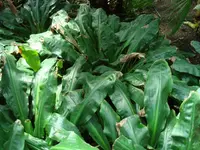
Leaf cleaning routine

Wipe the broad leaves every 2–4 weeks with a damp, soft cloth to remove dust so the plant can photosynthesize efficiently and to help you spot pests early.

Divide clumps carefully

Every 2–3 years, lift and divide crowded clumps in early spring by cutting sections that each include at least 2–3 growing points and some healthy roots, then pot them into fresh mix and keep evenly moist until re-established.

Edge protection in pots

Use a wide, shallow container with gently sloping sides or a soft rim so arching stems are not cut or bruised as they spill over the pot edge.

Pest scouting pattern

Inspect the undersides of leaves and the bases of leaf stalks once a month using a consistent top-to-bottom pattern so scale, mealybugs, and spider mites are detected and treated before they spread when caring for Palisota barteri.

Common Pests and Diseases

Spider mites

This pest feeds on the undersides of leaves, causing fine speckling, dulling of the foliage, and sometimes fine webbing between leaves and stems.

Solution

Rinse foliage thoroughly with lukewarm water, focusing on leaf undersides, then repeat every few days for 2–3 weeks; in persistent cases, apply a horticultural soap or neem oil spray labeled for mites, and raise humidity to 50–60% to make conditions less favorable.

Mealybugs

These insects hide in leaf axils and along stems, leaving cottony white clusters, sticky honeydew, and sometimes sooty mold on the glossy leaves.

Solution

Remove visible insects with cotton swabs dipped in isopropyl alcohol, then wash the plant with a mild soapy water solution; repeat inspections weekly and isolate the plant from others until no new mealybugs appear, using a targeted neem or insecticidal soap spray for heavier infestations.

Scale insects

This pest appears as small, rounded or oval bumps on stems and leaf midribs, causing yellowing, reduced vigor, and sticky honeydew on leaves or nearby surfaces.

Solution

Gently scrape or wipe off individual scales with a cotton swab or soft cloth, then treat the plant with insecticidal soap or neem oil, repeating every 7–10 days until new growth is clean and the infestation has stopped spreading.

Leaf spot

This disease causes brown or dark purple water-soaked spots that may enlarge and merge, especially on older, shaded leaves with limited airflow.

Solution

Remove and discard affected leaves, keep foliage dry when watering, and increase air circulation around the plant; in recurrent cases, use a copper-based or other broad-spectrum fungicide labeled for leaf spots and avoid crowding plants in very humid, low-light corners, which is important for Palisota barteri care.

Interesting Facts

Understory rainforest specialist

This species naturally grows on the shaded floor of West and Central African lowland rainforests, forming clumps that take advantage of dappled light and constantly moist leaf litter rather than direct sun.

Fleshy bird-dispersed fruits

It produces bright red, fleshy berries that are attractive to birds, which eat the fruits and help disperse the seeds across the forest understory.

Broad, water-shedding leaves

Its large, glossy leaves are shaped and angled to rapidly shed heavy tropical rainfall, which helps protect the roots from waterlogging in compact forest soils.

FAQs about Palisota barteri

This species spreads slowly by short rhizomes and clumping stems. It forms dense patches over time but is not typically aggressive. Control the spread by lifting and dividing clumps or edging beds every few years.

Grow Healthy Plants with Botan Care

Keep your plants happy and healthy with plant identification, disease detection, and easy care guidance.

Botan plant care app — identify plants on mobile

Explore More Plants