\Baquois redresse\ Care (Pandanus montanus)

Also known as: Baquois redresse
\Baquois redresse\

About \Baquois redresse\

Baquois redresse, botanically known as Pandanus montanus, is a woody, screw pine relative with a bold, architectural form. It typically develops a sturdy trunk with spirally arranged, narrow, straplike leaves.

This species is native to higher elevations of islands in the western Indian Ocean, where it grows in moist, exposed habitats. Its strong structure and slow to moderate growth make it more suitable for experienced growers than for beginners.

It prefers bright light, consistent moisture, and a free-draining, slightly acidic substrate. Understanding how to care for \Baquois redresse\ starts with providing stable warmth, high humidity, and room for its spiny foliage to expand safely.

Main Plant Requirements

Care Difficulty

Moderate Care

Light Preference

Partial Shade

Water Requirements

Regular Water

Temperature Preference

Tropical / Frost Sensitive

Hardiness Zone

11–12

Soil Texture

Sandy, Loamy, Organic-rich

Soil pH

Acidic (5.5–6.5), Slightly acidic (6.5–7.0)

Soil Drainage

Moist but well-drained

Fertilization

Minimal (feed rarely)

Get Personalized Care Plan

Scan your plant to receive care tips personalized for your specific plant

Available on iOS and Android

How to Care for the \Baquois redresse\

This highland screw pine prefers bright, filtered light similar to bright understory forest conditions.

  • Provide 4–6 hours of bright, indirect light daily, such as dappled sun under taller plants or light morning sun with afternoon shade.
  • Tolerates partial shade, but dense shade causes weak, stretched growth; on the other hand, harsh midday sun can scorch leaves, especially in dry or exposed sites when caring for \Baquois redresse\.
  • In hotter months, shift exposure toward early-morning sun and stronger filtering after 11 a.m.; in cooler seasons, allow a little more direct light to maintain compact, sturdy growth.

This species prefers steadily moist but not waterlogged conditions, similar to well-drained, humus-rich forest soils.

  • Water when the top 3–5 cm of soil feels slightly dry, then soak the root zone thoroughly so moisture penetrates at least 15–20 cm deep.
  • Use freely draining soil or a slope so excess water runs off; persistent wet, heavy ground or standing water leads to root rot and yellowing, mushy lower leaves in Pandanus montanus.
  • In warm, windy periods, expect faster drying and more frequent watering; in cooler or rainy seasons, extend intervals and watch for drooping, crisp leaf tips as a sign the soil has stayed dry too long.

This montane species prefers mild, frost-free conditions with stable, moderate temperatures.

  • Aim for 65–80°F (18–27°C) for active growth; short spells to 82–86°F (28–30°C) are tolerated if soil moisture and humidity remain adequate.
  • Avoid temperatures below 45°F (7°C); damage often appears first as dark, water-soaked patches on leaves after brief exposure to near-freezing air.
  • In cooler seasons, protect from cold downslope winds and radiative chill; in hotter periods, provide airflow and partial shade to reduce leaf stress and prevent heat scorch above 86°F (30°C).

This species prefers moderately humid air but copes with typical indoor levels if not too dry.

  • Aim for 50–70% humidity to reduce leaf-tip browning and maintain steady growth.
  • It tolerates brief dips to 35–40%, but prolonged very dry air causes crispy tips, pale bands, and stalled growth.
  • Increase humidity with a nearby humidifier, grouped plants, or a pebble tray, and avoid placing \\Baquois redresse\\ near heating vents or strong drafts.

This plant prefers a loose, sandy to loamy mix with excellent drainage and steady aeration around the roots.

  • Use roughly 40% coarse sand, 30% compost, and 30% perlite or fine bark to balance drainage and moisture retention for Pandanus montanus.
  • Ensure the mix feels gritty rather than sticky; compact, peat-heavy or clayey substrates limit oxygen and encourage root problems.
  • Keep pH slightly acidic to neutral, around 6.0–7.0, since strongly alkaline mixes can lock out nutrients and cause chlorosis (yellowing leaves).
  • Improve aeration by adding extra perlite or fine bark chips if water takes longer than a few minutes to drain through the pot.

This species adapts well to container growing when the pot is chosen for root space and stability.

  • Pick a wide, heavy container to counterbalance its arching, spiny foliage and reduce the risk of tipping in wind or when moved.
  • Select a pot slightly deeper than the root ball so the woody base sits just above the mix, preventing stem rot at the crown.
  • Use thick-walled terracotta or similar porous material in bright, warm locations to moderate moisture swings and keep roots from overheating.

This species grows on relatively poor soils, so use light fertilization only to support container-grown or stressed Pandanus montanus.

  • Apply a balanced NPK liquid fertilizer at 1/4–1/2 strength every 4–6 weeks during spring–summer for potted Baquois redresse.
  • Use a slow-release granular fertilizer in early spring, kept away from the stem to avoid burn.
  • Incorporate a thin layer of compost on top of the soil instead of heavy feeding for in-ground plants.
  • Stop fertilizing in fall–winter to avoid forcing weak, cold-sensitive growth.

Pruning is mainly used to remove damaged tissue and keep Pandanus montanus manageable in size.

  • Carry out light pruning in late winter or early spring before strong new growth begins.
  • Remove dead, yellowing, or badly damaged leaves at the base using clean, sharp pruners or a knife.
  • Thin crowded side shoots sparingly to improve airflow and maintain a single dominant crown if desired.
  • Avoid cutting into the central growing point, since this can permanently distort growth and reduce vigor.

Transplanting is more relevant than repotting, as this species is usually grown in the ground or large outdoor containers.

  • Look for roots circling the pot drainage holes, toppling plants, or slowed growth as signs it needs a larger space.
  • Transplant in late spring or early summer when soils are warm and the plant can re-establish quickly.
  • Move plants every 3–5 years at most, stepping up only 1 pot size or shifting to a slightly larger planting hole.
  • Water thoroughly before and after moving, keep the root ball intact, and shade for 1–2 weeks to reduce transplant shock.

Propagation of Pandanus montanus is usually done on a small scale and benefits from warm, stable conditions.

  • Use offsets or suckers that form near the base, cutting them away with a clean, sharp knife.
  • Best time is late spring–early summer when temperatures are consistently warm and growth is active.
  • Place divisions in a sharply draining, sandy mix, keeping humidity high but soil just lightly moist.
  • Seed germination is slower; provide 75–85°F warmth, bright indirect light, and consistent but not waterlogged moisture.

In mild, frost-free climates, this plant needs little winter attention, but it is sensitive to hard freezes.

  • In regions below about 40°F, grow in large containers that can be moved indoors or to a sheltered porch for winter.
  • For in-ground plants in marginal zones, apply a 5–8 cm mulch layer around the root zone, keeping it off the stem.
  • Use frost cloth or breathable covers during short cold snaps to limit leaf damage and desiccation.

Care Tips

Manage Leaf Spines

Wear gloves and use long-handled tools when trimming or repotting to avoid the sharp marginal spines, and remove only the most damaged outer leaves at the base with clean, angled cuts to reduce infection risk.

Support Aerial Roots

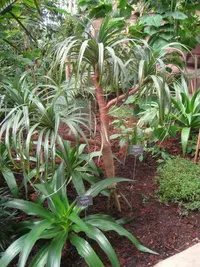
As aerial roots develop, gently guide them into the substrate or a side container of the same potting mix so they can anchor and help stabilize the plant’s eventually top-heavy rosette.

Controlled Size Management

In containers, limit plant size by choosing a slightly snug pot and refreshing only the top 3–5 cm of mix annually instead of frequent upsizing, which slows excessive vertical growth while keeping roots healthy.

Salt Buildup Prevention

Every 2–3 months, flush the pot thoroughly with clean, low-mineral water until it drains freely to wash out accumulated fertilizer salts that can scorch the narrow leaf tips.

Safe Outdoor Transition

When moving the plant outdoors for summer, increase light and wind exposure gradually over 7–10 days and stake the stem if necessary to prevent rocking in the pot, which protects the roots while growing \Baquois redresse\ in exposed sites.

Common Pests and Diseases

Spiral scale

This pest forms small, hard, brown to gray bumps along leaf midribs and stems, often causing yellowing and reduced vigor. Symptoms include sticky honeydew and sooty mold on leaf surfaces beneath infested areas.

Solution

Gently wipe leaves and stems with a soft cloth dipped in lukewarm soapy water, then rinse to remove residue. For persistent infestations, apply a light horticultural oil or neem oil thoroughly to leaf bases and midribs every 7–10 days until new growth appears clean, and isolate the plant from others during treatment.

Mealybugs

These insects appear as white, cottony clusters in leaf axils and along the leaf bases, where they suck sap and weaken growth. Symptoms include distorted new leaves, sticky honeydew, and occasional sooty mold development.

Solution

Remove visible insects with a cotton swab dipped in isopropyl alcohol, focusing on tight leaf bases and between spines. Follow with a series of neem oil or insecticidal soap sprays, ensuring coverage inside leaf rosettes, and inspect weekly to catch any re-emerging colonies early.

Leaf spot

This disease causes tan to dark brown spots with sometimes yellow halos on the strap-like leaves, often starting where moisture lingers in the leaf axils. Symptoms include gradual coalescing of spots and browning leaf tips on older foliage.

Solution

Trim and discard affected leaves or sections, cutting back to healthy tissue and sterilizing tools between cuts. Reduce overhead watering, improve air movement around the plant, keep water out of the leaf rosette as much as possible, and apply a broad-spectrum fungicide labeled for ornamental foliage plants if new spots continue to appear.

Pink disease

This disease, caused by Corticium salmonicolor, leads to dieback of branches and crowns, with affected tissues showing pinkish crusts or web-like fungal growth in humid conditions. Symptoms include yellowing leaves on one side of the plant, followed by collapse of the affected portion.

Solution

Prune out all visibly infected stems and crown sections well into healthy tissue and destroy removed material. Improve light and airflow, avoid wetting the stems, and in outdoor or landscape plantings consider a targeted fungicide program under local guidance if new pink lesions continue to form on remaining healthy tissue.

Interesting Facts

Mauritius highland endemic

This screw pine species occurs naturally only in the upland and montane regions of Mauritius, where it grows in wet thickets and along stream margins in cloud forest conditions.

Important wetland stabilizer

Its dense, fibrous root system helps bind wet, peaty soils on steep slopes in its native habitat, reducing erosion and supporting the structure of high-altitude marshes and ravines.

Distinct from coastal relatives

Unlike many Pandanus species that dominate coastal zones and sandy shores, this plant is adapted to cooler, misty upland climates with frequent cloud cover and high rainfall.

Botan icon

Did you know?

Pandanus montanus is listed as a threatened species due to the loss and fragmentation of Mauritius montane forests, and surviving wild populations are now restricted mainly to a few protected upland reserves.

FAQs about \Baquois redresse\

This species adapts well to large, sturdy containers, provided there is excellent drainage and room for its strong roots and stilt roots. Use a heavy pot, as the plant becomes top-heavy and can tip over in wind.

Grow Healthy Plants with Botan Care

Keep your plants happy and healthy with plant identification, disease detection, and easy care guidance.

Botan plant care app — identify plants on mobile

Explore More Plants