


Use Decaying Wood
Mount the culture on small, pesticide-free hardwood blocks or chips rather than loose substrate to mimic natural colonization and create more stable, long-lasting fruiting surfaces.

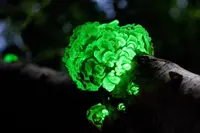
Luminescent Panellus (Panellus stipticus) is a small, wood-decaying mushroom best known for its natural glow in the dark, called bioluminescence. It typically forms tight clusters of fan-shaped caps on rotting logs and stumps.
In nature it occurs across North America, Europe, and parts of Asia, usually in moist forests on hardwood. It is more a specialty cultivation project than a typical houseplant and can be moderately challenging to maintain.
Stable moisture, cool to mild temperatures, and a consistently damp, woody substrate are important to care for Luminescent Panellus, while light needs are low once the culture is established.

Care Difficulty
Hard Care

Light Preference
Shade

Water Requirements
Keep Soil Moist

Temperature Preference
Cool Climate

Hardiness Zone
Unknown

Soil Texture
Loamy, Silty, Organic-rich

Soil pH
Strongly acidic (4.5–5.5), Acidic (5.5–6.5)

Soil Drainage
Moist but well-drained

Fertilization
Minimal (feed rarely)
Scan your plant to receive care tips personalized for your specific plant
Available on iOS and Android
This wood-decay fungus prefers low to moderate light that mimics a shaded forest floor.
Panellus stipticus needs consistently moist, not waterlogged, substrate to fruit well.
This species thrives in cool to mild conditions similar to a temperate forest understory.
This bioluminescent fungus prefers consistently moist, humid air to fruit well.
Panellus stipticus grows best on moist, well-aerated, organic-rich substrate rather than typical potting soil.
This species can be grown in containers if moisture and air exchange are carefully balanced.
Panellus stipticus grown for Luminescent Panellus indoor care needs only light feeding because it naturally thrives on nutrient-poor wood.
Panellus stipticus does not need true pruning, only hygienic removal of spent or unhealthy tissue.
This fungus is not repotted like a houseplant; management focuses on renewing or transferring its colonized substrate.
Panellus stipticus is typically propagated by spores or by transferring live mycelium rather than by vegetative cuttings.
Outdoor Panellus stipticus on hardy wood usually tolerates normal temperate winters and needs little targeted care.

Plant Health Check
Not sure what's wrong with your plant? Check your plant's health inside the app.
The visible glow comes from the mycelium and young gill tissue rather than the entire mushroom cap, and is strongest in very low light once eyes have adapted.
North American populations are reliably bioluminescent, while many European and Asian populations of this species do not glow at all, suggesting strong genetic variation in light-producing traits.
This fungus grows on dead hardwood, especially oak and beech, and functions as a saprotroph, breaking down lignin and cellulose and helping recycle nutrients in temperate forests.

The bioluminescence of this species is based on a luciferin–luciferase system similar in principle to that of fireflies, and it has been used as a model organism in research on fungal light production and gene regulation of bioluminescent pathways.
Yes, this species grows well in shallow containers or trays filled with moist, woody-based substrate. Provide pieces of hardwood, keep humidity high, and avoid direct sun or strong heat to maintain healthy mycelium and consistent fruiting.
Keep your plants happy and healthy with plant identification, disease detection, and easy care guidance.

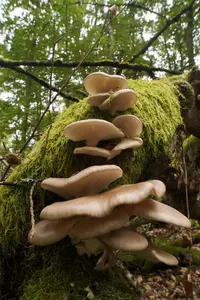
summer oyster mushroom
Pleurotus pulmonarius
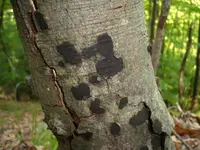
Beech Tarcrust
Biscogniauxia nummularia
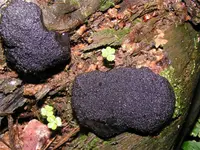
thick tarcrust
Camarops polysperma
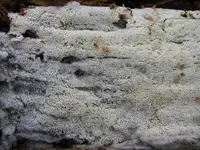
Anomoporia kamtschatica
Anomoporia kamtschatica
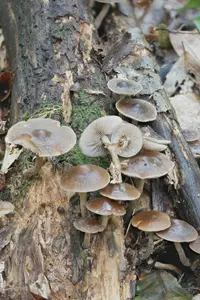
Agrocybe firma
Agrocybe firma
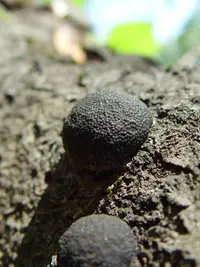
Cramp Balls
Annulohypoxylon thouarsianum
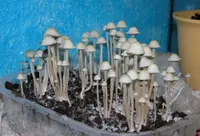
blue meanies
Panaeolus cyanescens
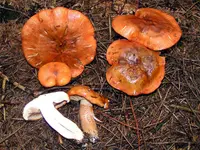
golden orange tricholoma
Tricholoma aurantium