Use host roots
Establish a compatible conifer host, such as spruce or pine, in the planting area, since this ectomycorrhizal fungus needs living tree roots to form its nutrient-exchanging partnership and fruit reliably.

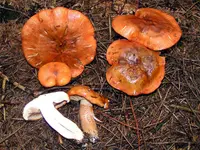
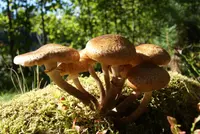
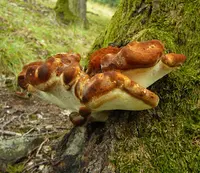
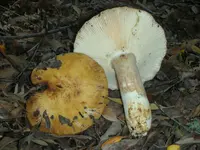
Golden orange tricholoma (Tricholoma aurantium) is a woodland mushroom, not a leafy houseplant. It forms medium-sized, bright orange caps with a fibrous, often scaly surface and pale to orange gills beneath. The stout stem usually shows orange fibers or scales.
This species occurs mainly in temperate coniferous forests, especially with spruce and pine, where it grows on the ground in soil rich in forest litter. It is considered difficult to cultivate at home because it forms mycorrhiza, a symbiotic relationship with tree roots that is hard to reproduce in pots or containers.
Anyone wanting to learn how to care for golden orange tricholoma should understand that it is best observed in its natural habitat rather than grown indoors or in gardens.

Care Difficulty
Hard Care

Light Preference
Partial Shade

Water Requirements
Keep Soil Moist

Temperature Preference
Cool Climate

Hardiness Zone
Unknown

Soil Texture
Loamy, Organic-rich

Soil pH
Acidic (5.5–6.5)

Soil Drainage
Moist but well-drained

Fertilization
Minimal (feed rarely)
Scan your plant to receive care tips personalized for your specific plant
Available on iOS and Android
This woodland fungus prefers cool, filtered light similar to a mixed conifer or deciduous forest floor.
This mycorrhizal fungus depends on consistently moist, well-drained forest soil rather than direct watering of the fruiting bodies.
This species fruits in cool to mild conditions typical of autumn forests.
Humidity is not a major factor for Tricholoma aurantium in outdoor cultivation, as it relies more on suitable host trees and soil conditions.
Tricholoma aurantium is a mycorrhizal mushroom that needs specific outdoor soil conditions rather than a standard potting mix.
This species is not suitable for container growing because it depends on forming mycorrhizal associations with living tree roots in open soil.
This ectomycorrhizal fungus does not need direct fertilization, as it depends on a healthy, unfertilized forest soil to form symbiosis with tree roots such as spruce and pine when caring for golden orange tricholoma.
Tricholoma aurantium does not require pruning, since it is a wild ectomycorrhizal fungus rather than a garden plant with stems or foliage to shape.
This fungus is not suited to normal repotting or transplanting because it relies on living host tree roots and stable forest soil conditions.
Establishing Tricholoma aurantium is difficult outside its natural habitat, and deliberate propagation is rarely successful for non-specialists.
This wild ectomycorrhizal fungus is naturally cold hardy in its native range and does not require active winter care.

Plant Health Check
Not sure what's wrong with your plant? Check your plant's health inside the app.
This species has a vivid orange cap and stem with scattered darker scales, a coloration thought to act as aposematic signaling, warning animals of its bitter, inedible flesh.
The mushroom has dense, white flesh with a distinct mealy or flour-like odor and taste, which helps field mycologists separate it from superficially similar orange species.
It typically forms ectomycorrhizal associations with conifers such as spruce and pine, growing on acidic, sandy or poor soils where its fungal network helps trees access nutrients.

The cap surface often shows fine, darker orange radial fibrils and scales that can crack or break up with age and weathering, creating a patchy, mosaic-like pattern that makes this species visually distinctive among orange Tricholoma in the field.
This mushroom is considered inedible due to its bitter taste and possible gastrointestinal upset. It is not a recommended food species. It should not be collected for eating and must never be confused with edible orange fungi.
Keep your plants happy and healthy with plant identification, disease detection, and easy care guidance.