Use sturdy supports
Install 45–60 cm tall, open-ring or grid supports around clumps in early spring so the tall flower stems grow through and are less likely to flop or snap in wind and rain.

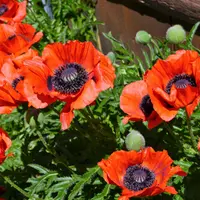
Papaver orientale 'Beauty of Livermere' is a hardy herbaceous perennial grown for its large, vivid scarlet-red flowers and dark central eye. It forms a leafy clump of rough, hairy foliage and sends up tall flower stems in late spring to early summer.
This cultivar originates from garden selections of oriental poppies, which trace back to mountainous regions of the Middle East. It is valued for bold color in sunny borders and mixed perennial beds.
The plant prefers full sun, well-drained soil, and moderate moisture, and it tends to be long-lived once established. Understanding how to care for Oriental Poppy is important because it resents waterlogged soil and summer disturbance of its roots.

Care Difficulty
Moderate Care

Light Preference
Full Sun

Water Requirements
Moderate Water

Temperature Preference
Cold Hardy

Hardiness Zone
3–7

Soil Texture
Sandy, Loamy, Rocky

Soil pH
Acidic (5.5–6.5), Slightly acidic (6.5–7.0)

Soil Drainage
Well-drained

Fertilization
Minimal (feed rarely)
Scan your plant to receive care tips personalized for your specific plant
Available on iOS and Android
Papaver orientale 'Beauty of Livermere' forms strongest flowers in open, sunny garden positions.
Papaver orientale 'Beauty of Livermere' prefers evenly moist but not saturated soil, especially during active growth and flowering.
This hardy perennial tolerates cold winters and cool springs better than prolonged heat.
This perennial tolerates low to moderate humidity and does not need special humidity control.
Papaver orientale 'Beauty of Livermere' prefers a loose, free-draining mineral-rich substrate that does not stay wet after rain or watering.
This species can be grown in containers, but performance is often better in the ground.
This perennial poppy needs only light feeding in most garden soils, so focus on supporting flowering without overfertilizing.
Pruning for Papaver orientale 'Beauty of Livermere' focuses on cleaning spent growth and managing the plant’s natural dieback cycle.
This perennial is best transplanted rarely, since its deep taproot resents disturbance once established.
Propagation of Papaver orientale 'Beauty of Livermere' is most reliable by root division, with seeds less dependable for keeping the cultivar true.
This hardy perennial tolerates typical winters in most temperate climates and usually needs only minimal winter care.

Plant Health Check
Not sure what's wrong with your plant? Check your plant's health inside the app.
This cultivar was selected for its stable, intense scarlet-red petals, which tend to hold their color better in strong sun than many other Oriental poppies that fade toward orange or pink.
Its clump-forming, deeply cut, hairy leaves create a dense mound that often dies back completely in summer heat, then re-emerges in cooler weather, giving the plant a pronounced seasonal rhythm in the border.
The large flowers show a striking contrast between the scarlet petals and the dark, almost black basal blotches and central boss of stamens, a visual pattern that strongly attracts pollinating bees.

Papaver orientale 'Beauty of Livermere' is widely used by breeders and garden designers as a reference cultivar for strong red Oriental poppies, because its flower color, size, and upright habit are considered a reliable benchmark when comparing or selecting new red-flowered selections.
Poor flowering often comes from too much shade, rich or overwatered soil, or crowded clumps. Division every 3–5 years and following basic Oriental Poppy care instructions usually restores strong flowering. Avoid heavy fertilizing, especially high-nitrogen products.
Keep your plants happy and healthy with plant identification, disease detection, and easy care guidance.