Early trellis training
Install a sturdy trellis or fence when the plant is still young and loosely tie new vines with soft ties so the shoots lignify in the desired direction without kinking or snapping.

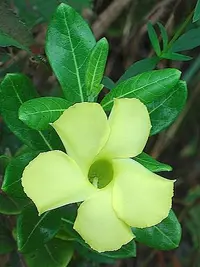
Hammock viper's-tail (Pentalinon luteum) is a vigorous tropical vine in the dogbane family, often grown for its bright yellow, trumpet-shaped flowers and glossy green leaves. It typically climbs or sprawls, so it suits trellises, fences, or large containers.
In nature it occurs in coastal hammocks, thickets, and scrub in Florida, the Caribbean, and parts of Central America. The plant is fairly resilient once established, but its fast growth and need for space mean it is better for outdoor or large, bright areas.
It prefers warm conditions, well-drained soil, and regular moisture without waterlogging. Understanding how to care for hammock viper's-tail starts with providing strong light, support to climb, and protection from cold.

Care Difficulty
Easy Care

Light Preference
Full Sun

Water Requirements
Moderate Water

Temperature Preference
Tropical / Frost Sensitive

Hardiness Zone
10–11

Soil Texture
Sandy, Loamy, Organic-rich

Soil pH
Acidic (5.5–6.5), Slightly acidic (6.5–7.0)

Soil Drainage
Well-drained

Fertilization
Minimal (feed rarely)
Scan your plant to receive care tips personalized for your specific plant
Available on iOS and Android
This sun-loving vine thrives in warm, bright conditions similar to its coastal native habitat.
This vine prefers steadily moist, well-drained soil rather than constant dryness or saturation.
This tropical vine grows best in consistently warm, frost-free conditions.
This coastal vine handles a range of humidity but grows best in moderately moist air.
Pentalinon luteum prefers light, airy soils that drain quickly yet retain some moisture.
This species is suitable for container growing in warm climates with careful attention to stability and drainage.
Pentalinon luteum responds well to light, consistent nutrition during its warm-season growth.
Pentalinon luteum benefits from periodic pruning to manage size and encourage dense, flowering growth.
This vine is more often transplanted outdoors than kept long term in containers, but it handles root disturbance reasonably well when timed correctly.
Pentalinon luteum is commonly propagated from semi-ripe cuttings, with seeds used less often for home growers.
In frost-free or very mild climates, this tropical vine needs minimal winter care, but it is sensitive to freezing conditions.

Plant Health Check
Not sure what's wrong with your plant? Check your plant's health inside the app.
Pentalinon luteum naturally anchors loose coastal sands in Florida, the Caribbean, and parts of Central America, where its deep, spreading roots help stabilize dunes and protect shorelines from erosion.
The stems and leaves contain a white, milky latex typical of the dogbane family (Apocynaceae), which deters many herbivores due to its sticky texture and complex chemical compounds.
Its bright yellow, funnel-shaped flowers have long corolla tubes adapted for pollination by long-tongued insects, including certain butterflies, which can reach nectar deep inside the bloom.

The fruits of Pentalinon luteum are paired, elongated pods that split open when mature to release numerous seeds equipped with silky hairs, allowing them to travel on wind and colonize new sandy habitats.
This species performs best outdoors in warm, frost-free climates where it receives strong light and space to climb or sprawl. Indoors, growth is slower and flowering is reduced unless light, heat, and humidity are high and consistent.
Keep your plants happy and healthy with plant identification, disease detection, and easy care guidance.