Encourage Bushy Form
After flowering, lightly trim back each spent stem to just above a pair of healthy leaves to encourage dense, compact regrowth rather than tall, woody, open growth.

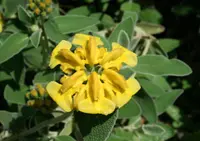
Shrubby Jerusalem sage, Phlomis fruticosa, is an evergreen shrub from the eastern Mediterranean, valued for its drought tolerance and long-lasting structure. It forms rounded, bushy clumps with soft, grey-green, fuzzy leaves and whorls of yellow, hooded flowers along upright stems.
This plant naturally occurs on rocky slopes and dry scrub, so it is well adapted to poor, stony soils and low to moderate water. It prefers full sun and good drainage, which makes it suitable for low-maintenance, dry gardens.
Gardeners who care for shrubby Jerusalem sage often choose it for sunny borders, Mediterranean-style plantings, and wildlife-friendly gardens, as it attracts bees and other pollinators yet needs little attention once established.

Care Difficulty
Easy Care

Light Preference
Full Sun

Water Requirements
Low Water

Temperature Preference
Warm Climate

Hardiness Zone
7–10

Soil Texture
Sandy, Loamy, Rocky

Soil pH
Slightly acidic (6.5–7.0), Slightly alkaline (7.0–7.5)

Soil Drainage
Well-drained

Fertilization
Minimal (feed rarely)
Scan your plant to receive care tips personalized for your specific plant
Available on iOS and Android
Phlomis fruticosa thrives in bright, open positions typical of Mediterranean-type gardens.
This drought-tolerant shrub prefers infrequent, deep watering and free-draining soil.
This Mediterranean shrub prefers warm, dry conditions and tolerates moderate cold once established.
This species comes from dry Mediterranean habitats, so humidity is rarely a concern indoors or outdoors.
Phlomis fruticosa prefers lean, very free-draining mineral soils and suffers in heavy, wet conditions.
This drought-tolerant shrub can be grown successfully in containers if drainage and stability are managed carefully.
This Mediterranean shrub needs only light feeding, as shrubby Jerusalem sage is adapted to lean, well-drained soils.
Phlomis fruticosa responds well to periodic pruning that maintains a compact, flowering shape.
This shrub is usually grown in the ground, so focus on careful transplanting rather than frequent repotting.
Phlomis fruticosa is commonly propagated from semi-ripe cuttings, division, or seeds.
This shrub is fairly cold tolerant in mild climates but benefits from some winter precautions in colder regions.

Plant Health Check
Not sure what's wrong with your plant? Check your plant's health inside the app.
This species is native to rocky, limestone slopes around the eastern Mediterranean and is strongly adapted to hot, dry summers with poor, stony soils.
Its gray-green leaves are covered in fine hairs that reduce water loss and reflect sunlight, a classic xerophytic adaptation to intense sun and drought.
The yellow flowers appear in distinctive stacked rings along the upper stems, providing long-lasting structure and nectar for bees and other pollinators.

Archaeobotanical studies have found remains of this shrub in ancient Mediterranean sites, indicating it grew in human-influenced landscapes for thousands of years and may have contributed to the characteristic maquis and garrigue vegetation mosaics.
Poor flowering usually results from heavy pruning at the wrong time, too much shade, or excess nitrogen fertilizer. Lightly trim after flowering only, keep it in a bright, open spot, and avoid rich, high-nitrogen feeds.
Keep your plants happy and healthy with plant identification, disease detection, and easy care guidance.