Train Central Leader
Stake a single strong stem upright from a young age and loosely tie side shoots downward so the plant develops a defined leader with graceful weeping branches instead of a sprawling, tangled form.

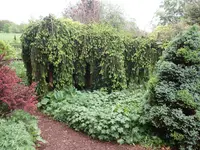
Picea abies 'Pendula', commonly called weeping Norway spruce, is an evergreen conifer valued for its strongly cascading, architectural form. It is usually staked when young, then drapes downward in dense, pendulous layers.
This cultivar originates from the Norway spruce species, which is native to northern and central Europe, but it is grown mainly as a landscape specimen in gardens and parks. Its hardiness, tolerance of cold, and relatively low pest pressure make it easier to manage than many ornamental conifers.
Once established, it copes well with urban conditions and moderate neglect, though it dislikes waterlogged or very dry soil. Gardeners who learn how to care for Weeping Norway Spruce usually find it long-lived and reliable in suitable climates.

Care Difficulty
Moderate Care

Light Preference
Full Sun

Water Requirements
Moderate Water

Temperature Preference
Cold Hardy

Hardiness Zone
3–7

Soil Texture
Sandy, Loamy, Clay

Soil pH
Acidic (5.5–6.5), Slightly acidic (6.5–7.0)

Soil Drainage
Moist but well-drained

Fertilization
Minimal (feed rarely)
Scan your plant to receive care tips personalized for your specific plant
Available on iOS and Android
This conifer prefers bright, open conditions with cool roots and consistent light exposure.
This plant prefers evenly moist, well-drained soil rather than frequent shallow watering.
This hardy conifer thrives in cool to cold climates with moderate summer heat.
This conifer tolerates a wide humidity range and usually does not need special humidity management outdoors.
Picea abies 'Pendula' prefers cool, moist, well-drained mineral soils with stable structure.
This species can be grown in large outdoor containers if attention is given to stability and drainage needs.
This conifer grows best in modestly fertile soil, so use light feeding only to support steady growth.
Pruning Picea abies 'Pendula' is minimal and focuses on health and maintaining its natural weeping form.
This spruce is usually grown in the ground, so focus on careful site transplanting rather than frequent repotting.
Propagation of Picea abies 'Pendula' is specialized and mainly done by grafting, so it is rarely attempted by home gardeners.
This spruce is very cold hardy and usually needs little special winter care in the ground.

Plant Health Check
Not sure what's wrong with your plant? Check your plant's health inside the app.
Most weeping Norway spruce sold in nurseries originate from a single or very few chance garden mutations and are maintained exclusively by grafting onto normal Picea abies rootstocks, so every plant is a clone of earlier selections rather than grown from seed.
Its strongly pendulous branches lack a rigid central leader, so the final height and outline are almost entirely determined by how the main stem is staked and trained when young, leading to very different forms from the same genetic plant.
The dense, skirt-like curtain of downward-hanging branches in mature specimens creates a cool, protected microhabitat that is often used by small birds and ground-dwelling wildlife for nesting and cover in larger gardens and parks.

Because this weeping form does not come true from seed and must be clonally propagated, historic specimens in old European gardens and arboreta are genetically very close to many modern nursery plants, effectively linking current landscapes to horticultural selections made more than a century ago.
This conifer is generally slow to moderate in growth, adding about 15–30 cm per year once established. Growth is faster in deep, well-drained, slightly acidic soil and cooler climates, and slower in heat or compacted ground.
Keep your plants happy and healthy with plant identification, disease detection, and easy care guidance.