Fremont cottonwood Care (Populus fremontii)

Also known as: Alamo Cottonwood, Desert Cottonwood
Fremont cottonwood

About Fremont cottonwood

Fremont cottonwood, Populus fremontii, is a fast-growing deciduous tree native to riparian areas of the southwestern United States and northern Mexico. It commonly lines riverbanks, desert washes, and floodplains.

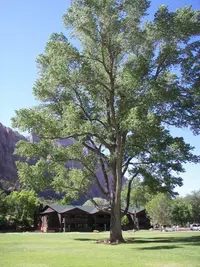
This species develops a broad, rounded crown with thick, furrowed bark and large, heart-shaped leaves that flutter in the wind. In the right conditions it can form dense stands that provide shade and wildlife habitat.

It favors full sun, consistently moist but not waterlogged soil, and space for its extensive root system. Because of its size, water needs, and vigorous roots, it is easier to manage on larger properties, and these traits guide how to care for Fremont cottonwood.

Main Plant Requirements

Care Difficulty

Moderate Care

Light Preference

Full Sun

Water Requirements

Regular Water

Temperature Preference

Cold Hardy

Hardiness Zone

3–9

Soil Texture

Sandy, Loamy, Clay

Soil pH

Slightly acidic (6.5–7.0), Neutral (7.0)

Soil Drainage

Waterlogged tolerant

Fertilization

Minimal (feed rarely)

Get Personalized Care Plan

Scan your plant to receive care tips personalized for your specific plant

Available on iOS and Android

How to Care for the Fremont cottonwood

This fast-growing riparian tree thrives with abundant direct light in open sites.

  • Provide full sun for 6–10 hours daily; Fremont cottonwood performs best in unobstructed exposure near watercourses or open fields.
  • Tree tolerates light partial shade (2–4 hours direct sun) but crown becomes more open and growth slower under prolonged shade.
  • In hot inland summers, strong afternoon sun is acceptable if soil moisture stays high; too little light causes sparse foliage, while dense shade increases disease risk.

This species is adapted to moist riparian soils and depends on consistent access to water, especially when young.

  • Aim for evenly moist soil, allowing only the top 2–5 cm to dry between soakings in the root zone, particularly during establishment years.
  • Increase watering during hot, dry periods if natural groundwater is low, using deep, infrequent soakings rather than shallow sprinkling to train deeper roots.
  • Watch leaves for signals: yellowing and dieback on saturated, poorly drained soils suggest overwatering, while dull, curling, or browning leaf edges indicate drought stress in Populus fremontii.

This tree tolerates a wide temperature range but grows fastest in warm conditions.

  • Active growth is strongest at about 70–90°F (21–32°C), with good performance in typical lowland summer climates of the western and southwestern US.
  • Dormant trees withstand winter lows to about -10°F (-23°C) once established, though young saplings are more vulnerable to sudden hard freezes.
  • It endures hot spells above 100°F (38°C) if soil moisture is high; extended heat with low water increases stress, twig dieback, and pest susceptibility.

This species tolerates low atmospheric humidity and usually does not need special humidity management outdoors.

Populus fremontii grows best in deep, moist, alluvial-type soils with consistent water availability.

  • Use a loamy or silty soil with high organic matter that stays evenly moist but is not stagnant.
  • Ensure slow to moderate drainage, such as along ditches or swales, rather than fast-draining, drought-prone ground.
  • Maintain slightly acidic to neutral pH around 6.0–7.5 for optimal nutrient availability.
  • In drier sites, work in compost and some coarse sand to improve both water-holding capacity and root aeration while avoiding waterlogging.

This fast-growing tree is generally unsuitable for long-term container growing due to vigorous roots and large mature size.

This fast-growing riparian tree usually needs minimal feeding in the ground but benefits from targeted nutrition in poor soils or containers.

  • Apply a balanced slow-release fertilizer (such as 10-10-10) in early spring for young or nutrient-deficient Fremont cottonwood.
  • Use compost or well-rotted manure as a light surface dressing once per year to improve soil structure and microbial activity.
  • For container-grown trees, use a half-strength balanced liquid feed every 4–6 weeks during the growing season.
  • Stop feeding in late summer so new growth hardens before winter, and avoid fertilizing during full dormancy.

Pruning helps manage the size, safety, and structure of Populus fremontii, especially in residential or high-traffic areas.

  • Carry out main pruning in late winter to very early spring, before buds swell, to reduce sap bleed and stress.
  • Remove dead, diseased, storm-damaged, or crossing branches first to lower risk of decay and improve airflow.
  • Thin crowded inner branches to maintain a strong, open framework and direct energy into stable scaffold limbs.
  • Use clean, sharp loppers or a pruning saw, making smooth cuts just outside the branch collar without leaving stubs.

This large, fast-growing tree is rarely kept long-term in containers, so care focuses on timely transplanting from nursery stock.

  • Transplant young trees in late fall or early spring when dormant to reduce transplant shock and water stress.
  • Look for circling roots, roots emerging from drainage holes, or slowed growth as signs a container plant needs a larger site.
  • Choose a site with deep, moist but well-drained soil and full sun, planting at the same depth as in the pot.
  • Water thoroughly after planting, apply a 5–8 cm mulch ring away from the trunk, and keep soil evenly moist during the first 1–2 years.

Populus fremontii is commonly propagated vegetatively to maintain desired traits and ensure rapid establishment.

  • Use dormant hardwood cuttings in late winter, taking 20–30 cm sections from vigorous 1-year shoots.
  • Insert cuttings into moist, well-drained sand or loam, burying at least half their length with buds oriented upward.
  • Keep the rooting zone consistently moist and in bright light, avoiding waterlogging that promotes rot.
  • Seed propagation is possible but requires very fresh seed, constant moisture, and bare, fine-textured soil for germination.

This species is generally cold hardy in much of its native range and needs only basic winter care once established outdoors.

  • Young or newly transplanted trees benefit from a 5–8 cm mulch layer over the root zone, kept away from the trunk.
  • Container-grown trees in colder climates should be moved to a sheltered, frost-free but cool location.
  • Avoid heavy pruning in mid to late fall so new growth does not remain tender going into freezing conditions.

Care Tips

Root zone protection

Lay a wide mulch ring 5–10 cm deep, starting 15–20 cm away from the trunk and extending at least to the drip line to buffer soil temperature, reduce mower damage, and keep surface roots from drying out.

Strong wind management

In very windy sites, install a single low, flexible stake for young trees only, placing ties loosely and removing the stake after 1–2 years so the trunk can strengthen naturally.

Structural pruning timing

Schedule any major structural pruning for late winter, before bud swell, focusing on removing co-dominant leaders and tight V-shaped crotches to reduce future branch breakage.

Irrigation basin shaping

During the first 2–3 years, build and maintain a shallow soil berm in a wide ring around the tree to form a watering basin that directs deep soaks to the root zone instead of letting water run off.

Riparian site monitoring

In flood-prone or streamside plantings, check annually for exposed roots, soil scouring, and leaning trunks, then add soil and mulch or reduce water flow where possible to stabilize the tree when caring for Fremont cottonwood.

Common Pests and Diseases

Cottonwood leaf beetle

This pest feeds heavily on young leaves, causing skeletonizing, holes, and in severe cases near-complete defoliation of Fremont cottonwood. Symptoms include ragged foliage and black beetle larvae clustered on leaves and shoots.

Solution

Prune and destroy heavily infested shoots, then wash foliage with a strong stream of water to dislodge larvae. For repeated infestations, use a targeted insecticide containing spinosad or a labeled systemic product applied in early spring, and encourage natural predators by avoiding broad-spectrum chemicals when possible.

Poplar leaf rust

This disease is caused by Melampsora rust fungi, producing yellow spots on upper leaf surfaces and orange to rust-colored pustules on the undersides. Symptoms include early leaf yellowing and drop, especially in late summer and fall in humid or irrigated sites.

Solution

Rake and remove fallen leaves to reduce overwintering spores and avoid overhead irrigation that keeps foliage wet. Improve air flow around trees, and in severe, recurring cases, consult a local arborist about timing a protective fungicide spray in early season when new leaves are expanding.

Cytospora canker

This disease affects stressed or wounded branches and trunks, causing elongated sunken cankers, oozing resin, and progressive dieback of affected limbs. Symptoms include sparse foliage on portions of the canopy and dead twigs above the cankered area.

Solution

Prune out infected branches several inches below visible cankers during dry weather, disinfecting tools between cuts with 70% alcohol or a 10% bleach solution. Reduce stress by providing deep, infrequent watering during drought, avoiding trunk injuries, and not overfertilizing, since good vigor is central to Populus fremontii care.

Aphids

These insects cluster on young shoots and leaf undersides, sucking sap and causing curled, distorted growth and sticky honeydew that can lead to sooty mold. This pest is especially common on fast-growing spring shoots of Fremont cottonwood.

Solution

Spray colonies off with a firm jet of water from a hose, focusing on shoot tips and leaf undersides, and repeat as needed. If populations remain high, apply insecticidal soap or a light horticultural oil in the early morning, ensuring thorough coverage but avoiding applications during high heat to prevent leaf burn.

Poplar borers

These insects tunnel into the trunk and larger branches, weakening the wood and disrupting water flow, which leads to thinning foliage, dieback, and sometimes breaking limbs. Symptoms include small round exit holes, sawdust-like frass, and swollen or cracked bark patches.

Solution

Maintain tree vigor with proper watering and by avoiding mechanical injuries, since healthy trees are more resistant to borers. Remove and destroy severely infested branches, and where borer pressure is high, consult a certified arborist about timed systemic or trunk-spray treatments targeting newly hatched larvae before they enter the wood.

Interesting Facts

Riparian habitat engineer

Fremont cottonwood is a dominant tree along desert and semi-arid rivers in the southwestern US and northern Mexico, where its roots stabilize streambanks and its leaf litter shapes soil structure and nutrient cycles.

Flood-dependent reproduction

This species relies on natural spring floods that expose moist bare sand or silt for seed germination, so damming and flow regulation have greatly reduced its successful regeneration in many river systems.

Keystone wildlife resource

Fremont cottonwood stands provide critical nesting, roosting, and foraging sites for many birds, bats, beavers, and insects, making them one of the most important tree species for biodiversity in southwestern riparian forests.

Botan icon

Did you know?

Individual Fremont cottonwood trees can grow very rapidly and reach large sizes, with mature specimens often exceeding 30 m tall and forming some of the most visually dominant canopies in arid-land river corridors.

FAQs about Fremont cottonwood

This species is considered fast-growing, often adding 60–120 cm of height per year in favorable conditions. Growth is quickest in deep, moist soils with regular water and slows as the tree becomes older and larger.

Grow Healthy Plants with Botan Care

Keep your plants happy and healthy with plant identification, disease detection, and easy care guidance.

Botan plant care app — identify plants on mobile

Explore More Plants