Establish strong leader
In the first 5–7 years, selectively prune competing upright shoots so the tree develops a single central leader, which greatly improves long‑term structure and wind resistance when growing littleleaf linden.

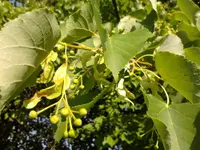
Littleleaf linden, Tilia cordata, is a long-lived deciduous tree valued for its dense crown and fragrant summer flowers. It develops a straight trunk, rounded canopy, and small heart-shaped leaves that turn yellow in fall.
This species is native to Europe and western Asia but is widely planted in towns and parks in many temperate regions. It is often used as a shade or street tree because it tolerates urban conditions fairly well.
The tree grows best in full sun to light shade, with moderate moisture and well-drained soil. Once established, it is considered relatively easy to manage, and basic knowledge of how to care for littleleaf linden helps maintain a healthy, balanced canopy.

Care Difficulty
Moderate Care

Light Preference
Full Sun

Water Requirements
Moderate Water

Temperature Preference
Cold Hardy

Hardiness Zone
3–7

Soil Texture
Loamy, Clay, Organic-rich

Soil pH
Acidic (5.5–6.5), Slightly acidic (6.5–7.0)

Soil Drainage
Moist but well-drained

Fertilization
Minimal (feed rarely)
Scan your plant to receive care tips personalized for your specific plant
Available on iOS and Android
This temperate tree prefers consistent outdoor light conditions with moderate direct sun exposure.
This species prefers evenly moist, well-drained soil rather than frequent shallow watering.
This hardy deciduous tree thrives in temperate climates with cold winters and mild to warm summers.
Tilia cordata is adaptable to a wide humidity range and usually does not need special humidity management outdoors.
Tilia cordata develops best in deep, moisture-retentive but well-drained mineral soils.
This species can be grown in containers only on a temporary basis, as it becomes very large and root-demanding.
This species usually grows well without fertilizer in decent soil, but feeding can support faster establishment and urban trees.
Pruning Tilia cordata is mainly done to maintain structure, safety, and clear form.
Tilia cordata is usually grown as a landscape tree, so transplanting young specimens is more relevant than repotting mature ones.
Propagation of Tilia cordata is possible but slow; it is more common in professional nurseries than in home gardens.
This species is cold hardy in much of the US and generally needs minimal winter care once established.

Plant Health Check
Not sure what's wrong with your plant? Check your plant's health inside the app.
Littleleaf linden flowers produce abundant nectar and are especially important for long-tongued bees and hoverflies, which can access the deep floral structures more easily than many other insects.
In its native European range, littleleaf linden naturally regenerates in the understory of deciduous forests, showing strong shade tolerance in youth before growing into the canopy.
This species readily hybridizes with Tilia platyphyllos, forming Tilia × europaea, a common urban street tree that combines traits of both parents, such as improved pollution tolerance and vigorous growth.

Ancient specimens of littleleaf linden in Europe have been dated to well over 1,000 years old, making this species one of the longest-lived broadleaf trees in temperate forests.
This tree is moderate-growing, typically adding about 30–60 cm (1–2 ft) of height per year under good conditions. Young trees often grow faster, then slow slightly as they mature and form a denser crown.
Keep your plants happy and healthy with plant identification, disease detection, and easy care guidance.