Shelterbelt Placement
Position young trees in rows perpendicular to prevailing winds or behind existing windbreaks to reduce salt and wind burn, which is especially important when growing Bishop Pine near coastal areas.

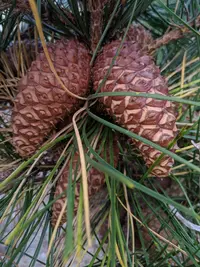
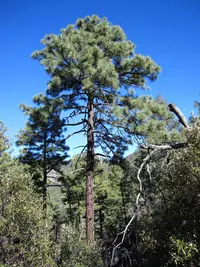
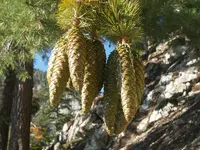
Bishop pine, Pinus muricata, is an evergreen conifer native to the coastal regions of California and northern Baja California. It typically forms a dense, irregular crown with dark green needles and woody cones that may stay on the tree for many years.
In nature it often grows in windy, fog-influenced coastal habitats and nutrient-poor, sandy or rocky soils. These traits make it relatively tolerant of wind, salt spray, and drought once established, but it dislikes heavy, waterlogged ground.
Gardeners who want to care for Bishop Pine should provide full sun, good air movement, and well-drained soil to support healthy, steady growth.

Care Difficulty
Moderate Care

Light Preference
Full Sun

Water Requirements
Low Water

Temperature Preference
Warm Climate

Hardiness Zone
7–10

Soil Texture
Sandy, Loamy, Rocky

Soil pH
Strongly acidic (4.5–5.5), Acidic (5.5–6.5)

Soil Drainage
Well-drained

Fertilization
Minimal (feed rarely)
Scan your plant to receive care tips personalized for your specific plant
Available on iOS and Android
This coastal pine prefers strong, consistent light to maintain dense, healthy growth.
This species prefers well-drained soil and benefits from deep but infrequent watering once established.
This coastal conifer is adapted to mild, maritime climates but tolerates a reasonable range of temperatures.
This coastal conifer tolerates a wide humidity range and usually does not need special humidity management in cultivation.
Pinus muricata prefers loose, fast-draining, sandy or sandy-loam soil that mimics its native coastal habitats.
This species can be grown in containers for several years, mainly as a juvenile or small specimen outdoors.
Pinus muricata grows well in lean soils and usually needs minimal fertilization once established.
Pruning Pinus muricata is mainly structural and sanitary, not heavy shaping.
Bishop Pine is usually grown in the ground, so focus on careful transplanting from nursery containers.
Pinus muricata is usually propagated from seed rather than vegetative methods.
Established Pinus muricata in mild coastal climates needs little specific winter care.

Plant Health Check
Not sure what's wrong with your plant? Check your plant's health inside the app.
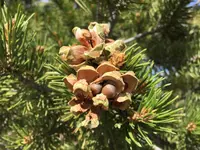
Many populations have serotinous cones that stay closed for years and open only after exposure to intense heat from wildfire, releasing seeds into freshly cleared ash beds.
This species has a naturally fragmented range restricted to the northern and central California coast and a few sites in Baja California, with stands often shaped by cold ocean fog and strong winds.
Genetic studies show pronounced differences between northern and southern populations, including growth form, cone shape, and needle characteristics, reflecting local adaptation and limited gene flow.

Bishop pine has formed extensive self-sustaining naturalized forests on parts of New Zealand’s South Island after being introduced for commercial planting, where it can outcompete some native vegetation and is now managed in certain regions as a wilding conifer.
Container cultivation is possible only while the tree is young. Use a deep, heavy pot with excellent drainage and coarse, well-aerated mix. Expect to up-pot regularly and eventually plant it in open ground for long-term health.
Keep your plants happy and healthy with plant identification, disease detection, and easy care guidance.