Deep root training
During the first 2–3 years, water less often but deeply and avoid frequent shallow watering so the young tree develops a deep taproot that anchors it and improves drought tolerance when growing Sugar Pine outdoors.

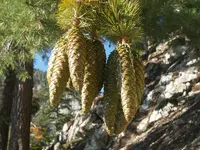
Sugar pine, Pinus lambertiana, is a long-lived, needle-leaved conifer and the tallest of all pine species. It forms a straight trunk with a high, open crown and very long cones. Native to the mountains of California and parts of Oregon, Nevada, and Baja California, it grows in cool, dry-summer forests at higher elevations. This species prefers full sun, well-drained, slightly acidic soil, and relatively low to moderate moisture. In gardens, it is slow to establish and ultimately becomes very large, so space and long-term planning are essential when learning how to care for Sugar Pine.

Care Difficulty
Moderate Care

Light Preference
Full Sun

Water Requirements
Low Water

Temperature Preference
Cold Hardy

Hardiness Zone
5–9

Soil Texture
Sandy, Loamy, Rocky

Soil pH
Strongly acidic (4.5–5.5), Acidic (5.5–6.5)

Soil Drainage
Well-drained

Fertilization
Minimal (feed rarely)
Scan your plant to receive care tips personalized for your specific plant
Available on iOS and Android
This conifer needs abundant direct sun to develop strong growth and dense needles.
This species prefers deep, infrequent watering that allows the soil to dry slightly between soakings.
This high-elevation conifer is adapted to cool to cold climates with moderate summers.
This conifer tolerates a wide humidity range and usually does not need special humidity control outdoors or in unheated structures.
Pinus lambertiana needs deep, well‑drained, slightly acidic soil to develop a stable root system and avoid water stress.
This species is only suitable for short‑term container growing as a juvenile, not as a long‑term potted tree.
Pinus lambertiana typically needs minimal fertilization when grown in suitable, well-drained soil.
Pruning Pinus lambertiana is usually limited to safety, structure, and health maintenance rather than shaping.
Sugar pine is rarely a long-term container plant, so management focuses on careful transplanting from nursery stock into the landscape.
Reproducing Pinus lambertiana is typically done from seed and is a slow, specialized process for forestry or conservation work.
Established Pinus lambertiana trees are cold hardy in suitable climates and generally need little special winter care.

Plant Health Check
Not sure what's wrong with your plant? Check your plant's health inside the app.
This species produces some of the longest cones of any conifer, commonly reaching 25–50 cm, which helps disperse its large, nutrient-rich seeds for wildlife such as Clark’s nutcrackers and squirrels.
The common name sugar pine refers to the sweet-tasting resin that was historically chewed by Indigenous peoples and early settlers, who valued it as a natural sweetener and for its pleasant flavor.
It is native to high-elevation mixed-conifer forests of the Sierra Nevada and parts of the Pacific Coast ranges, where it plays a major structural role in old-growth forest canopies and shows good adaptation to deep winter snowpacks.

Pinus lambertiana is the tallest of all pine species, with some wild individuals measured at over 70 m tall, making it one of the most massive trees in western North American forests.
Growth is relatively slow when young, often 15–30 cm per year, then gradually increasing under good conditions. Long, deep roots and site adaptation matter more than early height gains when growing Sugar Pine in managed landscapes or restoration projects.
Keep your plants happy and healthy with plant identification, disease detection, and easy care guidance.