Establish deep roots
For young plants, water less often but for a longer duration to encourage a deep, drought-resilient root system rather than shallow surface roots that are prone to stress.

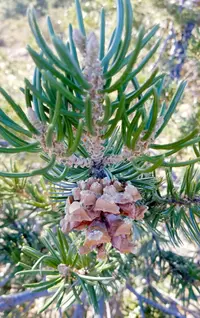
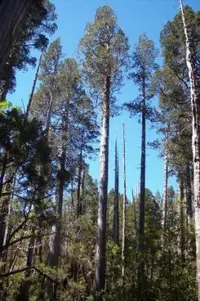
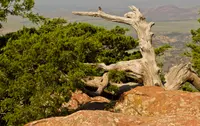
Parry pinyon (Pinus quadrifolia) is a small, slow-growing pine tree native to dry mountain slopes of southern California and northern Baja California. It usually forms a compact, rounded crown rather than a tall, narrow shape.
Its short, blue-green needles grow in bundles, and it produces heavy, woody cones with large edible seeds. The species is adapted to rocky, well-drained soils and low rainfall, which makes it relatively tolerant of drought but sensitive to poor drainage.
Because it grows slowly and prefers full sun and dry, open conditions, it is best suited to arid or Mediterranean-style climates. Understanding these natural conditions helps guide how to care for Parry Pinyon in cultivation.

Care Difficulty
Moderate Care

Light Preference
Full Sun

Water Requirements
Low Water

Temperature Preference
Cold Hardy

Hardiness Zone
7–9

Soil Texture
Sandy, Loamy, Rocky

Soil pH
Slightly acidic (6.5–7.0), Neutral (7.0)

Soil Drainage
Well-drained

Fertilization
Minimal (feed rarely)
Scan your plant to receive care tips personalized for your specific plant
Available on iOS and Android
This high-desert pine thrives in strong light and benefits from long daily sun exposure.
This dryland conifer prefers infrequent, deep watering once established.
This species is adapted to wide temperature swings and prefers cool to warm, dry climates.
This desert-adapted pine tolerates low humidity and usually needs no special moisture management indoors or outdoors.
This species prefers very well-drained, mineral soils that stay on the dry side.
This slow-growing pine can be maintained in containers for many years if drainage and stability are carefully managed.
This slow-growing desert pine needs minimal feeding, especially when planted in native, well-drained soil.
Pinus quadrifolia needs only light, corrective pruning to maintain health and a natural form.
This species is usually grown in the ground, so focus on careful transplanting rather than routine repotting.
Pinus quadrifolia is typically propagated from seed, and vegetative methods are rarely successful for home growers.
This pine is cold hardy in much of its range and usually needs little special winter care once established.

Plant Health Check
Not sure what's wrong with your plant? Check your plant's health inside the app.
Despite the species name meaning four-leaved, most leaves of Pinus quadrifolia actually occur in fascicles of 5 needles, with 4-needled bundles also present and 3-needled bundles less common, making its needle arrangement distinctive among North American pines.
In parts of its range, this species naturally hybridizes with Pinus monophylla (singleleaf pinyon), and intermediate trees can show mixed traits in needle number and cone morphology, which has complicated its taxonomy and field identification.
The relatively large, thick-shelled seeds are edible and were traditionally harvested by Indigenous peoples of the southwestern United States and northern Mexico as a local food resource, although the cones are fewer and less commercially important than those of some other pinyon pines.

Pinus quadrifolia is a long-lived tree of arid montane habitats, with some individuals documented to reach ages of several centuries, persisting on rocky slopes where many other tree species cannot survive for long.
Yes, this species is usually propagated from seeds collected from mature cones. Seeds need a cold stratification period to break dormancy, then germinate in a well-drained medium. Growth is slow, so patience is essential when raising seedlings.
Keep your plants happy and healthy with plant identification, disease detection, and easy care guidance.