


Loblolly Pine Identification (Pinus taeda)

Recognize Loblolly Pine by its needles in bundles of three, each usually 6 to 9 inches (15 to 23 cm) long, and by its stiff, ovoid cones about 3 to 6 inches (8 to 15 cm) long.

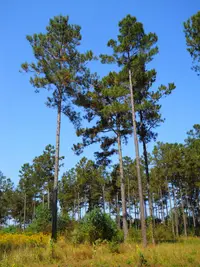
At first glance, Pinus taeda also shows a straight trunk and a tall, broad crown on mature trees.

Pinus taeda Identification

Scan to Confirm Loblolly Pine

Take or upload a photo to confirm your plant ID with Botan.

Clear images work best. Avoid photos taken too close or too far away

Use these quick visual traits to check Pinus taeda by eye.

  • Needles grow in bundles of three, and each needle is usually 6 to 9 inches (15 to 23 cm) long.
  • The crown is tall and straight-trunked, with an open, rounded top on older trees.
  • Bark is thick, gray-brown to reddish-brown, broken into broad, flat plates.
  • Cones are stiff, oval to narrow, about 3 to 6 inches (8 to 15 cm) long, with sharp prickles on the scales.

Check both needle bundles and cone shape for the quickest field confirmation.

Pinus taeda shows clear age-related changes in needles, branching, crown shape, and cones.

  • Seedling: Seedlings begin as a thin upright stem with soft juvenile needles, unlike later bundled foliage, and little branching near the base.
  • Young plant: Young plants show needles in bundles of 3, usually 5-9 inches (13-23 cm) long, with a straight leader and widely spaced side branches.
  • Mature plant: Mature trees develop a tall, straight trunk, broader irregular crown, and rough plated bark, replacing the narrow, more symmetrical outline of youth.
  • Fruiting stage: Cone-bearing branches display stiff, ovoid cones with short prickles, adding a coarse textured look absent on nonfruiting younger plants.

Pinus taeda stays green year-round, so seasonal color change is limited. The clearest shift is in spring, when soft, pale new needles extend at branch tips, creating a lighter flush against older darker foliage. By late winter into spring, pollen cones and seed cones become easier to spot. Mature cones often persist on the tree, so clusters of brown, egg-shaped cones can remain visible after the fresh spring growth appears.

Several southern pines can be mistaken for Pinus taeda at a glance.

shortleaf pine(Pinus echinata)

Both are tall pines with needles mostly in bundles of three. Shortleaf pine usually has shorter needles, often 3 to 5 inches (8 to 13 cm), and small prickles on cone scales; loblolly pine has longer needles and generally unarmed cones.

slash pine(Pinus elliottii)

It can look similar because it also has long needles in bundles of two or three and a straight trunk. Slash pine usually has glossier, slightly longer needles and larger cones, often 3 to 6 inches (8 to 15 cm).

Pinus taeda is native to the southeastern United States, from southern New Jersey south through Florida and west to eastern Texas. That range is useful because naturally occurring trees outside this region are often planted rather than wild. In the wild, it is common in lowland pine forests, old fields, flatwoods, and swamp margins, especially on coastal plains and Piedmont sites. Finding it on moist, acidic ground in the Southeast helps narrow identification.

Not Sure About the ID?

Use Botan to compare a photo and help identify or confirm the plant before you rely on the name.

FAQ

Yes. Mature trees are tall and straight, often 60 to 100 feet (18 to 30 m) or more, with an open, rounded crown. Bark becomes thick, reddish brown to gray, and deeply furrowed into broad plates.

Everything About Loblolly Pine

More Plant Identification Guides

Identify It. Learn More About It.

Snap a photo with Botan to identify the plant, then get plant details, care information, and common problems.

Botan app identifying a plant from a photo
Rice Water for Plants – Which Plants Love It and How to Make It

8 min read · 14 Jul 2026

Rice Water for Plants – Which Plants Love It and How to Make It

Rice water can be an ideal DIY solution for orchids, roses, or fruiting plants. It supports growth, leaf count, and height. We’ll share how to make and apply it correctly for your plant.

Plant Care
Rice Water for Plants – Which Plants Love It and How to Make It
20 Funny Plant Names That Make You Laugh

8 min read · 16 Oct 2026

20 Funny Plant Names That Make You Laugh

Some plants carry names that sound like jokes. This guide explains the origins of 20 funny plant names. You will also see which of these plants you can grow at home.

Plant Recommendations
20 Funny Plant Names That Make You Laugh
13 Best Front Yard Trees for Every Home and Yard

12 min read · 7 Aug 2026

13 Best Front Yard Trees for Every Home and Yard

A front yard tree can stay for decades. Therefore, choosing one deserves serious consideration. Here are 13 trees that have proven themselves, sorted by their purpose. You'll also find five species to avoid and basic planting information.

Plant Recommendations
13 Best Front Yard Trees for Every Home and Yard