Wind training
Plant in an open, windy exposure and avoid staking long term so the trunk and roots can strengthen naturally, which improves long‑term stability in coastal sites.

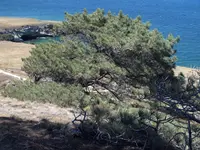
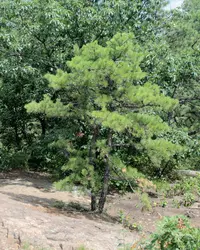
Torrey pine, Pinus torreyana, is a rare coastal pine native to a small area of southern California and Santa Rosa Island. It is a hardy conifer adapted to strong sun, wind, and poor, sandy soils.
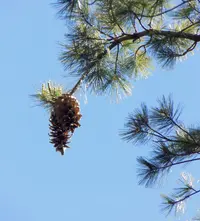
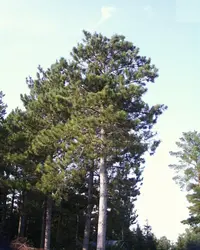
This species forms an irregular, sculpted tree with thick, gray-brown bark and long, stout needles in bundles of five. Large, heavy cones remain on the branches for several years.
In cultivation, it suits coastal or dry, mild climates and needs full sun, good drainage, and low to moderate moisture. These traits make it resilient once established but slow to adapt in more humid or cold regions, so learning how to care for Torrey Pine before planting is helpful.

Care Difficulty
Moderate Care

Light Preference
Full Sun

Water Requirements
Low Water

Temperature Preference
Warm Climate

Hardiness Zone
8–11

Soil Texture
Sandy, Loamy, Rocky

Soil pH
Acidic (5.5–6.5), Slightly acidic (6.5–7.0)

Soil Drainage
Well-drained

Fertilization
Minimal (feed rarely)
Scan your plant to receive care tips personalized for your specific plant
Available on iOS and Android
This coastal pine thrives in bright, open sites with long hours of direct sun.
This drought-adapted pine prefers deep, infrequent watering over constant surface moisture.
This species is adapted to mild coastal climates with warm, dry summers and cool, frost-light winters.
This coastal pine tolerates a wide humidity range and rarely needs special humidity management outdoors.
This species prefers sharply draining, sandy soil that mimics native coastal bluffs and dunes.
This species can be grown in containers when young, but long-term cultivation is challenging due to its eventual size and root system.
In most ground plantings, Torrey Pine needs minimal fertilization once established, especially in native or low-nutrient soils.
Pruning Pinus torreyana is mainly corrective, aimed at safety, structure, and tree health rather than size control.
Torrey pine is usually grown in the ground, so transplanting young trees correctly is more important than frequent repotting.
Pinus torreyana is propagated almost exclusively from seed; vegetative methods are difficult and rarely used outside specialist settings.
Torrey pine is suited to mild, coastal-type climates and generally needs minimal winter protection in its hardiness range.

Plant Health Check
Not sure what's wrong with your plant? Check your plant's health inside the app.
This species has one of the smallest natural ranges of any pine, occurring natively only along a short stretch of the southern California coast near Torrey Pines State Natural Reserve and on Santa Rosa Island.
Along exposed bluffs, trees develop dramatically leaning, contorted crowns due to persistent onshore winds and salt spray, while individuals in more sheltered sites are taller and more upright.
Its large, heavy cones produce relatively few but very large, nutritious seeds, which historically were an important food source for Indigenous peoples such as the Kumeyaay.

Pinus torreyana is considered one of the rarest pines in North America in terms of wild population and natural distribution, and is listed as endangered by the IUCN due to its tiny range and vulnerability to habitat loss and climate change.
Brown needles usually result from prolonged drought, root damage, or salt-laden wind. Check soil moisture, avoid heavy disturbance around roots, improve drainage, and prune only dead tissue. Severe, widespread browning may indicate bark beetles or fungal canker.
Keep your plants happy and healthy with plant identification, disease detection, and easy care guidance.