Establish Strong Leader
In the first 3–5 years, select one central trunk and remove competing upright stems early in winter to build a stable main leader and reduce future storm breakage.

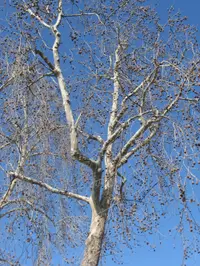
California sycamore (Platanus racemosa) is a large, fast-growing deciduous tree native to streambanks and canyons in California and parts of Baja California. It develops a broad, irregular canopy with mottled, peeling bark and large, maple-like leaves that turn pale yellow to brown before dropping.
In suitable conditions it is long-lived and can reach impressive size, so it fits best in spacious landscapes rather than small gardens. It tolerates seasonal drought once established but grows best with access to consistent moisture and deep, well-drained soil.
Understanding how to care for California sycamore starts with choosing a sunny, open site and allowing enough room for its mature height and spread.

Care Difficulty
Easy Care

Light Preference
Full Sun

Water Requirements
Regular Water

Temperature Preference
Cold Hardy

Hardiness Zone
7–10

Soil Texture
Sandy, Loamy, Clay

Soil pH
Slightly acidic (6.5–7.0), Neutral (7.0)

Soil Drainage
Moist but well-drained

Fertilization
Minimal (feed rarely)
Scan your plant to receive care tips personalized for your specific plant
Available on iOS and Android
This large riparian tree needs abundant direct sun to develop a strong canopy and healthy growth.
This species prefers consistently moist but not waterlogged soil, especially while establishing in the landscape.
This tree is adapted to warm-summer climates with cool to mild winters and can handle notable seasonal swings.
This riparian tree tolerates a broad humidity range and usually does not need special humidity management outdoors.
This species performs best in deep, moisture-retentive yet aerated mineral soils.
This species is generally unsuited to long-term container growing due to its eventual size and vigorous root system.
This native tree usually grows well in average soil, but light feeding can support young California sycamore specimens in poor sites.
Pruning Platanus racemosa focuses on safety, structure, and removal of weak wood rather than cosmetic shaping.
This species is usually grown in the ground, so care focuses on choosing a good site and minimizing stress during transplanting.
Propagation of Platanus racemosa is usually done from seed in managed settings rather than by home cuttings.
Mature trees are cold hardy in most mild-winter regions and usually need little specific winter care.

Plant Health Check
Not sure what's wrong with your plant? Check your plant's health inside the app.
California sycamore often grows along seasonal streams and rivers in California and helps stabilize banks with its extensive, fibrous root system, reducing erosion in flood-prone channels.
The tree’s mottled bark peels in irregular plates, revealing pale inner layers; this shedding helps the plant manage trunk growth and may reduce colonization by some bark-dwelling pests and organisms.
Its large seeds, leaves, and branching structure support many native birds, insects, and mammals, and mature trees are frequent nest sites for species such as red-shouldered hawks and herons.

Fossil evidence shows that sycamore-like trees very similar to California sycamore have existed in western North America since the Miocene epoch, meaning this lineage has been part of the region’s flora for several million years.
This species is considered fast-growing, often adding 60–90 cm in height per year when young, sometimes more with ample water. Growth slows as it matures, but it still becomes a large shade tree relatively quickly.
Keep your plants happy and healthy with plant identification, disease detection, and easy care guidance.