Juvenile stake training
Support the tall, single juvenile stem with a slim, firm stake and a few soft ties so it grows straight and stable before it begins to branch in its adult form.

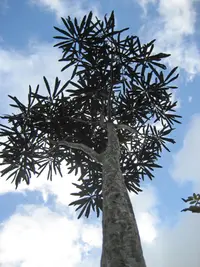
Lancewood (Pseudopanax crassifolius) is an evergreen tree from New Zealand, known for its striking juvenile and adult forms. Young plants have long, narrow, drooping leaves, giving a spiky, architectural look.
As it matures, the canopy becomes fuller, with shorter, broader leaves and a small tree shape. This slow, shape-shifting growth habit makes it a distinctive feature plant for mild, frost-free gardens.
In cultivation it prefers bright light, shelter from harsh frost, and well-drained soil. Understanding these natural preferences helps guide how to care for Lancewood, especially in cooler or very wet climates.

Care Difficulty
Moderate Care

Light Preference
Full Sun

Water Requirements
Moderate Water

Temperature Preference
Warm Climate

Hardiness Zone
8–11

Soil Texture
Sandy, Loamy, Organic-rich

Soil pH
Acidic (5.5–6.5), Slightly acidic (6.5–7.0)

Soil Drainage
Well-drained

Fertilization
Minimal (feed rarely)
Scan your plant to receive care tips personalized for your specific plant
Available on iOS and Android
Pseudopanax crassifolius prefers bright conditions that mimic its native New Zealand forest margins.
Pseudopanax crassifolius prefers evenly moist but not saturated soil once established.
This species prefers mild, temperate conditions and dislikes hard frost or extreme heat.
This species prefers moderate, stable humidity but usually adapts to most home conditions.
Soil for this species must stay aerated and free-draining to protect the roots from rot.
This species is suitable for container growing, especially in cooler or exposed locations.
This species benefits from modest feeding under cultivation, especially in containers, but does not need heavy fertilization.
Pruning Pseudopanax crassifolius is usually light and focused on maintaining a clean, stable form.
This plant is more often grown in the ground than in containers, so care usually focuses on transplanting young trees correctly.
Propagation of Pseudopanax crassifolius is possible but slower and less commonly attempted by beginners.
Established plants tolerate light frosts but young or container-grown specimens benefit from some winter protection.

Plant Health Check
Not sure what's wrong with your plant? Check your plant's health inside the app.
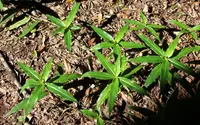
This species shows strong heteroblasty, spending many years in a juvenile form with long, narrow, downward-pointing leaves on a single unbranched stem, then later changing to a much shorter-leaved, branched adult tree.
The stiff, tough juvenile leaves and their downward angle are widely interpreted as an evolutionary adaptation against browsing by now-extinct giant moa birds, making the foliage harder to reach and less palatable at their feeding height.
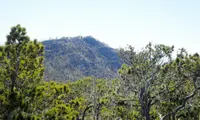
This tree is naturally restricted to New Zealand, where it grows from lowland to montane forests and forest margins, often forming part of the mid-story layer under taller canopy trees.

In its native range, genetic and field studies have shown that this species can hybridize with the closely related Pseudopanax lessonii, producing naturally occurring intermediate forms in overlapping coastal habitats.
This species grows slowly, usually 10–20 cm per year in garden conditions. Growth is especially slow in the juvenile, narrow-leaved stage, then gradually increases as it transitions to the broader-leaved adult form.
Keep your plants happy and healthy with plant identification, disease detection, and easy care guidance.