Shelter From Wind
On exposed sites, install a temporary windbreak fence or plant the tree on the leeward side of a building or taller evergreens to reduce winter desiccation and leader breakage.

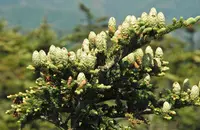
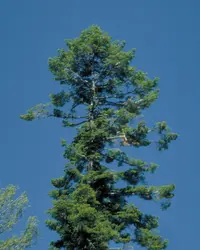
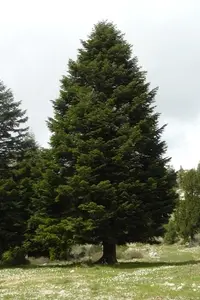
Fraser's fir, Abies fraseri, is a compact, pyramidal conifer best known as a premium Christmas tree and cold-climate landscape evergreen. It forms dense, whorled branches with short, dark green needles that have a silvery underside and a pleasant resinous scent.
This species is native to high-elevation forests of the southern Appalachian Mountains in the United States, where it grows in cool, moist conditions. It is relatively slow-growing and prefers consistent moisture, cool summers, and acidic, well-drained soil.
Gardeners who care for Fraser's Fir should know it dislikes heat, drought, and polluted or heavy urban soils, which makes it easier to grow in cooler regions than in warm, lowland areas.

Care Difficulty
Moderate Care

Light Preference
Full Sun

Water Requirements
Regular Water

Temperature Preference
Cold Hardy

Hardiness Zone
4–7

Soil Texture
Sandy, Loamy, Rocky

Soil pH
Strongly acidic (4.5–5.5), Acidic (5.5–6.5)

Soil Drainage
Moist but well-drained

Fertilization
Minimal (feed rarely)
Scan your plant to receive care tips personalized for your specific plant
Available on iOS and Android
This high-elevation conifer prefers bright, cool sun conditions for dense, healthy growth.
This species prefers consistently moist, cool soil that never stays waterlogged.
This cold-hardy conifer thrives in cool to cold climates with moderate summer temperatures.
This species prefers cool, moderately moist air but usually adapts to outdoor humidity levels.
Abies fraseri needs cool, moist, well‑aerated soil that drains freely yet does not dry out quickly.
This species can be grown in containers for several years, mainly as a temporary or seasonal display.
Nutrient needs for Abies fraseri are modest, especially in the ground with reasonably fertile soil.
Pruning Abies fraseri is mainly corrective, aimed at maintaining a single strong leader and removing problem wood.
This species is usually grown in the ground; transplanting young Abies fraseri needs careful timing and root handling.
Abies fraseri is typically propagated by seed for forestry and Christmas tree production, with grafting used for select forms.
This fir is naturally cold hardy, so established outdoor plants require minimal winter care in most temperate climates.

Plant Health Check
Not sure what's wrong with your plant? Check your plant's health inside the app.
This fir occurs naturally only on a few high mountain peaks in the southern Appalachian range of North Carolina, Tennessee, and Virginia, where it forms cool, moist spruce–fir forests above roughly 1,500 m elevation.
Its high-elevation stands provide key nesting habitat for species such as the northern saw-whet owl and support specialized insect and moss communities that are far less common at lower elevations.
Populations in the wild have declined significantly since the mid-20th century due to the balsam woolly adelgid, an introduced sap-feeding insect that attacks mature trees and alters the structure of entire spruce–fir ecosystems.
This species is one of the most important native American Christmas trees, especially in the eastern United States, because its short, soft needles have excellent retention, its branches are strong yet flexible, and its naturally symmetrical, narrow crown suits indoor display.
Growth is relatively slow, averaging about 20–30 cm per year in suitable outdoor conditions. Young trees establish slowly, then put on steadier height and trunk diameter each season if moisture, soil drainage, and cool temperatures are adequate.
Keep your plants happy and healthy with plant identification, disease detection, and easy care guidance.