


Controlled fresh air
Provide brief, regular fresh air exchange to reduce carbon dioxide buildup and encourage sturdier, more compact fruiting bodies, but avoid strong drafts that dry the substrate surface.

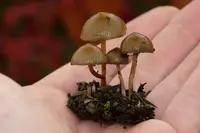
Stuntz's blue legs (Psilocybe stuntzii) is a small mushroom-forming fungus, not a true houseplant. It produces caramel to yellow-brown caps with distinctive bluish staining on the stems when bruised. In nature it typically appears in coastal regions of the Pacific Northwest, often in wood chips, lawns, and other disturbed, moist habitats.
This species is known for its psychoactive compounds, which makes it unsuitable as an ornamental or edible mushroom for general home growing. It prefers cool, damp conditions and nutrient-rich woody debris, so it is not practical to cultivate casually or to care for Stuntz's blue legs like common culinary mushrooms.

Care Difficulty
Hard Care

Light Preference
Partial Shade

Water Requirements
Keep Soil Moist

Temperature Preference
Cool Climate

Hardiness Zone
Unknown

Soil Texture
Loamy, Organic-rich

Soil pH
Acidic (5.5–6.5)

Soil Drainage
Moist but well-drained

Fertilization
Minimal (feed rarely)
Scan your plant to receive care tips personalized for your specific plant
Available on iOS and Android
Psilocybe stuntzii develops best in low to moderate natural light that mimics a shaded forest floor.
Moisture management for Psilocybe stuntzii focuses on evenly damp, never saturated, substrate.
Stable cool to mild temperatures are important for healthy development and fruiting.
This wood-inhabiting fungus needs high, stable humidity for reliable fruiting and healthy mycelial growth.
Psilocybe stuntzii grows on very organic, woody substrates rather than typical garden soil.
This species can be maintained in containers for controlled substrate moisture and hygiene.
This fungus grows on nutrient-rich woody debris or manure and does not benefit from added fertilizer in typical cultivation setups.
Psilocybe stuntzii does not require pruning, since mushrooms are the fruiting bodies of an underground mycelial network.
Transplanting focuses on moving colonized substrate rather than individual fruiting bodies, which are temporary structures.
Propagation relies on spreading spores or transferring live mycelium rather than vegetative cuttings or division used for plants.
Outdoor colonies are naturally cold tolerant in many temperate areas and usually need minimal targeted winter care.

Plant Health Check
Not sure what's wrong with your plant? Check your plant's health inside the app.
This species shows a rapid blue to blue‑green staining where the tissue is bruised, especially on the stem base and cap margin, due to oxidation of its indole alkaloids.
It is strongly associated with urban lawns, parks, mulched garden beds, and newly sodded areas in the Pacific Northwest, often fruiting in fall during cool, wet weather.
Microscopically, it has a gelatinous layer in the cap cuticle and a separable, viscid pellicle, which helps distinguish it from similar small brown mushrooms in the same region.

The species was formally described in 1978 by mycologist Daniel Stuntz, and its common name Stuntz's blue legs honors him while also referring to the characteristic bluish staining of its stems.
This mushroom contains psychoactive compounds and is not suitable as a casual edible food. Misidentification with toxic look‑alikes is common. Consumption carries legal, medical, and psychological risks, so it should not be eaten.
Keep your plants happy and healthy with plant identification, disease detection, and easy care guidance.

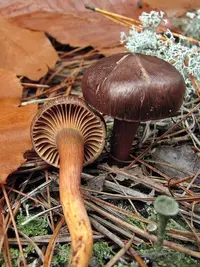
Pine Spikes
Chroogomphus vinicolor
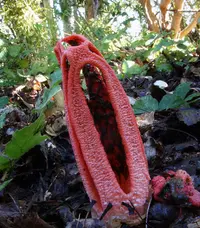
column stinkhorn
Clathrus columnatus
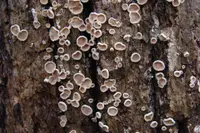
Acanthophysium oakesii
Acanthophysium oakesii
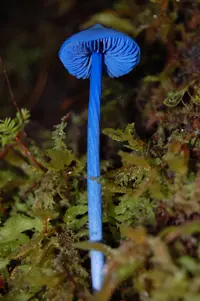
Werewere-kokako
Entoloma hochstetteri
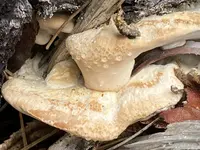
Calcipostia
Calcipostia guttulata
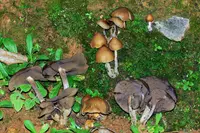
Psilocybe zapotecorum
Psilocybe zapotecorum
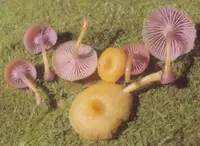
Chromosera cyanophylla
Chromosera cyanophylla
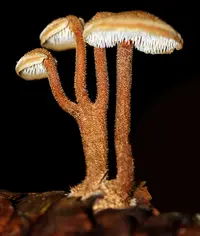
Earpick Fungus
Auriscalpium vulgare