


Use Conifer Debris
Place the culture on a slab of well-aged pine or spruce wood and lightly top it with a thin layer of dry needles to mimic its natural substrate and protect the developing fruiting bodies from rapid drying.

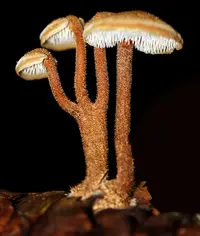
Earpick fungus, Auriscalpium vulgare, is a small, wood-decaying fungus that typically grows on old pine cones and buried conifer debris. It is not a houseplant in the usual sense, but a specialized woodland species. The fruiting bodies are tiny, with a dark, spoon-shaped cap and a short, fuzzy stem, usually held sideways from the cone surface. It prefers cool, moist, shaded forest conditions and appears seasonally rather than year-round. Because it depends on specific decaying conifer material, it is challenging to cultivate and not suited to casual indoor culture or decorative use. Enthusiasts who care for Earpick Fungus usually focus on mimicking natural forest floor conditions in outdoor or controlled terrarium setups.

Care Difficulty
Hard Care

Light Preference
Partial Shade

Water Requirements
Keep Soil Moist

Temperature Preference
Cold Hardy

Hardiness Zone
3–8

Soil Texture
Sandy, Loamy, Organic-rich

Soil pH
Strongly acidic (4.5–5.5), Acidic (5.5–6.5)

Soil Drainage
Moist but well-drained

Fertilization
Minimal (feed rarely)
Scan your plant to receive care tips personalized for your specific plant
Available on iOS and Android
This small wood-decaying fungus prefers cool, shaded forest conditions rather than direct sun.
Moist but not waterlogged conditions are essential for this pine-cone associated fungus.
This species is adapted to cool, temperate forest climates with marked seasonal changes.
This fungus prefers consistently moist, cool air around the fruiting site rather than specific indoor humidity control.
This species grows on decaying conifer cones or wood, so conditions should mimic loose, well-aerated forest litter rather than typical garden soil.
This fungus can be grown in shallow containers that mimic a damp, well-ventilated conifer forest floor.
Auriscalpium vulgare typically grows on decaying conifer cones and rarely needs added fertilizer in naturalistic culture.
Auriscalpium vulgare requires no true pruning, as each fruiting body is short-lived and small.
When grown experimentally in containers or trays, this fungus dislikes disturbance and should be moved only when clearly necessary.
Propagation of Auriscalpium vulgare is specialized work and not commonly attempted by casual growers.
In the ground on natural conifer litter, Auriscalpium vulgare is very cold hardy and generally needs no winter care.

Plant Health Check
Not sure what's wrong with your plant? Check your plant's health inside the app.
This fungus almost exclusively fruits on old, decaying cones of pine and a few other conifers, making it strongly tied to specific host trees in its habitat.
Instead of typical mushroom gills, it carries dense downward-pointing spines under the cap, a hallmark of the toothed fungi group, which increase surface area for spore production.
The small, dark brown cap is covered in coarse hairs and often curves into an ear‑shaped form pressed against the cone, giving rise to the common name earpick fungus.

DNA studies have shown that this species, once grouped with typical bracket and gilled mushrooms, actually belongs in the Russulales, revealing an evolutionary link to brittle gills like Russula and Lactarius despite its very different appearance.
This species performs best outdoors on decaying conifer cones or wood in cool, moist, shaded conditions. Indoors it is very difficult to maintain, so most growers focus on outdoor setups rather than Earpick Fungus indoor care.
Keep your plants happy and healthy with plant identification, disease detection, and easy care guidance.

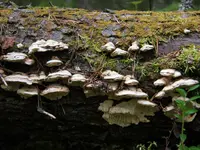
Antrodia heteromorpha
Antrodia heteromorpha
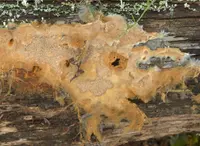
Asterodon ferruginosus
Asterodon ferruginosus
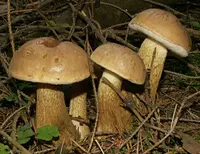
Bitter Bolete
Tylopilus felleus
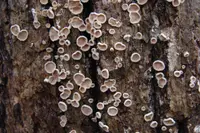
Acanthophysium oakesii
Acanthophysium oakesii
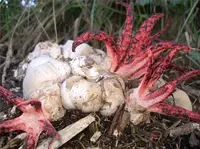
devil's-fingers
Clathrus archeri
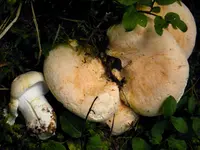
fused polypore
Albatrellopsis confluens
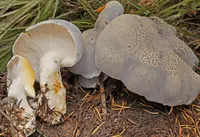
blue knight
Albatrellopsis flettii
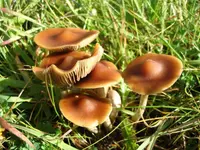
Psilocybe subaeruginosa
Psilocybe subaeruginosa