


Use mesh cages
Place a fine mesh or wire cage over inoculated substrate to keep rodents and pets from disturbing the eggs while still allowing air flow and spore dispersal once the fruiting bodies emerge.

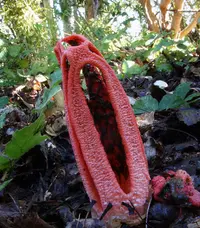
Column stinkhorn, Clathrus columnatus, is a fungus rather than a traditional green plant. It forms striking orange to red column-like arms that rise from a white, egg-like base and are coated in a smelly spore mass that attracts flies.
This species is native to warmer regions, including parts of North and South America, and often appears in mulch, rich soil, or decaying wood in gardens and landscapes. It typically emerges quickly after rain, then collapses within a short time.
Because it is a saprophytic fungus, it feeds on decomposing organic matter and does not need fertilizer. Gardeners who want to know how to care for column stinkhorn mainly manage moisture, shade, and mulch depth to encourage or discourage its growth.

Care Difficulty
Moderate Care

Light Preference
Partial Shade

Water Requirements
Keep Soil Moist

Temperature Preference
Tropical / Frost Sensitive

Hardiness Zone
9–13

Soil Texture
Loamy, Silty, Organic-rich

Soil pH
Acidic (5.5–6.5), Slightly acidic (6.5–7.0)

Soil Drainage
Moist but well-drained

Fertilization
Minimal (feed rarely)
Scan your plant to receive care tips personalized for your specific plant
Available on iOS and Android
This fungus develops best in bright outdoor conditions that avoid prolonged, intense midday sun.
This species relies on consistently moist, well-drained organic substrates rather than a fixed watering schedule.
This fungus fruits best in warm, humid conditions typical of mild to hot climates.
Humidity is not a major factor for outdoor Clathrus columnatus growth, as long as soil moisture is adequate.
Clathrus columnatus fruits best in consistently moist, organic-rich soil that still drains freely.
This species is not well suited to typical decorative container growing, but can be maintained in a dedicated culture tub for observation.
This fungus grows on decaying organic matter and usually does not need fertilization in garden or natural settings.
Pruning is not relevant for Clathrus columnatus, since it is a mushroom-forming fungus rather than a leafy ornamental plant.
Transplanting focuses on moving or renewing the organic substrate rather than handling the visible fruiting bodies.
Propagation of Clathrus columnatus is mainly by spreading its spores or moving colonized substrate rather than traditional plant methods.
In mild to warm climates where it naturally occurs, this fungus usually requires no special winter care.

Plant Health Check
Not sure what's wrong with your plant? Check your plant's health inside the app.
The foul odor of the mature fruiting body mimics decaying organic matter and specifically attracts carrion- and dung-loving flies, which pick up the sticky spores on their legs and bodies and distribute them to new sites.
Unlike many other stinkhorns that form lattices or single stalks, this species develops 2–6 bright orange to red vertical columns that rise from a gelatinous egg, leaving remnants of the egg as a cup-like volva at the base.
This fungus is now widely reported from warm-temperate and subtropical regions and is especially common in landscape mulch and disturbed garden soils, likely spread through the movement of wood chips and nursery substrates.

Molecular studies have shown that some populations once described as separate species are genetically very close to Clathrus columnatus, illustrating how variable its fruiting bodies can be in color and shape while still belonging to the same species.
This fungus spreads locally by spores carried by insects attracted to its smell. It may appear suddenly in rich mulch or compost but does not form large, choking colonies or damage nearby plants or roots.
Keep your plants happy and healthy with plant identification, disease detection, and easy care guidance.

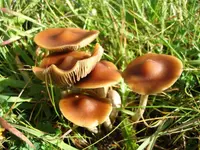
Psilocybe subaeruginosa
Psilocybe subaeruginosa
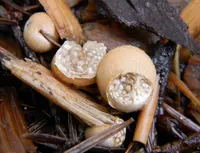
amorphous bird's nest fungus
Nidularia deformis
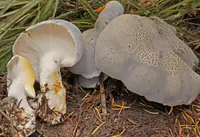
blue knight
Albatrellopsis flettii
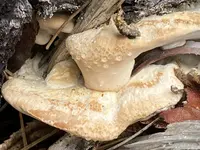
Calcipostia
Calcipostia guttulata
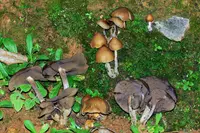
Psilocybe zapotecorum
Psilocybe zapotecorum
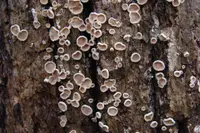
Acanthophysium oakesii
Acanthophysium oakesii
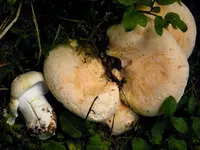
fused polypore
Albatrellopsis confluens
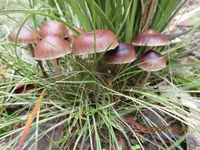
Psilocybe tasmaniana
Psilocybe tasmaniana