Controlled substrate depth
Use a very shallow layer (0.5–1 cm) of fine, well‑decayed wood or bark over a stable base so the fungus has enough organic material to fruit without collapsing or drying out too fast.

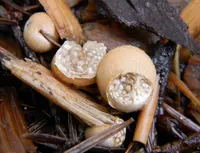
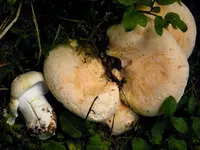
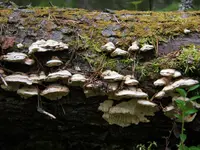
Amorphous bird's nest fungus, Nidularia deformis, is a small saprobic fungus, not a true plant, that lives on decaying wood and other organic debris. It forms irregular, cushion-like masses that hold tiny spore-filled structures resembling a loose, broken bird’s nest.
This species is typically found in cool, damp forests and shaded garden areas where woody mulch or rotting branches stay moist. It usually appears in groups, quietly breaking down organic matter and recycling nutrients in the substrate.
Because it is a decomposer, it is not suited to typical houseplant-style culture and can be difficult to maintain deliberately. Those who want to care for amorphous bird's nest fungus need consistently cool, humid, shaded conditions with plenty of decaying wood as a substrate.

Care Difficulty
Moderate Care

Light Preference
Partial Shade

Water Requirements
Keep Soil Moist

Temperature Preference
Warm Climate

Hardiness Zone
Unknown

Soil Texture
Organic-rich, Loamy

Soil pH
Acidic (5.5–6.5)

Soil Drainage
Moist but well-drained

Fertilization
Minimal (feed rarely)
Scan your plant to receive care tips personalized for your specific plant
Available on iOS and Android
Nidularia deformis prefers low, forest-like light levels rather than direct, open sun exposure.
Moist, not waterlogged, conditions best support the development of Nidularia deformis.
Stable, cool to mild temperatures support reliable growth and fruiting for this species.
This fungus prefers consistently moist, high-humidity microhabitats rather than specific room humidity control.
Nidularia deformis develops best on loose, organic-rich substrates that stay evenly moist yet drain freely.
This species can be grown in shallow containers if the substrate and moisture are managed precisely.
Nidularia deformis, often noticed as amorphous bird's nest fungus, lives on decaying wood and does not benefit from conventional fertilizing in garden or container settings.
Nidularia deformis does not require horticultural pruning, since it is a saprophytic fungus that naturally completes short life cycles on decaying wood.
Transplanting Nidularia deformis is rarely practical, as this fungus depends on specific decaying wood substrates in stable, moist microhabitats.
Propagation of Nidularia deformis is not typically managed by gardeners, as the fungus spreads naturally by spores under suitable woodland conditions.
Nidularia deformis is generally cold hardy in temperate climates and does not require specific winter care from gardeners.

Plant Health Check
Not sure what's wrong with your plant? Check your plant's health inside the app.
Nidularia deformis produces its spores in irregular, cushion-like masses rather than the neat, cup-shaped “nests” seen in many other bird’s nest fungi, which is why it is sometimes called the amorphous bird’s nest fungus.
This species is a saprotroph, meaning it feeds on dead organic matter, and is most often found breaking down decaying hardwood, contributing to nutrient recycling in forest ecosystems.
The fruiting bodies are very small, quickly maturing, and often partly embedded in decaying wood or plant debris, so the fungus is frequently overlooked even where it is locally common.

Some mycologists consider Nidularia deformis and a few closely related species taxonomically challenging because their irregular fruiting body shapes blur the typical boundaries used to separate genera within the bird’s nest fungi group.
This species does not spread aggressively but can colonize suitable damp, decaying wood or mulch gradually via spores. It usually appears in small patches and remains localized unless conditions stay consistently moist and organic debris is abundant.
Keep your plants happy and healthy with plant identification, disease detection, and easy care guidance.