


Use conifer duff
Layer 3–5 cm of aged conifer needles and small rotted wood over the substrate to better mimic natural forest litter and support the mycorrhizal partnership this fungus relies on.

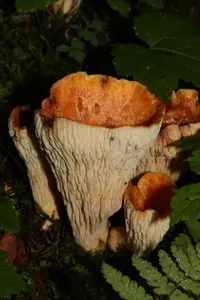
Scaly chanterelle, Turbinellus floccosus, is a large woodland fungus, not a true plant, known for its striking, funnel-shaped orange cap covered with coarse scales. It typically grows on the ground in coniferous forests, especially under firs and spruces, across North America and parts of Asia.
The underside has pale, wrinkled ridges instead of true gills, and the fruiting body often appears in late summer to autumn. Although visually attractive, this species is not recommended for eating due to reported gastrointestinal upset.
In cultivation, it is very challenging because it forms complex associations with tree roots and depends on specific forest conditions. Most guides on how to care for Scaly Chanterelle focus on protecting natural habitats rather than growing it at home.

Care Difficulty
Hard Care

Light Preference
Partial Shade

Water Requirements
Keep Soil Moist

Temperature Preference
Cool Climate

Hardiness Zone
Unknown

Soil Texture
Loamy, Organic-rich, Peaty

Soil pH
Strongly acidic (4.5–5.5), Acidic (5.5–6.5)

Soil Drainage
Moist but well-drained

Fertilization
Minimal (feed rarely)
Scan your plant to receive care tips personalized for your specific plant
Available on iOS and Android
This forest-dwelling fungus prefers sheltered, cool light conditions that mimic conifer woodland floors.
This species thrives in consistently moist, cool, well-drained forest soil, not in waterlogged or bone-dry conditions.
This fungus prefers cool to mild conditions and is sensitive to both hard frost and intense heat.
This fungus forms best in consistently moist, cool, forest-like air rather than very dry conditions.
This ectomycorrhizal fungus relies on specific soil conditions around conifer roots rather than a conventional potting substrate.
This species is not realistically suitable for container growing because it depends on complex mycorrhizal relationships with living conifer roots in open ground.
This ectomycorrhizal fungus does not need direct fertilization when grown near suitable host trees in naturalistic conditions.
Turbinellus floccosus does not require structured pruning, as fruiting bodies are seasonal and short-lived.
Growing Turbinellus floccosus in containers is uncommon; management focuses on positioning near compatible host trees in the ground.
Propagation of this fungus is specialized and is rarely attempted by home growers.
In its native range, Turbinellus floccosus is cold hardy and typically needs no special winter care.

Plant Health Check
Not sure what's wrong with your plant? Check your plant's health inside the app.
This species forms large, vase-shaped fruiting bodies with a strongly scaly, orange to reddish-brown cap surface and a paler, often wrinkled underside that lacks true gills, which helps distinguish it from true chanterelles.
Despite its chanterelle-like appearance, it has caused numerous documented gastrointestinal poisoning cases in North America, likely due to poorly characterized compounds that irritate the digestive system rather than classic neurotoxins.
It forms ectomycorrhizal associations with conifers such as spruce, fir, and pine, exchanging mineral nutrients and water from the soil for sugars produced by the tree through photosynthesis, and is often found in acidic, montane coniferous forests.

Some populations in parts of Asia have traditionally parboiled and consumed this species despite its known toxicity elsewhere, but poisoning cases from underprocessed specimens have led many mycologists and toxicologists to advise against eating it at all.
This species is considered inedible and often described as poisonous. It can cause strong gastrointestinal upset, including nausea, vomiting, and diarrhea. It should not be collected for food, even if it resembles edible chanterelles.
Keep your plants happy and healthy with plant identification, disease detection, and easy care guidance.

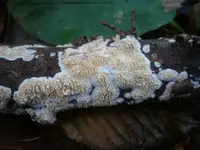
Toothed Crust
Basidioradulum radula
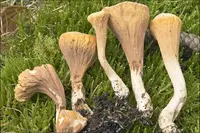
truncated club
Clavariadelphus truncatus
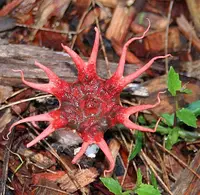
anemone stinkhorn fungus
Aseroe rubra
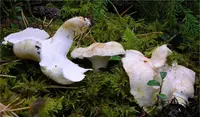
Albatrellus subrubescens
Albatrellus subrubescens
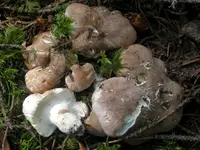
Sheep Polypore
Albatrellus ovinus
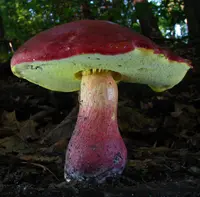
two-colored bolete
Baorangia bicolor
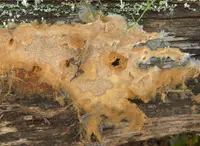
Asterodon ferruginosus
Asterodon ferruginosus
Antrodia ramentacea
Antrodia ramentacea