
Use host trees
Establish cultures near compatible conifer hosts, such as pines or spruces, since this mycorrhizal fungus depends on tree roots for nutrients and will not persist long-term in isolated beds.

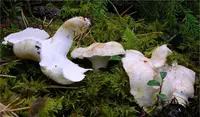
Albatrellus subrubescens is a terrestrial polypore fungus, not a leafy plant. It forms thick, fleshy caps with a pale surface that often develops pinkish to reddish tones, supported by short, stout stems. The underside has small pores instead of gills.
This species typically grows on the ground in coniferous forests, often associated with pine or spruce, in temperate regions of North America and parts of Europe and Asia. It is considered uncommon and can be challenging to cultivate, as it depends on specific tree partners and soil conditions.
For those studying how to care for Albatrellus subrubescens, it generally prefers cool, moist, well-drained forest-like conditions with stable shade and undisturbed soil, which are hard to replicate at home.

Care Difficulty
Hard Care

Light Preference
Partial Shade

Water Requirements
Keep Soil Moist

Temperature Preference
Cool Climate

Hardiness Zone
Unknown

Soil Texture
Loamy, Silty, Organic-rich

Soil pH
Strongly acidic (4.5–5.5), Acidic (5.5–6.5)

Soil Drainage
Moist but well-drained

Fertilization
Minimal (feed rarely)
Scan your plant to receive care tips personalized for your specific plant
Available on iOS and Android
This fungus prefers bright forest light that mimics open woodland edges rather than deep shade or exposed full sun.
Moist but not waterlogged soil is essential for healthy mycelium and consistent fruiting.
This species develops best in cool to mild conditions typical of temperate forests.
Humidity is not a primary factor for Albatrellus subrubescens, which focuses more on moisture and substrate conditions than air humidity.
Albatrellus subrubescens relies on a specific forest-like substrate rather than standard garden or potting soil.
This species is generally unsuitable for container growing because it forms mycorrhizal relationships with tree roots in natural soils.
This forest fungus is not cultivated like a garden plant, so Albatrellus subrubescens generally should not be fertilized in home settings.
Pruning is not applicable for Albatrellus subrubescens, since it is a wild, mycorrhizal fungus rather than an ornamental plant.
This species is a mycorrhizal forest fungus, so it is not suited to normal repotting or garden transplanting.
Practical home propagation of Albatrellus subrubescens is difficult and rarely attempted outside research or specialized cultivation.
This is a temperate woodland fungus with good cold tolerance, so it generally needs no special winter care in its natural habitat.

Plant Health Check
Not sure what's wrong with your plant? Check your plant's health inside the app.
This species belongs to the order Boletales, yet forms a firm, stipeless, shelf-like fruiting body with a pore-bearing underside instead of the typical cap-and-stipe bolete form.
Its caps often show pinkish, orange, or reddish tints that can become more pronounced with age or handling, a key feature used by mycologists to separate it from similar pale Albatrellus species.
It forms ectomycorrhizas, a mutualistic root association, mainly with conifers such as spruce and pine in temperate forests, exchanging mineral nutrients for plant-derived sugars.
This mushroom is generally regarded as inedible or at least of poor culinary value due to its tough texture and sometimes bitter taste. Identification can be difficult, so it is safest not to collect it for food.
Keep your plants happy and healthy with plant identification, disease detection, and easy care guidance.
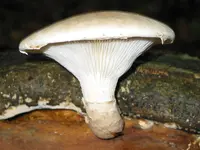
Veiled Oyster
Pleurotus dryinus
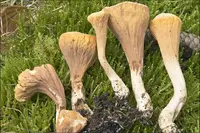
truncated club
Clavariadelphus truncatus
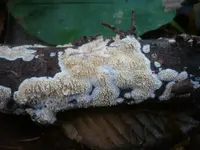
Toothed Crust
Basidioradulum radula
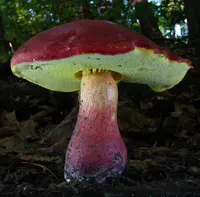
two-colored bolete
Baorangia bicolor
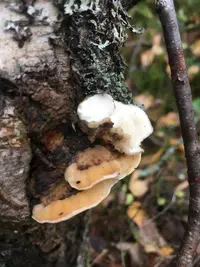
Antrodiella pallescens
Antrodiella pallescens
Antrodia ramentacea
Antrodia ramentacea
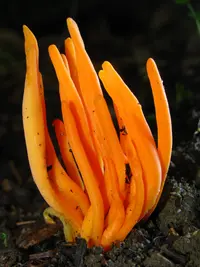
Clavulinopsis aurantiocinnabarina
Clavulinopsis aurantiocinnabarina
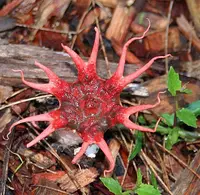
anemone stinkhorn fungus
Aseroe rubra