


Use Host Trees
Establish the fungus in outdoor beds near compatible host trees such as spruce, pine, or beech, since this mycorrhizal mushroom depends on living roots rather than isolated substrate blocks.

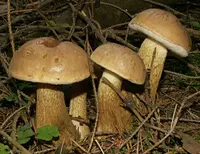
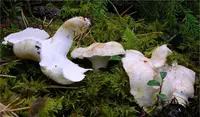
Bitter bolete (Tylopilus felleus) is a wild mushroom-forming fungus, not a typical houseplant. It forms sturdy, fleshy caps with a thick, netted stem and pale pores underneath. The flesh tastes strongly bitter, which makes it inedible despite being non-lethal.
This species usually grows on the ground in coniferous and mixed forests, often near pines and spruces, in temperate regions of Europe, Asia, and North America. It lives in symbiosis with tree roots, so it is very difficult to cultivate artificially.
Because of this close tree association, attempts to care for Bitter Bolete at home are rarely successful. It prefers well-drained, slightly acidic forest soils with consistent moisture and dappled shade under established trees.

Care Difficulty
Hard Care

Light Preference
Partial Shade

Water Requirements
Keep Soil Moist

Temperature Preference
Cool Climate

Hardiness Zone
Unknown

Soil Texture
Loamy, Sandy, Organic-rich

Soil pH
Acidic (5.5–6.5)

Soil Drainage
Moist but well-drained

Fertilization
Minimal (feed rarely)
Scan your plant to receive care tips personalized for your specific plant
Available on iOS and Android
This mycorrhizal fungus prefers woodland light conditions rather than open-field sun exposure.
Tylopilus felleus depends on consistently moist but not saturated forest soil around its tree partners.
This fungus grows best in cool to mild woodland temperatures typical of temperate forests.
Humidity is not a meaningful factor for this outdoor, soil-dwelling fungus and does not require active humidity management when grown in its natural woodland setting.
This ectomycorrhizal fungus relies on specific forest soil conditions rather than conventional potting soil preparation.
This species is not suitable for container growing because it depends on complex, long-term associations with tree roots in undisturbed soil.
Tylopilus felleus is a mycorrhizal fungus that normally gains nutrients through its tree host and soil, so added fertilizer is not required.
Tylopilus felleus does not need pruning in the horticultural sense; only basic removal of spent fruiting bodies is useful for hygiene.
This fungus is not suited to typical container culture, so focus on careful transplanting of the tree host and preserving the native soil community.
Propagation of this ectomycorrhizal fungus is specialized and usually left to natural spore dispersal and soil processes rather than deliberate methods.
This species is naturally cold hardy in temperate forests and generally needs no specific winter care in the landscape.

Plant Health Check
Not sure what's wrong with your plant? Check your plant's health inside the app.
This bolete is famously inedible because its flesh and pores have a very strong, lingering bitterness that does not disappear with cooking and can spoil a whole dish if mixed with edible boletes.
Unlike many edible boletes with yellow or olive pores, this species typically develops a pale pink to flesh-colored pore surface as it matures, which is a key field feature for distinguishing it from look‑alikes.
It commonly forms ectomycorrhizal partnerships with coniferous trees such as spruce and pine, exchanging mineral nutrients for sugars and playing an important role in forest nutrient cycling.

Chemical analyses have shown that the intense bitterness is caused by a group of unique triterpenoid compounds, which are so potent that even a small amount of fruiting body can make a much larger mixed mushroom meal taste unpleasantly bitter.
This mushroom is technically edible but extremely bitter, making it unsuitable as food. The intense bitterness usually ruins any dish, even in small amounts. It is safer to avoid collecting it for culinary use.
Keep your plants happy and healthy with plant identification, disease detection, and easy care guidance.

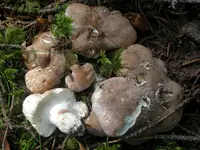
Sheep Polypore
Albatrellus ovinus
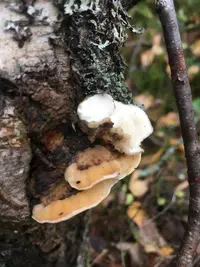
Antrodiella pallescens
Antrodiella pallescens
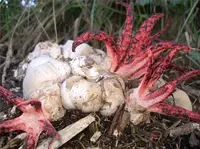
devil's-fingers
Clathrus archeri
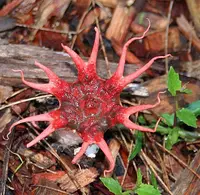
anemone stinkhorn fungus
Aseroe rubra
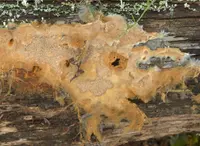
Asterodon ferruginosus
Asterodon ferruginosus
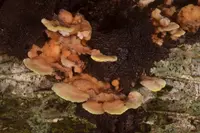
Antrodiella serpula
Antrodiella serpula
Antrodia ramentacea
Antrodia ramentacea
Albatrellus subrubescens
Albatrellus subrubescens