


Use clean host
Only establish colonies on healthy, lichen-free host bark or wood with no visible fungal decay, since this epiphytic crust fungus relies on intact surface tissue rather than decomposed material.

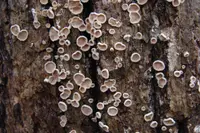
Acanthophysium oakesii is a crust-like wood-decay fungus rather than a leafy houseplant. It typically forms thin, patchy, whitish to pale fruiting layers on bark or dead wood. In nature it is recorded mainly on hardwoods in temperate regions of North America. It plays an ecological role in breaking down dead trees and recycling nutrients. For anyone looking to care for Acanthophysium oakesii under controlled conditions, it is important to know it behaves more like a specialized decomposer than an ornamental species. It generally prefers shaded, consistently moist environments with access to suitable woody material as its food source.

Care Difficulty
Moderate Care

Light Preference
Partial Shade

Water Requirements
Moderate Water

Temperature Preference
Warm Climate

Hardiness Zone
Unknown

Soil Texture
Loamy

Soil pH
Slightly acidic (6.5–7.0)

Soil Drainage
Well-drained

Fertilization
Minimal (feed rarely)
Scan your plant to receive care tips personalized for your specific plant
Available on iOS and Android
This species prefers bright, indirect woodland-style light rather than exposed full sun.
Moist but well-drained conditions support healthy growth and help prevent rot.
Stable, cool to mild temperatures favor this organism and reduce physiological stress.
This species grows best in moderately moist air rather than very dry conditions.
This wood-decaying fungus does not need conventional potting soil but can be managed on prepared substrates when cultured.
This species can be maintained in shallow containers mainly for observation and controlled culture rather than ornamental display.
This wood-inhabiting fungus gains nutrients from its host and usually does not need additional fertilization in cultivation.
Pruning is generally unnecessary for Acanthophysium oakesii, as it develops naturally on woody substrates without shaping needs.
Transplanting focuses on moving the colonized wood rather than the fungus itself.
Propagation of this fungus is usually done by specialists and is not a routine task for general plant keepers.
In temperate climates this species tolerates normal outdoor winter conditions and typically needs no special care.

Plant Health Check
Not sure what's wrong with your plant? Check your plant's health inside the app.
This corticioid fungus is typically found forming thin, whitish patches on the bark of living hardwood trees, especially oaks, where it grows as a smooth, resupinate crust closely attached to the substrate.
The genus is characterized by acanthophyses, which are distinctive spine-bearing sterile structures visible only under a microscope and help separate it from similar crust fungi in taxonomic studies.
As a saprotroph on bark and dead wood, this species contributes to the early stages of wood decomposition, helping to break down complex plant tissues and recycle nutrients in forest ecosystems.
This species grows relatively slowly, forming new tissue gradually over time. Growth is strongly influenced by moisture, substrate quality, and temperature stability. In marginal conditions it may appear almost static, with noticeable expansion only over several seasons.
Keep your plants happy and healthy with plant identification, disease detection, and easy care guidance.

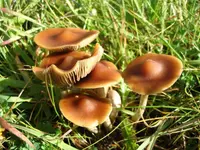
Psilocybe subaeruginosa
Psilocybe subaeruginosa
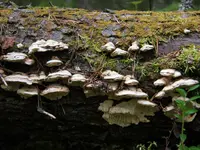
Antrodia heteromorpha
Antrodia heteromorpha
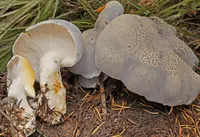
blue knight
Albatrellopsis flettii
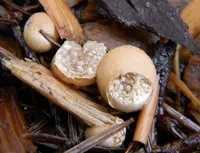
amorphous bird's nest fungus
Nidularia deformis
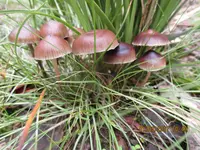
Psilocybe tasmaniana
Psilocybe tasmaniana
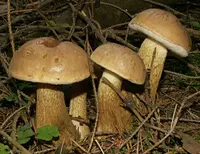
Bitter Bolete
Tylopilus felleus
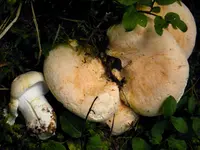
fused polypore
Albatrellopsis confluens
Calcipostia
Calcipostia guttulata