

Host tree selection
Establish this ectomycorrhizal fungus only in beds under compatible hosts like pine, spruce, or fir, since fruiting is strongly linked to the presence and age of suitable conifer roots.

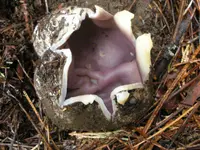
Pink crown, Sarcosphaera coronaria, is a distinctive cup fungus, not a leafy houseplant. It forms hollow, crown-shaped fruiting bodies that emerge from the soil, often partly buried at first. As it expands, the top splits into irregular, petal-like lobes with pale lilac to pink tones.
This species occurs mainly in montane and subalpine conifer forests in parts of Europe and North America, typically in cool, moist conditions. It forms mycorrhizal associations, living in partnership with tree roots, which makes it difficult to cultivate reliably at home. Gardeners who try to care for pink crown usually focus on mimicking its natural, humus-rich, well-drained woodland soils and moderate, indirect light.

Care Difficulty
Hard Care

Light Preference
Partial Shade

Water Requirements
Regular Water

Temperature Preference
Cool Climate

Hardiness Zone
5–8

Soil Texture
Loamy, Silty, Organic-rich

Soil pH
Slightly acidic (6.5–7.0)

Soil Drainage
Moist but well-drained

Fertilization
Minimal (feed rarely)
Scan your plant to receive care tips personalized for your specific plant
Available on iOS and Android
This fungus prefers cool, dappled woodland light rather than open sun.
Moist, cool, free-draining soil is essential for this mycorrhizal fungus.
This species thrives in cool, temperate woodland climates with distinct seasons.
This fungus prefers moderate forest-like humidity but is not highly sensitive in shaded outdoor conditions.
This species relies on specific woodland soils and is difficult to establish artificially.
This species is generally unsuitable for long-term container culture because of its mycorrhizal lifestyle and complex soil requirements.
This woodland fungus is adapted to nutrient-poor soils and typically does not need supplemental feeding in gardens or cultivation.
Sarcosphaera coronaria does not require structured pruning because the fruiting bodies are short-lived and the organism persists mainly as underground mycelium.
Transplanting is rarely appropriate because this mycorrhizal fungus depends on stable soil and host tree roots.
Propagation of Sarcosphaera coronaria in gardens is difficult and rarely successful, as it requires specific soil fungi-host relationships and conditions.
This species is naturally cold hardy in its native range and usually needs no special winter care outdoors.

Plant Health Check
Not sure what's wrong with your plant? Check your plant's health inside the app.
This species starts as an almost closed, underground sphere that pushes through the soil and then opens into a deep, funnel-shaped cup, a growth pattern that helps protect its developing spore surface from damage and drying.
It typically appears in late spring in mountain conifer forests, often near melting snow, taking advantage of cool, moist conditions in calcium-rich soils.
Molecular studies indicate that this species likely forms ectomycorrhizal associations with conifers, exchanging mineral nutrients for sugars and contributing to forest nutrient cycling.

In several European countries this fungus is legally protected or listed as rare because its specialized mountain habitat and sensitivity to disturbance make its fruiting bodies infrequent and vulnerable to local extinction.
This fungus is considered poisonous and should never be eaten, even after cooking or drying. It can cause serious stomach and systemic symptoms. Treat it as a species for observation only, not for consumption.
Keep your plants happy and healthy with plant identification, disease detection, and easy care guidance.

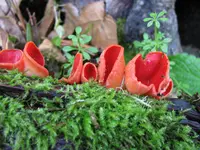
Scarlet Cup
Sarcoscypha coccinea
Acanthophysium oakesii
Acanthophysium oakesii
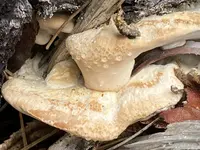
Calcipostia
Calcipostia guttulata
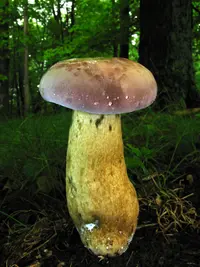
Reddish brown bitter bolete
Tylopilus rubrobrunneus
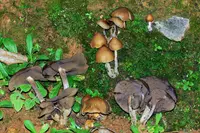
Psilocybe zapotecorum
Psilocybe zapotecorum
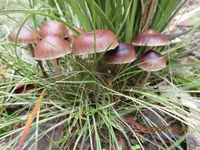
Psilocybe tasmaniana
Psilocybe tasmaniana
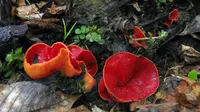
Scarlet Elfcup
Sarcoscypha austriaca
Common Rustgill
Gymnopilus penetrans