

Establish host trees
Introduce or maintain suitable ectomycorrhizal hosts like oak or beech on site, since this fungus relies on living tree roots for carbohydrates and will not persist in isolated beds or containers.

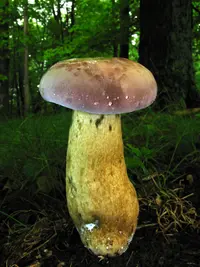
Reddish brown bitter bolete (Tylopilus rubrobrunneus) is a wild ectomycorrhizal fungus, not a typical houseplant, forming symbiotic relationships with tree roots. It produces stout, fleshy caps in reddish brown tones with a pale pore surface that often bruises slightly darker.
This species occurs mainly in North American forests, especially with oaks and other hardwoods, emerging from soil in summer to early fall. Its very bitter taste makes it unsuitable as an edible mushroom and limits interest to foragers, mycologists, and advanced hobby growers.
Because it depends on living tree partners and specific forest soils, it is difficult to cultivate at home. Most people do not attempt to care for Reddish brown bitter bolete beyond protecting natural habitats where it appears.

Care Difficulty
Hard Care

Light Preference
Shade

Water Requirements
Keep Soil Moist

Temperature Preference
Cool Climate

Hardiness Zone
Unknown

Soil Texture
Loamy, Silty, Organic-rich

Soil pH
Acidic (5.5–6.5)

Soil Drainage
Moist but well-drained

Fertilization
Minimal (feed rarely)
Scan your plant to receive care tips personalized for your specific plant
Available on iOS and Android
This mycorrhizal mushroom prefers forest light conditions rather than direct, open sun.
This ectomycorrhizal fungus depends on stable soil moisture rather than direct surface watering of its fruiting bodies.
This species develops best in temperate forest conditions with moderate temperatures and distinct seasons.
Humidity does not meaningfully affect this ectomycorrhizal fungus in outdoor cultivation, as long as its woodland habitat stays naturally moist.
This fungus relies on forming ectomycorrhizal associations with trees, so the surrounding soil conditions are more important than any artificial substrate.
This species is not suitable for container growing, because it depends on extensive root and soil-fungi networks around host trees that cannot be reproduced in pots.
This mycorrhizal fungus relies on host trees and natural soil nutrients, so added fertilizer is not recommended for Tylopilus rubrobrunneus or its habitat.
Pruning is not applied to Tylopilus rubrobrunneus, as it is a wild ectomycorrhizal fungus rather than a cultivated garden plant.
Transplanting this ectomycorrhizal fungus is rarely successful because it depends on a complex root partnership with its host trees.
Reproduction of Tylopilus rubrobrunneus is mainly left to natural spore dispersal in suitable forest habitats, so intentional propagation is rarely attempted.
Native populations overwinter naturally in soil and leaf litter, so typical forest conditions provide all needed winter protection for the Reddish brown bitter bolete.

Plant Health Check
Not sure what's wrong with your plant? Check your plant's health inside the app.
This bolete has a pronounced, lingering bitterness that makes it inedible despite being non-toxic, and even a small piece can render an entire dish unpalatable.
The pore surface starts pale, then becomes pinkish with maturity, a key feature that helps distinguish it from look-alike edible boletes with yellow or olive pores.
It typically forms ectomycorrhizal associations with hardwood trees, especially oaks, meaning its underground mycelium and host roots exchange nutrients in a mutualistic partnership.
This species is considered inedible due to its very bitter taste, which remains even after cooking. It is not known to be deadly, but consumption is strongly discouraged and it should be left in place.
Keep your plants happy and healthy with plant identification, disease detection, and easy care guidance.

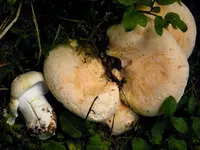
fused polypore
Albatrellopsis confluens
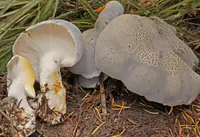
blue knight
Albatrellopsis flettii
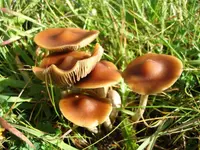
Psilocybe subaeruginosa
Psilocybe subaeruginosa
Scarlet Elfcup
Sarcoscypha austriaca
Scarlet Cup
Sarcoscypha coccinea
amorphous bird's nest fungus
Nidularia deformis
Calcipostia
Calcipostia guttulata
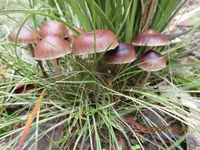
Psilocybe tasmaniana
Psilocybe tasmaniana