

Mimic woodland debris
When setting up a bed, layer well-rotted hardwood chips over a thin base of partially decomposed twigs and leaves to imitate the moist, woody debris where Sarcoscypha austriaca naturally fruits.

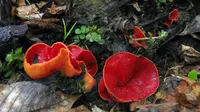
Scarlet elfcup, Sarcoscypha austriaca, is a small cup-shaped fungus, not a true plant, valued for its bright red fruiting bodies. It typically appears in late winter to early spring on decaying sticks and branches. The cups are smooth and vivid red inside, with a paler, sometimes slightly fuzzy outer surface, and usually grow in small groups close to the ground. This species occurs mainly in temperate woodlands across Europe and parts of North America, favoring moist, shaded habitats with plenty of rotting hardwood. It is considered challenging to cultivate indoors, since it depends on specific wood-decay conditions, so most people simply enjoy it in nature rather than try to care for Scarlet Elfcup.

Care Difficulty
Hard Care

Light Preference
Partial Shade

Water Requirements
Keep Soil Moist

Temperature Preference
Cool Climate

Hardiness Zone
4–9

Soil Texture
Loamy, Silty, Organic-rich

Soil pH
Strongly acidic (4.5–5.5), Acidic (5.5–6.5)

Soil Drainage
Moist but well-drained

Fertilization
Minimal (feed rarely)
Scan your plant to receive care tips personalized for your specific plant
Available on iOS and Android
This cup fungus prefers cool, shaded woodland light rather than direct open sun.
This fungus depends on consistently moist, not waterlogged, woodland soil and litter.
This species is adapted to cool, temperate climates and fruits in late winter to early spring.
This cup fungus prefers consistently moist, humid woodland-like conditions but tolerates short dry spells.
Sarcoscypha austriaca develops best on very organic, moisture-retentive, but aerated substrates rather than mineral garden soil.
This species is only marginally suitable for container growing because it depends on stable, decaying wood and litter environments.
Sarcoscypha austriaca usually grows on nutrient-rich decaying wood and needs little to no added fertilizer in gardens or containers.
Sarcoscypha austriaca does not respond to pruning like a typical plant and generally needs no shaping or cutting for health.
Transplanting is only relevant when Sarcoscypha austriaca is grown in culture or moved with its woody substrate.
Propagation of Sarcoscypha austriaca is specialized and not usually attempted by home growers.
This fungus is naturally cold hardy and forms cups in late winter to early spring, so it needs no special winter protection outdoors.

Plant Health Check
Not sure what's wrong with your plant? Check your plant's health inside the app.
The inner spore-bearing surface of this fungus is smooth and bright red, while the outer surface is paler and finely hairy, a combination used by mycologists to separate it from similar red cup fungi in the field.
This species typically fruits on buried or very decayed hardwood sticks and branches, so the cups often appear to grow directly from the soil, even though they are actually feeding on hidden woody debris.
In temperate regions, the bright red cups often appear from late winter to early spring, taking advantage of cool, moist conditions when many other fungi are not fruiting.

Microscopic examination of its spores and the tiny hair-like structures on the outer cup surface is often required to distinguish Sarcoscypha austriaca reliably from its close relative Sarcoscypha coccinea, because they can look nearly identical to the naked eye.
The cups are considered edible but have little flavor and a somewhat tough texture. They are usually eaten cooked, not raw. Always confirm identification with an expert, as confusing similar red cup fungi can be risky.
Keep your plants happy and healthy with plant identification, disease detection, and easy care guidance.

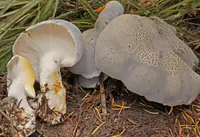
blue knight
Albatrellopsis flettii
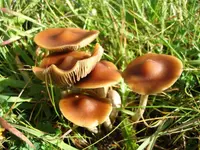
Psilocybe subaeruginosa
Psilocybe subaeruginosa
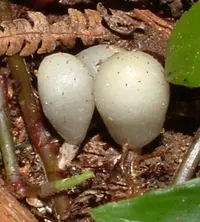
Psilocybe weraroa
Psilocybe weraroa
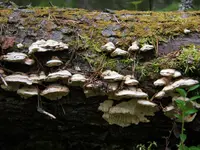
Antrodia heteromorpha
Antrodia heteromorpha
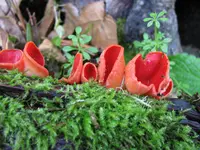
Scarlet Cup
Sarcoscypha coccinea
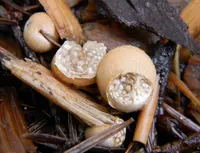
amorphous bird's nest fungus
Nidularia deformis
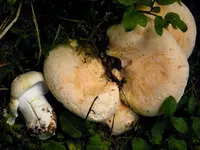
fused polypore
Albatrellopsis confluens
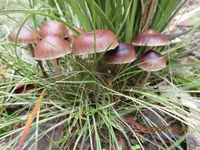
Psilocybe tasmaniana
Psilocybe tasmaniana