Hypomyces microspermus Care

Hypomyces microspermus

About Hypomyces microspermus

Hypomyces microspermus is not a traditional leafy plant but a parasitic fungus that colonizes other mushrooms. It forms a dense, often pale to brightly colored crust over its host, gradually replacing the host’s natural surface with its own tissue.

This species is usually found in forested areas where suitable host mushrooms grow, often on decaying wood or rich leaf litter. It is challenging to maintain outside controlled fungal culture conditions, so attempts to care for Hypomyces microspermus at home are largely experimental and not comparable to regular houseplant cultivation.

Successful growth depends on providing the right host mushroom, stable humidity, and cool, well-ventilated conditions, which are difficult to replicate in typical indoor settings.

Main Plant Requirements

Care Difficulty

Moderate Care

Light Preference

Partial Shade

Water Requirements

Moderate Water

Temperature Preference

Warm Climate

Hardiness Zone

Unknown

Soil Texture

Loamy

Soil pH

Slightly acidic (6.5–7.0)

Soil Drainage

Well-drained

Fertilization

Minimal (feed rarely)

Get Personalized Care Plan

Scan your plant to receive care tips personalized for your specific plant

Available on iOS and Android

How to Care for the Hypomyces microspermus

This fungus prefers bright but softened light conditions that mimic dappled woodland shade.

  • Aim for 2–4 hours of gentle morning sun with the rest of the day in bright, indirect light or open shade, avoiding harsh midday exposure.
  • Provide partial shade under shrubs, low branches, or shade cloth so the substrate surface never bakes or bleaches in direct sun.
  • Reduce exposure in summer if temperatures rise above 85°F (29°C), since combined heat and strong sun can dry the host surface too quickly for Hypomyces microspermus to develop well.

Moisture management focuses on keeping the host substrate evenly damp but never waterlogged.

  • Water when the top 2–3 cm of the host substrate feel just barely moist, avoiding both complete drying and visible pooling or sheen on the surface.
  • Improve drainage with coarse particles so excess water moves through within 30–60 seconds, preventing stagnant pockets that favor bacterial rot over fungal growth.
  • In warmer, windy periods, check moisture daily for subtle surface dulling or shrinkage; in cool seasons extend intervals, watching for cracking or curling as signs of underwatering.

Stable, cool to mildly warm conditions support this fungus best over long periods.

  • Target an active growth range of 60–72°F (16–22°C), where metabolic processes remain steady without stressing the host organism.
  • Protect from cold below 40°F (4°C), since repeated chilling near freezing can slow colonization and damage delicate fungal tissues.
  • Limit exposure above 82–86°F (28–30°C) and combine shade with higher ambient humidity during hot spells to avoid rapid surface drying and thermal stress.

This fungus does not have specific humidity requirements under typical outdoor conditions.

This parasitic fungus develops on suitable hosts rather than in potting mixes, so standard horticultural soil preparation is not applicable.

  • Do not attempt to cultivate this species in prepared mixes such as loam, compost blends, or commercial substrates, as it relies on host tissues, not soil, for growth.
  • Management focuses on avoiding build-up of dense, poorly drained organic debris that can encourage unwanted fungal complexes on cultivated mushrooms or plants.
  • Where Hypomyces microspermus appears on cultivated hosts, remove and discard infected material rather than modifying soil composition or pH.
  • Sterilizing or thoroughly cleaning any reused organic blocks or casing materials helps reduce residual inoculum instead of relying on soil amendments.

This species is not suitable for decorative or horticultural container growing.

This fungus typically grows on host material without added nutrients, so Hypomyces microspermus care rarely involves deliberate fertilizing.

Pruning is not a standard practice for Hypomyces microspermus, as it is a parasitic fungus rather than a conventional garden plant.

Transplanting focuses on moving colonized substrate rather than the fungus itself, since Hypomyces microspermus lives on host organisms.

  • Transplant only when the host substrate is fully colonized and growth appears stable.
  • Work in cool, shaded conditions to limit drying of the colonized material.
  • Gently move chunks of infected substrate to a similar new environment, avoiding mechanical damage.
  • Maintain comparable moisture and airflow at the new site to reduce stress on fungal growth.

Propagation of Hypomyces microspermus is specialized and usually left to advanced growers or researchers rather than home cultivation.

This fungus does not receive conventional winter care, as it persists or declines according to host and site conditions.

Care Tips

Sterile Substrate Choice

Use sterilized grain, agar plates, or other lab-grade media rather than garden soil to culture this fungus, as a clean, nutrient-controlled substrate greatly reduces contamination from faster-growing molds and bacteria.

Laminar-Flow Handling

Perform all inoculations and transfers in a laminar-flow hood or still-air box, wiping tools and work surfaces with 70% isopropyl alcohol to keep competing fungi from outgrowing Hypomyces microspermus.

Spore Source Management

Collect spores or tissue from fresh, firmly colonized host material and avoid overmature, sporulating infections, which often carry mixed contaminant flora that are difficult to separate in culture.

Incremental Scale-Up

Start from a clean agar plate, then stepwise expand to small liquid cultures or grain jars before moving to larger batches, discarding any container that shows off-color patches, unusual odors, or atypical texture.

Monitoring Growth Traits

Record colony color, edge shape, and growth rate on standard media and temperature to build a reference for healthy development, which helps identify subtle contamination or stress when caring for Hypomyces microspermus in repeated cultures.

Common Pests and Diseases

Host fruit deformation

Symptoms include corky, misshapen spots and warty overgrowth on the surface of infected mushrooms or ascomata that Hypomyces microspermus parasitizes. This disease gradually replaces normal spore tissue and can sterilize the host fungus.

Solution

Remove and discard all visibly deformed or overgrown host fruit bodies to limit spore production and spread. Improve spacing, airflow, and hygiene around cultures or collected specimens, and avoid keeping parasitized hosts in close contact with healthy fungal material if you want to grow Hypomyces microspermus in a more controlled, research or culture setting.

Secondary saprobic molds

This disease involves fast-growing molds colonizing senescing or heavily parasitized fruit bodies, often appearing as gray, green, or black fuzzy growth over the Hypomyces layer. These fungi can outcompete Hypomyces microspermus and break down the host before it sporulates fully.

Solution

Promptly remove and discard fruit bodies that show dense contaminant mold growth and reduce excess moisture and crowding around stored or cultured material. Use clean tools and containers, and keep humidity moderate rather than constantly wet to favor more stable Hypomyces development over aggressive contaminants.

Fungivorous mites

These insects feed on fungal tissues and spores, sometimes grazing over Hypomyces stromata and the underlying host. This pest can reduce spore production and introduce small wounds that invite secondary mold colonization.

Solution

Inspect stored or cultured material with a hand lens and remove heavily infested pieces, sealing them in a bag before disposal. Keep fungal cultures in fine-mesh-covered containers or closed boxes, reduce debris and dust that harbor mites, and if necessary briefly chill infested material (above freezing) to slow mite activity without damaging the fungus severely.

Interesting Facts

Parasitic on porcini

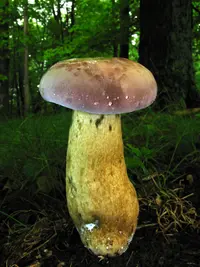
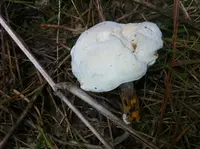
This species is known to parasitize Boletus edulis and closely related porcini-like boletes, overgrowing their caps and pore surfaces with a dense fungal layer.

White then yellowing crust

Infected mushrooms are first covered by a whitish mycelial film that later becomes more yellowish or pale ochre as the fungus matures.

Microscopic spore features

It is characterized by very small ascospores that are typically ellipsoid to slightly fusiform, a key trait used by mycologists to distinguish it from other Hypomyces species.

FAQs about Hypomyces microspermus

This species can be maintained in containers if its host material, such as infected mushrooms or substrate, is also contained. Use a well-ventilated setup, avoid air stagnation, and monitor regularly for contamination by other fungi or molds.

Grow Healthy Plants with Botan Care

Keep your plants happy and healthy with plant identification, disease detection, and easy care guidance.

Botan plant care app — identify plants on mobile

Explore More Plants