Mounting on bark
Attach the plant to a slab of cork or hardwood bark with soft ties and a thin layer of long-fiber sphagnum, which keeps the rhizomes aerated and makes watering and inspection much easier than in dense pots.

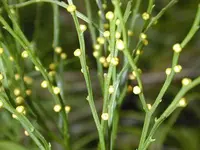
Whisk fern, Psilotum nudum, is a primitive vascular plant that lacks true roots and leaves, giving it a simple, broom-like look. Its green, jointed stems and tiny scale-like appendages create a sparse, architectural form.
This species naturally occurs in tropical and subtropical regions, often growing as an epiphyte on trees or on rocky, well-drained substrates. It is generally moderate in difficulty, as it dislikes disturbance, needs steady moisture without waterlogging, and prefers stable, humid conditions.
Bright, indirect light and airy, low-organic growing media suit it best, which guides how to care for whisk fern in home or greenhouse settings.

Care Difficulty
Hard Care

Light Preference
Partial Shade

Water Requirements
Keep Soil Moist

Temperature Preference
Tropical / Frost Sensitive

Hardiness Zone
9–12

Soil Texture
Sandy, Loamy, Organic-rich

Soil pH
Acidic (5.5–6.5), Slightly acidic (6.5–7.0)

Soil Drainage
Moist but well-drained

Fertilization
Minimal (feed rarely)
Scan your plant to receive care tips personalized for your specific plant
Available on iOS and Android
Psilotum nudum grows best in bright, filtered light that mimics dappled woodland conditions.
This species prefers consistently moist but not waterlogged conditions around its roots and rhizomes.
This ancient fern ally prefers mild, frost-free climates with stable, warm conditions.
This species prefers consistently moist air and reacts quickly to dry conditions.
Psilotum nudum anchors in loose, rocky, organic-rich substrates rather than dense potting soil.
This species can be grown in containers if the pot and medium stay airy and free-draining.
Psilotum nudum has low nutrient demands, so use light feeding to support growth without overloading its simple root system.
Psilotum nudum needs minimal pruning, mainly to maintain a tidy appearance and remove damaged tissue.
This species is usually grown mounted or in shallow containers, so disturbance should be infrequent and gentle.
Psilotum nudum is botanically primitive and propagation is specialized, so home growers rarely multiply plants.
This species prefers mild, frost-free conditions and needs protection in regions with cold winters.

Plant Health Check
Not sure what's wrong with your plant? Check your plant's health inside the app.
Psilotum nudum is not a true fern but a fern ally, belonging to its own distinct lineage within the group of vascular plants, with DNA evidence placing it close to eusporangiate ferns such as Ophioglossaceae.
This species lacks true leaves and instead has small, scale-like flaps called enations that contain no veins, while photosynthesis occurs mainly in the green, photosynthetic stems.
Psilotum nudum has no true roots and relies on underground rhizomes with a symbiotic fungal partner (a mycorrhiza) that helps it absorb water and nutrients, an arrangement similar to that found in many early-diverging land plants.

The branching pattern and extremely simple body plan of Psilotum nudum have made it a classic model organism in botany classes and textbooks, often used to demonstrate how modern plants can retain primitive features that resemble early land plants in the fossil record.
Growth is usually slow to moderate. New stems arise from creeping underground rhizomes, often adding only a few inches per year. Stable moisture, consistent warmth, and regular light are key factors for growing whisk fern successfully.
Keep your plants happy and healthy with plant identification, disease detection, and easy care guidance.