Wind-firm training
During the first 2–3 years, stake young trees loosely and gradually reduce support so the trunk flexes slightly in wind, which helps develop stronger wood and a more wind-firm root system.

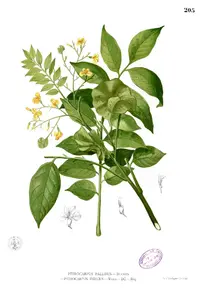
Burmese rosewood, Pterocarpus indicus, is a tropical legume tree valued for its attractive form, foliage, and timber. It is often grown as a shade or ornamental tree in warm climates. The tree has a broad, rounded crown, glossy compound leaves, and small yellow flowers followed by distinctive winged pods.
In nature it occurs across Southeast Asia and nearby Pacific regions, typically in lowland forests and coastal areas. It grows quickly when given warmth, sun, and reasonably moist, well-drained soil, so established trees are relatively easy to manage.
For gardeners interested in how to care for Burmese Rosewood, the main challenge is providing enough light, space, and frost-free conditions, especially outside its native climate zones.

Care Difficulty
Moderate Care

Light Preference
Full Sun

Water Requirements
Moderate Water

Temperature Preference
Tropical / Frost Sensitive

Hardiness Zone
11–12

Soil Texture
Sandy, Loamy, Organic-rich

Soil pH
Slightly acidic (6.5–7.0), Neutral (7.0)

Soil Drainage
Well-drained

Fertilization
Minimal (feed rarely)
Scan your plant to receive care tips personalized for your specific plant
Available on iOS and Android
This tropical tree prefers bright, direct sun in warm climates but adapts to some light shade.
This species prefers evenly moist, well-draining soil once established in the landscape.
This lowland tropical tree thrives in consistently warm, frost-free conditions.
This species prefers moderately humid air but usually adapts to typical indoor levels if not extremely dry.
This tree prefers deep, well-drained, moderately fertile soil with stable structure.
This species can be grown in containers for its juvenile stages or as a managed patio tree if the pot is chosen carefully.
This tropical tree benefits from moderate feeding when grown as a landscape or container specimen.
Pruning Pterocarpus indicus helps manage size, structure, and clearance in landscape settings.
This species is usually grown in the ground, so care focuses on correct transplanting of young trees.
Pterocarpus indicus is propagated mainly from seeds and semi-hardwood cuttings under warm, humid conditions.
This tropical tree is frost-sensitive and needs protection in regions with cool winters.

Plant Health Check
Not sure what's wrong with your plant? Check your plant's health inside the app.
The heartwood of this species is initially light yellow to golden but gradually darkens to reddish-brown after cutting and exposure to light, which is why it is traded as Burmese rosewood in some markets.
Like many legumes, it forms root nodules with symbiotic bacteria that convert atmospheric nitrogen into plant-available forms, improving soil fertility around mature trees.
Its seeds are enclosed in flat, circular pods with a broad papery wing, an adaptation that allows wind to carry the fruits away from the parent tree in open coastal and lowland habitats.

In several Southeast Asian countries, this species has been widely planted as an urban and roadside shade tree, and long-lived avenue plantings have become culturally significant landmarks despite the species being considered vulnerable in parts of its native range due to overexploitation for timber.
This species is considered fast-growing under warm, frost-free conditions. Young trees may add 60–150 cm in height per year, then gradually slow as they mature. Growth speed drops noticeably in poor soil or cool climates.
Keep your plants happy and healthy with plant identification, disease detection, and easy care guidance.