


Early framework pruning
In the first 2–3 years, remove only crossing, damaged, or inward-growing shoots and lightly tip-prune to create 3–5 strong scaffold branches that will support the mature canopy.

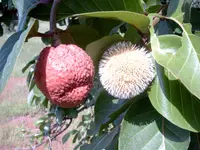
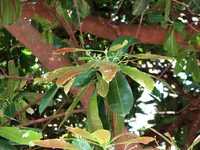
African peach, Nauclea latifolia, is a tropical shrub or small tree native to West and Central Africa. It is often grown for its dense foliage and rounded crown. The plant produces glossy green leaves and spherical flower heads that develop into orange to reddish fruit, giving it ornamental value in warm climates. In cultivation, it tends to form a multi-stemmed, bushy shape if not pruned. It prefers warm temperatures, consistent moisture, and well-drained soil, which influences how to care for African peach in gardens or large containers.

Care Difficulty
Moderate Care

Light Preference
Full Sun

Water Requirements
Regular Water

Temperature Preference
Tropical / Frost Sensitive

Hardiness Zone
11–12

Soil Texture
Loamy, Sandy, Organic-rich

Soil pH
Acidic (5.5–6.5), Slightly acidic (6.5–7.0)

Soil Drainage
Moist but well-drained

Fertilization
Minimal (feed rarely)
Scan your plant to receive care tips personalized for your specific plant
Available on iOS and Android
This sun-loving tropical shrub grows best with strong, consistent light in warm climates.
This species prefers evenly moist, well-drained soil and shows stress if kept either too dry or waterlogged.
This tropical shrub thrives in warm, frost-free conditions with stable seasonal temperatures.
This species prefers moderately humid air but usually adapts to typical household conditions.
This species grows best in deep, moist, well-aerated soil with consistent drainage.
This species can be grown in containers, especially when young or in cooler regions.
This species benefits from light feeding in cultivation but grows acceptably in reasonably fertile soil without it.
Pruning helps manage size and structure of Nauclea latifolia, especially in gardens or containers.
This species is usually field-grown, so care focuses more on transplanting young trees than frequent repotting.
Propagation of Nauclea latifolia is possible from both seeds and semi-hardwood cuttings under suitable conditions.
In mild, frost-free climates this tropical species needs minimal winter care, but it is sensitive to freezing conditions.

Plant Health Check
Not sure what's wrong with your plant? Check your plant's health inside the app.
This species produces round, many-flowered heads that resemble small golf balls, which turn yellow to orange-red when mature and contain numerous tiny seeds embedded in a fleshy matrix.
It is a characteristic shrub or small tree of African savanna and woodland edges, often colonizing disturbed sites and helping stabilize soil and provide shade for other species.
Leaves and young shoots are commonly browsed by livestock and wild herbivores in its native range, making it an important dry-season fodder source where other greenery is scarce.

In several West and Central African regions, the fibrous wood of this species has traditionally been used for light construction, tool handles, and household items because it is workable yet reasonably durable under local conditions.
Growth is moderately fast in warm climates, typically adding 30–60 cm per year once established. It often reaches a small-tree size in 5–10 years, depending on moisture, soil fertility, and overall site conditions.
Keep your plants happy and healthy with plant identification, disease detection, and easy care guidance.

Pomelo
Citrus maxima
Arizona cypress
Hesperocyparis arizonica
 POPULAR
Anthurium clarinervium
Anthurium clarinervium
Upright Yellowwood
Podocarpus latifolius
 POPULAR
Monstera lechleriana
Monstera lechleriana
creeping juniper
Juniperus horizontalis
Allegheny-spurge
Pachysandra procumbens
satinwood
Buchanania arborescens