turkey oak Care (Quercus laevis)

Also known as: American turkey oak, turkey-foot oak
turkey oak

About turkey oak

Turkey oak, Quercus laevis, is a medium to large deciduous tree native to the sandy coastal plains of the southeastern United States. It is typically used as a landscape or restoration tree rather than a houseplant.

The tree has a rounded, often irregular crown and deeply lobed leaves that turn rusty red to brown in autumn. It develops a strong taproot and grows best in dry, acidic, well-drained soils.

Turkey oak tolerates drought, wind, and poor, sandy sites, which makes it relatively resilient once established. These same traits mean care for turkey oak is easier in low-fertility, full-sun conditions than in rich or poorly drained soils.

Main Plant Requirements

Care Difficulty

Moderate Care

Light Preference

Full Sun

Water Requirements

Low Water

Temperature Preference

Warm Climate

Hardiness Zone

6–9

Soil Texture

Sandy, Loamy

Soil pH

Acidic (5.5–6.5), Slightly acidic (6.5–7.0)

Soil Drainage

Well-drained

Fertilization

Minimal (feed rarely)

Get Personalized Care Plan

Scan your plant to receive care tips personalized for your specific plant

Available on iOS and Android

How to Care for the turkey oak

Quercus laevis thrives in strong outdoor light and develops best with full sun exposure.

  • Provide 6–10 hours of direct sun daily; open, unshaded sites suit this species best for sturdy growth and dense crowns.
  • The tree tolerates light partial shade, especially in the afternoon, but prolonged shade leads to sparse branching and reduced vigor.
  • In hot summers, young turkey oak trees benefit from slight afternoon shade to limit leaf scorch, while mature trees handle intense sun well year-round.

Quercus laevis prefers dry to moderately dry conditions once established and is adapted to sandy, fast-draining soils.

  • For young trees, water deeply when the top 5–8 cm of soil feels dry, then allow the soil to return close to dry before the next soaking.
  • During the first 2–3 growing seasons, check moisture after hot, rainless periods; dull, curling leaves suggest drought stress, while yellowing leaves and soft new growth suggest overwatering.
  • Ensure sharply draining soil; avoid persistently wet or compacted sites, which increase root rot risk and shorten long-term health and lifespan.

This oak is adapted to warm, temperate to subtropical climates and handles heat better than prolonged cold.

  • Active growth is strongest around 70–90°F (21–32°C), typical of late spring through early fall in much of its native range.
  • Mature trees tolerate winter lows near 5–10°F (-15 to -12°C), though young saplings benefit from protection during hard freezes.
  • The species endures hot spells above 95°F (35°C) if roots are established and soil is not waterlogged, but extreme cold snaps below its tolerance can cause branch dieback.

Humidity plays a minor role for this drought-adapted oak, which tolerates typical outdoor air in most regions.

This species prefers dry, sandy, sharply drained soil that mimics its native upland habitats.

  • Use a predominantly sandy or sandy-loam mix with minimal organic matter to prevent water retention around the roots.
  • Aim for slightly acidic to neutral pH, roughly 5.5–7.0, and avoid highly alkaline or compacted substrates.
  • In heavy soils, incorporate coarse sand and small gravel to improve drainage and aeration before planting Quercus laevis.
  • Do not plant where water stands after rain, since prolonged saturation promotes root decline and fungal problems.

This oak is generally unsuited to long-term container culture, as its deep, extensive root system and mature size exceed most pots.

This oak usually needs little feeding once established in the ground, especially on sandy, low-fertility soils.

  • For container or young turkey oak trees, use a balanced slow-release fertilizer (around 10-10-10) in early spring.
  • Apply lightly 1–2 times during the growing season, following label rates rather than exceeding them.
  • Avoid high-nitrogen lawn fertilizers near the root zone to limit weak, excessive shoot growth.
  • Stop feeding by late summer so new growth can harden before colder weather.

Pruning Quercus laevis is mainly structural and corrective rather than cosmetic.

  • Schedule main pruning in late winter while the tree is dormant and leafless for clear visibility.
  • Remove dead, diseased, or storm-damaged branches with clean, sharp bypass loppers or a pruning saw.
  • Thin crowded, inward-crossing branches to improve light penetration and strong branch structure.
  • Avoid cutting large limbs unnecessarily; keep cuts just outside the branch collar to support proper healing.

Turkey oak is typically grown in the ground, so transplanting young trees correctly is more important than frequent repotting.

  • Transplant in late fall or very early spring when the tree is dormant and temperatures are mild.
  • Look for roots circling the container, reduced vigor, or frequent drying as signs a nursery plant needs a larger hole or pot.
  • Dig a wide, shallow planting hole, gently loosen circling roots, and keep the root flare at soil level.
  • Water deeply after planting and maintain consistent moisture for the first 1–2 growing seasons to limit transplant shock.

Propagation of Quercus laevis is usually done from seed rather than cuttings.

  • Collect ripe acorns in fall, discarding any with holes or obvious damage.
  • Sow fresh acorns outdoors in fall or cold-stratify indoors at 35–40°F for 8–12 weeks before spring sowing.
  • Plant acorns 2–3 cm deep in well-drained sandy mix, keeping the medium evenly moist but not waterlogged.
  • Grow seedlings in deep containers to accommodate the strong taproot, then transplant while still small to minimize disturbance.

This oak is cold hardy in much of its native range and usually needs minimal winter care once established.

  • Young trees benefit from 5–8 cm of mulch over the root zone, kept away from the trunk.
  • In marginally cold climates, shelter first-year saplings from drying winter winds using a simple windbreak.
  • Container-grown plants in colder regions can be moved into an unheated garage or against a sheltered wall to prevent root freeze.

Care Tips

Establish deep roots

During the first 2–3 years, give the tree one slow, deep soak during dry weeks rather than frequent light watering to encourage a strong taproot that helps it tolerate future drought and sandy sites.

Protect young trunk

Install a light-colored, ventilated trunk guard or wrap on young trees for the first 2–3 summers to reduce sunscald and mower or trimmer damage, checking twice a year so it does not constrict the bark.

Mulch for sandy soils

Maintain a 5–8 cm ring of coarse wood chip mulch over the root zone, kept 5–8 cm away from the trunk, to buffer soil temperature, slow moisture loss, and add gradual organic matter to very sandy ground.

Plan for mature size

Site young plants at least 7–9 m from buildings, driveways, and overhead lines, since branches become broad and heavy and need space to develop a stable, wind-resistant canopy.

Monitor oak-specific pests

Inspect new leaves and twigs in spring and early summer for caterpillars, galls, or scale insects, and only treat when damage is significant, since most pests can be tolerated without intervention when caring for turkey oak.

Common Pests and Diseases

Oak leaf blister

This disease causes raised, blister-like, pale green to yellow spots on young leaves that later turn brown and puckered. Symptoms include distorted foliage and premature leaf drop, especially after cool, wet springs.

Solution

Prune and destroy heavily affected leaves and small twigs in fall to reduce overwintering spores, and avoid overhead irrigation that keeps foliage wet. In high-value landscape trees, a registered copper or chlorothalonil spray timed at bud break can reduce infection, but is usually needed only when leaf distortion is severe for several years in a row.

Oak wilt

This disease causes rapid wilting, browning from the leaf edges inward, and sudden branch dieback, often starting in the upper canopy. Symptoms include streaked sapwood under the bark and potentially quick death of the tree once infected.

Solution

Immediately remove and properly dispose of infected trees and major branches to limit spread, and avoid pruning or wounding turkey oak during spring and early summer when beetle vectors are active. In areas with known oak wilt, keep root grafts in check by physical trenching where practical, and consult a certified arborist for possible preventive fungicide injections in high-value trees nearby.

Two-lined chestnut borer

This pest is a metallic wood-boring beetle whose larvae tunnel beneath the bark, causing progressive dieback from the top of the crown downward. Symptoms include sparse foliage, small leaves, branch tip death, and D-shaped exit holes in the bark.

Solution

Maintain tree vigor with proper watering during drought and avoid mechanical damage, since stressed trees are most susceptible. Prune out and destroy infested branches showing dieback, and in severe or high-value cases, a licensed professional may use systemic insecticides labeled for borers applied according to regional guidelines for Quercus laevis care.

Gouty oak gall

This problem is caused by tiny wasps that trigger hard, knotty galls on twigs and small branches. Symptoms include swollen woody growths that can restrict sap flow, leading to twig dieback and thinner foliage over time.

Solution

Prune out and destroy heavily galled twigs and small branches during dormancy or before adult wasps emerge, disinfecting tools between cuts. Promote overall tree health with proper watering and mulch, since vigorous turkey oaks better tolerate gall damage and usually do not require chemical control.

Oak leaf skeletonizer

These insects feed on the soft leaf tissue between veins, leaving a skeletonized, lace-like appearance and brown, scorched-looking foliage. Heavy infestations can cause significant defoliation on young or stressed trees.

Solution

Rake and dispose of fallen leaves to remove overwintering stages and break the life cycle, and encourage natural predators by avoiding broad-spectrum insecticides. Light infestations often require no treatment, but severe, repeated damage on young trees can be managed with targeted Bacillus thuringiensis (Bt) or spinosad sprays applied when larvae are small and actively feeding on leaves.

Interesting Facts

Sandhill specialist

This oak is strongly associated with dry, sandy ridges and sandhill ecosystems of the southeastern United States, where its deep root system allows it to persist on nutrient-poor, drought-prone soils that many other trees cannot tolerate.

Distinctive three-lobed leaves

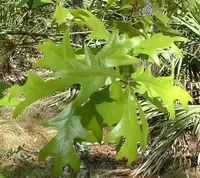
Its leaves usually have 3 narrow, bristle-tipped lobes that resemble a turkey’s foot, a feature that helps distinguish it from other red oaks in the field.

Fire-adapted growth

In its native habitats with frequent fires, this species often grows with a crooked trunk and irregular crown, a growth form that reflects repeated top damage and resprouting from protected buds and roots.

Botan icon

Did you know?

This species frequently forms hybrid swarms with other red oaks, especially species like southern red oak and laurel oak, which can complicate identification and creates a wide range of intermediate leaf and acorn forms in areas where they grow together.

FAQs about turkey oak

This species usually grows at a moderate rate, adding around 30–60 cm of height per year in good conditions. Young trees become visually prominent in the landscape after about 5–10 years of establishment.

Grow Healthy Plants with Botan Care

Keep your plants happy and healthy with plant identification, disease detection, and easy care guidance.

Botan plant care app — identify plants on mobile

Explore More Plants