

blackjack oak Identification (Quercus marilandica)

Recognize blackjack oak by its thick, alternate leaves: each blade is narrow at the base and broad near the tip, usually with three main lobes that create a club-like outline.

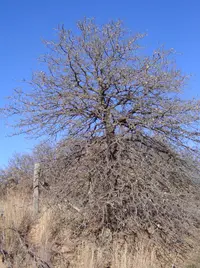
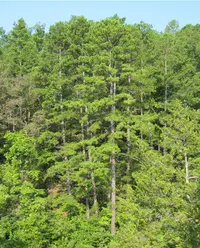
It is also identified by a short, often irregular trunk with dark, blocky bark and a broad, stiff-branched crown on a small to medium tree.

Quercus marilandica Identification

Scan to Confirm blackjack oak

Upload a clear photo to check your plant identification with Botan.

Clear images work best. Avoid photos taken too close or too far away

Check the leaves, twig pattern, bark, and acorns for a fast ID.

  • Leaves are thick and broadest near the tip, often 4-8 inches (10-20 cm) long, with three main lobes that make a blunt, bell-like outline.
  • Leaves grow alternately along the twigs, not in opposite pairs.
  • Bark is very dark, rough, and broken into small, blocky plates on older trunks.
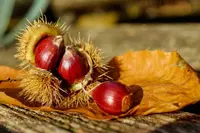
  • Acorns are short and stout, with a deep cup that covers about half the nut.

A squat crown with crooked branches adds support when other features match.

Blackjack oak shows useful visual shifts from sapling form to acorn-bearing mature trees.

  • Seedling: Seedlings have alternate leaves early, often broader toward the tip, on a slender upright stem with little branching and a sparse, simple outline.
  • Young plant: Young plants become shrubby or small-tree shaped, with stiff, irregular branching and thicker leaves that show the species’ broad three-lobed silhouette more consistently.
  • Mature plant: Mature trees commonly reach 20-50 feet (6-15 m), with a short trunk, crooked heavy limbs, and a broad, uneven crown rather than a narrow sapling outline.
  • Fruiting stage: Fruiting branches carry rounded acorns about 1/2-3/4 inch (1.3-1.9 cm) long, partly enclosed by a thick cup, adding a clear visible feature absent earlier.

In spring, Quercus marilandica leafs out with pale to yellow-green new leaves, and the tree’s catkins become visible as it flowers. By late summer into fall, acorns are easy to spot, often sitting close to the twig. Fall color is usually dull yellow-brown to rusty brown before the leaves drop, leaving a dark, rough-branched winter outline.

A few scrubby oaks can be mistaken for blackjack oak at a glance.

post oak(Quercus stellata)

Both can have broad, lobed leaves on dry sites. Post oak leaves usually have 5 rounded lobes with a clear cross shape, while blackjack oak leaves are often 3-lobed with a much broader tip. Post oak bark is also paler and more blocky.

black oak(Quercus velutina)

Both are dark-barked oaks with bristle-tipped lobes. Black oak leaves are usually larger and have 5-7 deeper lobes, not the squat, broad-tipped outline typical of blackjack oak. Its buds are also longer and more pointed.

Quercus marilandica is native to the eastern and south-central United States, from southern New York and New Jersey west to Kansas and Oklahoma, and south to Florida and Texas. It is most often found in dry, open habitats such as sandy or rocky uplands, barrens, open oak woods, and scrubby ridges. Seeing it on poor, dry sites can help separate it from similar oaks that are more typical of deeper, moister forest soils.

Quercus marilandica has a meaningful safety concern because its acorns and leaves contain tannins. These are mainly a risk if eaten, especially by pets and livestock.

  • Ingestion risk: Acorns and leaves can be harmful when eaten. The concern applies to humans and pets, and is better documented in animals.

Does Your Plant Match?

Upload a photo to Botan to identify the plant or confirm your ID before you spend more time comparing details.

FAQ

The clearest feature is the leaf: broad near the tip with three main lobes, almost like a bell or duck foot. For blackjack oak identification, look for thick, leathery leaves with a pale, often fuzzy underside.

More Plant Identification Guides

Find Out What Plant It Is

Use a photo to identify the plant with Botan, then review plant details, care information, and common problems for that species.

Botan app identifying a plant from a photo
Top 15 Plants That Don’t Need Sunlight

8 min read · 17 Sept 2026

Top 15 Plants That Don’t Need Sunlight

Some plants thrive in dim rooms, shaded corners, and places with indirect light. In this guide, you’ll explore the top 15 species best suited to low-light conditions and how to care for them.

Plant Recommendations
Top 15 Plants That Don’t Need Sunlight
How Often to Water Fruit Trees

7 min read · 11 Aug 2026

How Often to Water Fruit Trees

Irrigation needs change as roots establish and weather shifts. This guide gives practical starting intervals, explains how soil and tree type change them, and shows how to recognize both excess moisture and drought stress.

Plant Care
How Often to Water Fruit Trees
How to Water Houseplants: Watering Guide

7 min read · 24 Aug 2026

How to Water Houseplants: Watering Guide

Learn how often to water indoor plants, key factors for proper watering, and how to adjust the care routine by plant type, season, pot size, light, and indoor conditions.

Plant Care
How to Water Houseplants: Watering Guide