


pin oak Identification (Quercus palustris)

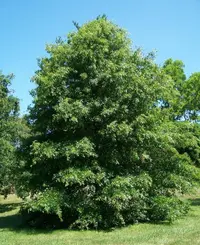
Recognize pin oak by its deeply lobed leaves with 5 to 7 pointed, bristle-tipped lobes and very deep U-shaped sinuses, plus a straight trunk with lower branches that angle downward.

At first glance, the crown often looks pyramidal, and small rounded acorns sit on short stalks.

Quercus palustris Identification

Check Your Plant with Botan

Not sure about your plant ID? Upload a photo and check it with Botan.

Clear images work best. Avoid photos taken too close or too far away

  • 1 free identification
  • No sign-up
  • 30,000+ plants in database

Check the overall form and leaf shape of Quercus palustris.

  • Crown often shows a strong central trunk with upper branches ascending, middle branches horizontal, and lower branches drooping.
  • Leaves are alternate, deeply cut into 5 to 7 narrow, bristle-tipped lobes.
  • Leaf blades are usually 3 to 6 inches (8 to 15 cm) long, with very deep U-shaped sinuses reaching close to the midrib.
  • Acorns are small, about 1/2 inch (1.3 cm) long, nearly round, with a thin, shallow cap.

Use several traits together, especially branch habit, leaf depth, and acorn shape.

Quercus palustris shows clear age-related changes in form, branching, bark, and acorns.

  • Seedling: First growth shows opposite-looking early leaves, then alternate true leaves with deep, bristle-tipped lobes on a thin upright stem.
  • Young plant: Saplings develop a straight central leader and many slender lower branches that angle downward, giving a narrow, layered outline unlike older trees.
  • Mature plant: The crown broadens to about 40-60 feet (12-18 m) wide, with lower branches drooping, middle branches horizontal, and upper branches ascending; bark stays relatively smooth.
  • Fruiting stage: Acorns become obvious on mature trees: small, nearly round nuts with shallow caps, hanging singly or in pairs among the leaves.

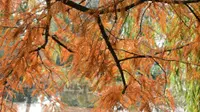
In spring, Quercus palustris leafs out with fresh green, deeply lobed leaves, and its small yellow-green male catkins become noticeable as the canopy opens. By fall, the foliage often turns bronze, russet, or red before dropping. After leaf fall, the tree is easier to recognize by its sharply downward-pointing lower branches and small, rounded acorns that may remain visible into winter.

Several red oaks are often mistaken for pin oak.

northern red oak(Quercus rubra)

Both have deeply lobed leaves. Northern red oak usually has shallower sinuses and broader lobes, and its lower branches do not strongly angle downward.

scarlet oak(Quercus coccinea)

Both can show very deep leaf sinuses. Scarlet oak typically has more C-shaped sinuses and a more open, irregular crown rather than the neat pyramidal outline.

Shumard oak(Quercus shumardii)

Leaves can look similar at a glance. Shumard oak usually has larger leaves, often 6-8 inches (15-20 cm), and a broader crown with less distinctly drooping lower branches.

Quercus palustris is native to the eastern and central United States, especially from New England and the Mid-Atlantic west to the Mississippi Valley and south into parts of the Southeast. It naturally occurs on bottomlands, floodplains, stream margins, and other wet lowlands. Finding an oak in seasonally flooded ground is a useful clue, especially in its native range, because that setting helps separate it from many upland oaks.

Pin oak can be a poisoning concern if parts are eaten. Leaves and acorns contain tannins, which are harmful by ingestion to pets and livestock, especially in larger amounts.

Confirm It from a Photo

Upload a clear photo to Botan to identify it or verify your result before you label, buy, or plant it.

FAQ

The quickest clue is the branch pattern: lower limbs usually angle sharply downward, middle branches spread outward, and upper branches rise. Deeply lobed leaves with 5 to 7 bristle-tipped lobes support pin oak identification.

More Plant Identification Guides

One Photo. More About Your Plant.

Use Botan to identify a plant from a photo, then review its profile, care information, and common problems.

Botan app identifying a plant from a photo
Best Time to Plant Grass Seed: When to Seed Your Lawn

6 min read · 19 Nov 2026

Best Time to Plant Grass Seed: When to Seed Your Lawn

The best time to plant grass seed depends on your climate and grass type. Cool-season lawns establish best in late summer or early fall, while warm-season grasses perform best once soil warms in late spring or early summer.

Plant Care

Best Time to Plant Grass Seed: When to Seed Your Lawn
Plants That Repel Mosquitoes – 10 Effective Choices

8 min read · 6 Jul 2026

Plants That Repel Mosquitoes – 10 Effective Choices

Plants that repel mosquitoes can help mask human scent naturally and make outdoor spaces more comfortable. Explore the most effective options, their benefits and drawbacks, and choose the right plant for your space.

Plant Recommendations
Plants That Repel Mosquitoes – 10 Effective Choices
12 Best Cold-Hardy Vegetables for Cold Weather

7 min read · 13 Oct 2026

12 Best Cold-Hardy Vegetables for Cold Weather

Cold-hardy vegetables can keep a garden productive through chilly fall, winter, and early spring weather. This guide covers 12 reliable crops, their frost tolerance, and practical growing tips for better cold-season harvests.

Plant Recommendations
12 Best Cold-Hardy Vegetables for Cold Weather