

Meadow Mushroom Identification (Agaricus campestris)

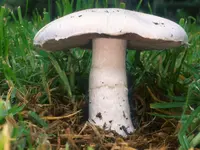
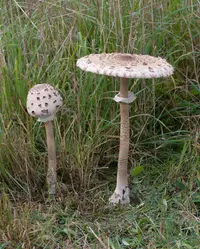
To recognize Meadow Mushroom, look for a smooth white cap about 2 to 4 inches (5 to 10 cm) wide, free gills that do not attach to the stem, and a short central stem with a single ring.

The fruiting body stays low and compact, usually under 4 inches (10 cm) tall.

Agaricus campestris Identification

Check Your Plant ID

Check your plant ID by uploading a clear photo to Botan.

Clear images work best. Avoid photos taken too close or too far away

Check the cap, gills, and stem together for a quick Meadow Mushroom look.

  • Cap is white to creamy, smooth, and broadly convex to nearly flat, usually 2-4 inches (5-10 cm) across.
  • Gills are crowded and free from the stem, ending just before they touch it.
  • Stem is white, fairly even in width, about 1-3 inches (3-8 cm) tall, with no cup at the base.
  • A small, thin ring sits on the upper stem.

Use several of these visible traits together rather than one alone.

Agaricus campestris shows clear age-related changes in cap shape, gill color, and veil.

  • Young plant: Button stage is rounded and compact, with the cap margin tucked under and a partial veil still covering the gills.
  • Mature plant: Cap expands to broadly convex or nearly flat, often 2-4 inches (5-10 cm) across, while the ring becomes thin or may disappear.
  • Fruiting stage: Gills shift from pale pink to dark chocolate-brown as spores mature, making older fruiting bodies visibly darker underneath than younger ones.

Agaricus campestris is most useful seasonally when the fruiting bodies appear, usually from late summer into fall. In that period, fresh mushrooms may appear in groups or rings in grass, making the species far easier to spot than at other times. As the caps expand, the pink gills become more visible, then darken to chocolate-brown with age. Outside the fruiting season, there is no persistent above-ground structure to identify.

Several mushrooms can be mistaken for Meadow Mushroom.

yellow stainer(Agaricus xanthodermus)

Similar cap and gill color when young. Check the stem base: it bruises bright yellow, and older specimens often smell inky or phenolic rather than mild.

horse mushroom(Agaricus arvensis)

Also white with pink then brown gills. Usually larger, often 4-8 inches (10-20 cm) wide, and it has a thicker ring and a stronger anise scent.

destroying angel(Amanita virosa)

White cap can cause confusion before gills darken. The key visible difference is white gills that stay white, plus a cup-like volva at the stem base.

Agaricus campestris is native across much of Europe and is also widely reported from temperate parts of Asia and North America. Geography alone is not a strong identifier, but its repeated association with temperate open ground is useful. It typically grows in short grass in pastures, meadows, lawns, and other grazed or disturbed grassland, rather than in woodland. Finding it in open grassy places helps separate it from many similar mushrooms that are more often tied to forest habitats.

  • Hazardous misidentification: This mushroom is often confused with poisonous Amanita species. The risk is ingestion by humans and pets. A key check is the gills: Agaricus campestris starts pink and turns chocolate-brown, while deadly Amanita gills stay white.
  • Yellow-staining look-alike: It can also be confused with Agaricus xanthodermus, which is poisonous if eaten by humans. The most useful visible difference is strong chrome-yellow staining, especially at the stem base and cap margin.

Scan. Check. Confirm.

Use Botan to identify or verify it from a photo, helping narrow look-alikes before you spend more time researching.

FAQ

Look for a smooth white cap, free gills that start pink and turn chocolate brown, a short stem with a small ring, and growth in grass. This is central to Agaricus campestris identification.

More Plant Identification Guides

Identify Your Plant with Botan

Upload a photo to identify it, then get plant details, care information, and safety notes tailored to that species.

Botan app identifying a plant from a photo
Best Bedroom Plants – Top 10 to Grow in Your Space

8 min read · 8 Jul 2026

Best Bedroom Plants – Top 10 to Grow in Your Space

Discover the top 10 houseplants that are suitable for growing in your bedroom. Compare their light and water needs, pet safety, and benefits. Find out where best to place greenery in your relaxation space and what species to avoid.

Plant Recommendations
Best Bedroom Plants – Top 10 to Grow in Your Space
How to Water Houseplants: Watering Guide

7 min read · 24 Aug 2026

How to Water Houseplants: Watering Guide

Learn how often to water indoor plants, key factors for proper watering, and how to adjust the care routine by plant type, season, pot size, light, and indoor conditions.

Plant Care
How to Water Houseplants: Watering Guide
Top 15 Fast-Growing Trees For Your Garden

13 min read · 28 Jul 2026

Top 15 Fast-Growing Trees For Your Garden

Learn which of the 15 fastest-growing trees will suit your area. We’ll share detailed information on each: growth rate, mature spread, key tree demands, and main vulnerabilities. Read on and make the best choice possible.

Plant Recommendations
Top 15 Fast-Growing Trees For Your Garden