Establish strong leader
In the first 5–8 years, select one central trunk and remove competing upright stems on young trees to reduce future weak crotches and storm damage.

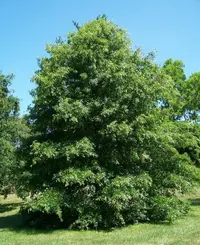
Pin oak, Quercus palustris, is a fast-growing deciduous tree valued for its strong central trunk and dense, pyramidal crown. It develops deeply lobed leaves that turn rich red to bronze in autumn and often persist on younger branches into winter. Native to lowland forests and wet bottomlands in eastern and central North America, it is commonly used as a street and landscape tree. This species prefers full sun, acidic soil, and consistent moisture, which makes it adaptable but less suited to very dry or alkaline sites. Understanding how to care for pin oak starts with selecting a suitable location and soil type.

Care Difficulty
Moderate Care

Light Preference
Full Sun

Water Requirements
Regular Water

Temperature Preference
Cold Hardy

Hardiness Zone
4–8

Soil Texture
Loamy, Clay, Silty

Soil pH
Strongly acidic (4.5–5.5), Acidic (5.5–6.5)

Soil Drainage
Moist but well-drained

Fertilization
Minimal (feed rarely)
Scan your plant to receive care tips personalized for your specific plant
Available on iOS and Android
Quercus palustris grows best in open, bright conditions that support strong trunk and branch development.
Quercus palustris prefers consistently moist but not waterlogged soil, especially during establishment.
This species is a hardy temperate tree adapted to regions with cold winters and warm summers.
This species tolerates a wide humidity range and does not usually require humidity management outdoors.
This species prefers deep, moist, acidic, loamy soil with steady drainage.
This species is only moderately suitable for container growing and usually works best as a temporary patio or nursery specimen rather than a long-term potted tree.
Mature Quercus palustris in the ground usually needs little fertilizer if soil is moderately fertile.
Pruning supports safe structure and clearance for Quercus palustris without excessive crown thinning.
Pin oak is normally field-grown; focus on careful transplanting rather than frequent repotting.
Propagation of Quercus palustris for home growers is usually done from seed rather than cuttings.
This oak is cold hardy in much of its range and generally needs minimal winter care once established.

Plant Health Check
Not sure what's wrong with your plant? Check your plant's health inside the app.
This oak naturally occurs in seasonally flooded bottomlands and has specialized shallow roots that tolerate poorly drained, oxygen-poor soils much better than many other North American oaks.
Young trees show a very characteristic crown structure: upper branches angle upward, middle branches grow nearly horizontal, and lower branches often angle downward, creating a tiered, pyramidal outline useful for reliable field identification.
Its relatively small, abundant acorns are an important autumn food source for ducks, turkeys, deer, and many small mammals, and the dense canopy provides nesting sites for several woodland bird species.

This species has become one of the most widely planted urban and suburban oaks in parts of the United States, yet it is now declining or absent in some of its natural wetland habitats because land drainage and river regulation have reduced the seasonally flooded conditions it depends on for regeneration.
This species grows about 30–60 cm per year under good conditions, so it is classed as moderately fast-growing for a shade tree. Growth slows with age, drought, compacted soil, or restricted rooting space.
Keep your plants happy and healthy with plant identification, disease detection, and easy care guidance.