

willow oak Identification (Quercus phellos)

To recognize willow oak, look first for its narrow, willow-like leaves: simple, alternate, smooth-edged, and usually 2 to 5 inches (5 to 13 cm) long. The blade is much longer than wide, often with a tiny bristle tip.

Also check the overall form. Quercus phellos typically develops a straight trunk and a broad, rounded crown.

Quercus phellos Identification

Identify a Plant by Photo

Not sure about your plant ID? Upload a photo and check it with Botan.

Clear images work best. Avoid photos taken too close or too far away

  • 1 free identification
  • No sign-up
  • 30,000+ plants in database

Start with the leaf shape and overall branch pattern.

  • Leaves are narrow and willow-like, usually 2 to 5 inches (5 to 13 cm) long and about 1/2 inch (1 to 1.5 cm) wide.
  • Leaf margins are smooth, with no lobes or teeth visible along the edges.
  • Leaves sit alternately on the twig, not in opposite pairs.
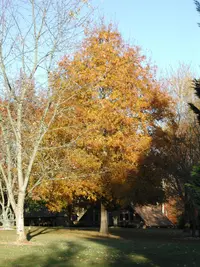
  • The crown is broad and rounded, with many fine branchlets that give the tree a soft, feathery outline.
  • Acorns are small and nearly round, set in shallow, saucer-like caps.

Check several leaves on different twigs, since size can vary across the canopy.

Quercus phellos shows useful visual shifts from slender seedlings to broad, strongly branched trees.

  • Seedling: Seedlings have a thin upright stem with alternate, narrow leaves that already suggest the species, while bark remains smooth and branching is minimal or absent.
  • Young plant: Young plants form a narrow crown with ascending side branches; leaves stay long and willow-like, often about 2-5 inches (5-13 cm) long.
  • Mature plant: Mature trees develop a tall straight trunk and a broader rounded crown, with heavier horizontal limbs and darker, more furrowed bark than younger plants.
  • Fruiting stage: Fruiting branches show small rounded acorns set close to twigs, adding a clear visual cue not present on nonfruiting juvenile or young plants.

In spring, Quercus phellos leafs out with narrow, willow-like leaves that are soft and light green at first, then deepen to a smoother medium green. Small yellowish flower clusters may be visible as the leaves emerge. By fall, the foliage usually turns yellow to yellow-brown before dropping. After leaf fall, the fine twigs, pointed brown buds, and developing acorns from the current season become easier to see through winter.

Several narrow-leaved oaks can be mistaken for willow oak.

shingle oak(Quercus imbricaria)

Similar unlobed, willow-like leaves. Shingle oak leaves are usually broader with a paler, fuzzy underside; acorns are larger and bark becomes darker and more blocky.

laurel oak(Quercus laurifolia)

Often confused because leaves can be narrow and mostly unlobed. Laurel oak usually has broader, thicker leaves, often widest above the middle, with tiny bristle tips.

water oak(Quercus nigra)

Young or narrow-leaved forms can resemble it. Water oak more often shows variable leaves, including spoon-shaped blades with a broader tip, instead of consistently willow-like leaves.

Quercus phellos is native to the eastern and southeastern United States, from New Jersey south to Florida and west to eastern Texas. That range is a useful clue when separating it from similar oaks outside the Atlantic and Gulf Coastal Plain. In the wild it is most common in bottomland woods, stream edges, floodplains, and other moist low areas. Finding it in wet coastal plain habitats can strongly support the identification.

  • Acorns and leaves: Quercus phellos contains oak tannins, mainly in the acorns and leaves. Ingestion can be harmful to humans and pets, especially dogs, livestock, and other animals that eat larger amounts.
  • Pet exposure: The main concern is ingestion rather than skin contact. Fallen acorns and wilted or fresh leaves are the parts most likely to be eaten by pets around the tree.

Confirm It from a Photo

Use Botan to identify or verify the plant from a photo, which helps avoid mix-ups before you label, buy, or remove it.

FAQ

In winter, this plant shows slender twigs, small pointed buds, and many narrow, willow-like leaves often persisting late into fall. Mature trees keep a broad, rounded crown, and small acorns may still be visible after leaf drop.

More Plant Identification Guides

One Photo. More About Your Plant.

Identify a plant from a photo with Botan, then review species-specific care information, safety notes, and common problems.

Botan app identifying a plant from a photo
Best Time to Plant Grass Seed: When to Seed Your Lawn

6 min read · 19 Nov 2026

Best Time to Plant Grass Seed: When to Seed Your Lawn

The best time to plant grass seed depends on your climate and grass type. Cool-season lawns establish best in late summer or early fall, while warm-season grasses perform best once soil warms in late spring or early summer.

Plant Care

Best Time to Plant Grass Seed: When to Seed Your Lawn
How Fast Does Bamboo Grow Per Day, Month, and Year

10 min read · 7 Jul 2026

How Fast Does Bamboo Grow Per Day, Month, and Year

Bamboo grows extremely fast: some species can reach 5-6 m in just 3-4 months under the right conditions. This guide explains how much bamboo can grow per day, week, and year, and what affects its growth rate.

Plant Recommendations
How Fast Does Bamboo Grow Per Day, Month, and Year
Can Plants Grow With Artificial Light?

6 min read · 15 Sept 2026

Can Plants Grow With Artificial Light?

Plants can grow under artificial light when the setup provides a suitable spectrum, enough intensity, and sufficient daily exposure. This guide explains how artificial lighting compares with sunlight, which options work indoors, and how to match a setup to houseplants.

Plant Care
Can Plants Grow With Artificial Light?