Winter rest period
Reduce watering and keep the plant in a bright, cool spot (45–55°F) in winter to encourage compact growth and better flowering the following season.

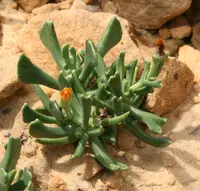
Hatchet-Leav'd Fig-Marigold (Rhombophyllum dolabriforme) is a compact, clump-forming succulent from arid regions of South Africa. It belongs to the Aizoaceae family, known for many drought-tolerant, stone-like plants.
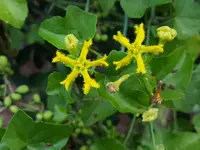
Its short, fleshy, hatchet-shaped leaves store water and often have a bluish-green surface with fine, rough texture. In good light it produces bright, daisy-like yellow flowers that open in sun.
This species stays small, adapts well to containers, and grows slowly, which makes it suitable for windowsills and indoor collections. Understanding how to care for Hatchet-Leav'd Fig-Marigold mainly involves providing bright light, very well-drained soil, and careful watering that avoids prolonged wetness around the roots.

Care Difficulty
Easy Care

Light Preference
Full Sun

Water Requirements
Low Water

Temperature Preference
Tropical / Frost Sensitive

Hardiness Zone
10–11

Soil Texture
Sandy, Loamy, Rocky

Soil pH
Slightly acidic (6.5–7.0), Neutral (7.0)

Soil Drainage
Well-drained

Fertilization
Minimal (feed rarely)
Scan your plant to receive care tips personalized for your specific plant
Available on iOS and Android
This compact succulent prefers bright, dry conditions with several hours of direct sun each day.
This drought-adapted succulent needs infrequent, careful watering in fast-draining soil.
This species prefers mild, dry conditions and does not tolerate hard freezes.
This succulent prefers dry air and does not need elevated humidity.
Use a sharply draining, mineral-based mix that dries quickly after watering.
This species is well suited to container growing, especially in dry, bright locations.
This compact succulent has low nutrient demands, so light feeding supports growth without risking root burn.
Rhombophyllum dolabriforme benefits from minimal, targeted pruning to maintain a compact, tidy form.
This succulent grows slowly and prefers slightly tight quarters, so repotting is infrequent but should be done carefully.
Rhombophyllum dolabriforme is commonly propagated from stem or leaf cuttings under warm, bright, and dryish conditions.
This succulent dislikes prolonged frost and benefits from simple winter precautions, especially in cold climates.

Plant Health Check
Not sure what's wrong with your plant? Check your plant's health inside the app.
This species produces thick, triangular, hatchet-like leaves whose outer surface is covered with translucent windows that help light reach the inner photosynthetic tissues while reducing water loss in its arid native habitat.
Unlike many succulents, it tends to grow and flower mainly in the cooler months and often slows down or becomes semi-dormant in the heat of summer, reflecting the seasonal pattern of rain in parts of South Africa where it occurs.
The plant forms bright yellow, daisy-like flowers with many narrow petals, typical of the Aizoaceae family, that open in strong light and are mainly visited by small insects in cultivation and in its native range.
Lack of flowers usually comes from insufficient light, excess nitrogen fertilizer, or too-warm, dry winter conditions. Provide bright conditions, a cool, drier rest in winter, and use a low-nitrogen fertilizer sparingly to support bud formation.
Keep your plants happy and healthy with plant identification, disease detection, and easy care guidance.