Digby's Beaked Laelia Care (Rhyncholaelia digbyana)

Digby's Beaked Laelia

About Digby's Beaked Laelia

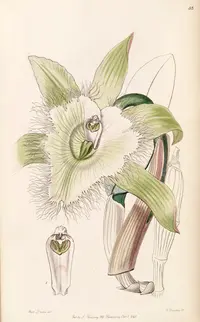
Rhyncholaelia digbyana, often called Digby's beaked laelia, is a compact epiphytic orchid that usually grows on trees in warm, humid climates. It is best known for its large, pale green to cream flowers with a striking, fringed lip.

The plant forms sturdy, elongated pseudobulbs with thick, leathery leaves, adapted to bright light and good air movement. In nature, it occurs from Mexico to Central America, where it experiences strong light, good drainage, and regular moisture followed by drying.

Its need for high light, excellent drainage, and consistent but not excessive moisture makes it moderately challenging for beginners. Those who learn how to care for Digby's Beaked Laelia often find it a rewarding, long-lived specimen orchid.

Main Plant Requirements

Care Difficulty

Moderate Care

Light Preference

Partial Sun

Water Requirements

Moderate Water

Temperature Preference

Tropical / Frost Sensitive

Hardiness Zone

11–12

Soil Texture

Sandy, Organic-rich

Soil pH

Acidic (5.5–6.5)

Soil Drainage

Well-drained

Fertilization

Light (every 4–6 weeks)

Get Personalized Care Plan

Scan your plant to receive care tips personalized for your specific plant

Available on iOS and Android

How to Care for the Digby's Beaked Laelia

This epiphytic orchid prefers bright, filtered light that mimics high-canopy woodland conditions.

  • Provide 4–6 hours of bright, indirect light daily, with gentle morning sun and shaded or filtered light from late morning onward for Digby's Beaked Laelia.
  • Outdoors, place where it receives dappled light under a tree or 30–50% shade cloth; avoid harsh midday and afternoon sun that can scorch leaves.
  • If new growth is weak, dark green, or flowering declines, increase light slightly; if leaves turn yellow or develop bleached patches, reduce sun exposure.

This orchid prefers frequent light moisture around the roots but dries slightly between waterings.

  • Water thoroughly, then allow the bark or mount surface to dry to the touch before watering again; in warm, bright weather this may be every 2–4 days, in cooler seasons every 5–10 days.
  • Use very free-draining orchid bark or a mounting setup so water runs through within seconds, preventing waterlogged roots and rot in Rhyncholaelia digbyana.
  • Signs of overwatering include blackened, mushy roots and yellowing, limp leaves; wrinkled pseudobulbs and dull, leathery leaves indicate underwatering and the need for slightly more frequent soakings.

This warm-growing orchid prefers consistently mild to warm conditions with no frost exposure.

  • Aim for 65–80°F (18–27°C) by day and 60–65°F (16–18°C) at night for steady growth and flowering.
  • Protect from cold; growth slows below about 55°F (13°C), and sustained exposure under 45°F (7°C) can damage tissues or kill the plant.
  • In hot weather above 90°F (32°C), increase air movement and humidity and provide stronger shade to prevent heat stress, leaf scorch, and bud blast.

This epiphytic orchid prefers moderately humid air to maintain healthy roots and flowers.

  • Aim for 50–70% humidity, as very dry indoor air slows growth and can desiccate aerial roots.
  • It tolerates brief dips to 30–40%, but prolonged low humidity causes wrinkled pseudobulbs and limp, folding leaves in Digby's Beaked Laelia.
  • Increase humidity with a pebble tray under the pot, grouping plants together, or using a room humidifier near but not blowing directly on the plant.

Rhyncholaelia digbyana grows best in a very airy, fast-draining orchid substrate rather than standard potting soil.

  • Use a chunky mix such as medium to large orchid bark with 10–20% perlite or pumice to keep the structure open and well aerated.
  • Ensure excellent drainage so water runs through in seconds; the roots should dry moderately fast between waterings, not stay waterlogged.
  • A slightly acidic to neutral pH (5.5–7.0) suits this orchid, which naturally anchors to bark or rock rather than dense ground soil.
  • Avoid peat-heavy, compact, or fine-textured mixes that hold water around the roots, as these quickly lead to suffocation and rot.

This species is well suited to container growing when the pot setup mimics its natural airy root environment.

  • Choose a shallow but wide pot or basket so thick roots can spread outward rather than being forced into deep, tight spaces.
  • Use slotted or net pots to increase air movement around roots, then place them inside a decorative cachepot only if drainage remains unobstructed.
  • Select heavier or wider-bottom containers if the plant becomes top-heavy in bloom, to prevent tipping when the large lip flower develops.

This epiphytic orchid benefits from light, consistent feeding during active growth.

  • Use a balanced orchid fertilizer (around 20-20-20) diluted to 1/4–1/2 strength in low‑salt water.
  • Feed every 2–3 weeks in spring and summer while roots and new pseudobulbs are developing.
  • Reduce to monthly or stop feeding in autumn and winter when growth slows.
  • For caring for Digby's Beaked Laelia, flush the medium with plain water monthly to limit salt buildup.

Pruning needs for Rhyncholaelia digbyana are minimal and focus on hygiene rather than shaping.

  • Trim spent flower spikes at the base once blooms are fully faded, using clean, sharp scissors or pruners.
  • Remove only dead, shriveled pseudobulbs and dry leaf sheaths to improve air flow and reduce disease risk.
  • Avoid cutting green, firm pseudobulbs, since they store water and energy for future growth.
  • Sterilize tools with alcohol between plants to prevent spreading pathogens.

This orchid prefers slightly tight conditions and resents frequent disturbance of its roots.

  • Plan to repot every 2–3 years, or when roots spill heavily over the pot or medium breaks down and stays soggy.
  • Repot in late winter to early spring, just before new root tips emerge, to support fast re-establishment.
  • Use a coarse, fast-draining orchid mix and place the plant so new growths have room to expand.
  • Handle roots gently, trimming only dead, mushy ones, and keep shading and humidity higher for 1–2 weeks to reduce stress.

Propagation of Rhyncholaelia digbyana at home is usually done by careful division rather than from seed.

  • Divide only mature clumps with at least 6–8 healthy pseudobulbs to maintain vigor in each section.
  • Best time is late winter to early spring when new roots are starting to grow.
  • Cut the rhizome with a sterile blade, keeping 3–4 pseudobulbs per division for stable recovery.
  • Pot divisions in fresh coarse orchid mix, maintain high humidity, bright filtered light, and gentle air movement until established.

This warmth-loving orchid is not frost hardy and needs indoor winter care in most climates.

  • Keep plants above 55°F, ideally 60–70°F, avoiding cold drafts near windows or doors.
  • Move outdoor container plants indoors before night temperatures drop below 60°F.
  • Provide bright, indirect light and slightly drier medium, but do not allow roots to stay bone dry for long.
  • Ensure good air movement to reduce fungal issues in cooler, lower-light conditions.

Care Tips

Support heavy blooms

Use a thin bamboo stake and soft ties to support the flowering pseudobulb once the large, frilled lip bud forms, so the inflorescence does not kink or snap under its own weight.

Optimize air movement

Place a small fan on a low setting to create gentle, constant air movement around the foliage and roots, which reduces fungal spotting, keeps new root tips active, and is especially helpful when caring for Digby's Beaked Laelia in warm, humid rooms.

Seasonal potting timing

Schedule any repotting or mount refreshing just as new roots start to extend in late winter or spring, so the plant anchors quickly and suffers less setback after disturbance.

Night temperature drop

Allow a 10–15°F drop between day and night temperatures whenever possible, since this diurnal swing helps trigger stronger growth and more reliable flowering.

Check root attachment

On mounted or basket-grown plants, gently test root attachment every few months and add a thin layer of fresh, coarse material only where roots are exposed and desiccating, instead of fully disturbing the established root system.

Common Pests and Diseases

Scale insects

This pest attaches firmly to pseudobulbs, leaves, and flower spikes, sucking sap and weakening the plant over time. Symptoms include yellowing areas, sticky honeydew, and sooty mold growth on affected surfaces.

Solution

Isolate the plant, then wipe infested areas with cotton pads soaked in 70% isopropyl alcohol, repeating weekly until no new scale appears. Improve air movement and light, and for larger collections use a systemic insecticide labeled for orchids according to Rhyncholaelia digbyana care instructions.

Spider mites

These insects thrive on thin leaf undersides in warm, dry conditions, causing fine stippling, dull leaves, and sometimes delicate webbing. This pest can deform new growth and reduce flowering if not controlled early.

Solution

Increase humidity and rinse foliage thoroughly under lukewarm water, focusing on leaf undersides. For persistent infestations, apply an acaricide or insecticidal soap labeled for orchids in several treatments 5–7 days apart, keeping leaves dry between applications to prevent fungal issues.

Mealybugs

This pest hides in leaf axils, along pseudobulbs, and in roots, appearing as white cottony masses. Symptoms include sticky honeydew, distorted new growth, and slow decline in vigor.

Solution

Remove visible insects with cotton swabs dipped in 70% isopropyl alcohol and flush the root zone with water to dislodge hidden mealybugs. For severe cases, unpot the plant, trim heavily infested roots, repot in fresh medium, and consider a systemic insecticide while monitoring closely for several weeks.

Bacterial soft rot

This disease causes rapidly spreading, water-soaked, foul-smelling lesions on leaves and pseudobulbs, often starting at wounds or trapped moisture points. Symptoms include collapse of affected tissue and a slimy texture.

Solution

Immediately cut away all affected tissue with sterile tools, extending into healthy tissue, and discard contaminated material. Keep the plant much drier on the foliage, improve air circulation, avoid water sitting in the leaf axils, and apply a bactericide labeled for orchids if the plant is valuable or the infection was extensive.

Leaf spot fungi

This disease produces small yellow, brown, or black spots on leaves that may coalesce under prolonged high humidity and poor air flow. Symptoms include cosmetic damage and, in severe cases, premature leaf drop.

Solution

Remove badly spotted leaves, reduce overhead watering, and increase air movement around the plant. Allow leaf surfaces to dry quickly after watering, then apply a broad-spectrum fungicide suitable for orchids if new spots continue to appear.

Interesting Facts

National flower status

This species is the national flower of Honduras, chosen for its large fringed lip and strong nighttime fragrance.

Fringed lip adaptation

The flower’s very broad, deeply fringed lip creates a conspicuous visual target that likely helps guide nocturnal moth pollinators toward the column where pollinia are located.

Night-scented blooms

Its flowers produce a strong citrus-like perfume that intensifies after dusk, a trait associated with attraction of night-flying sphingid moths in its native habitats.

Botan icon

Did you know?

This orchid was historically placed in the large genus Brassavola and later segregated into the small genus Rhyncholaelia based on its distinctive floral morphology, including the massive fringed lip and stout pseudobulbs, making it one of only two recognized species in the genus.

FAQs about Digby's Beaked Laelia

Flowering usually occurs in late spring to early summer, often once a year in home culture. Individual blooms commonly last 2–4 weeks if temperatures are moderate, light is stable, and the plant is not moved or stressed.

Grow Healthy Plants with Botan Care

Keep your plants happy and healthy with plant identification, disease detection, and easy care guidance.

Botan plant care app — identify plants on mobile

Explore More Plants