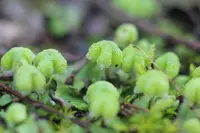
Jagged Germanderwort Care (Riccardia chamedryfolia)

Jagged Germanderwort

About Jagged Germanderwort

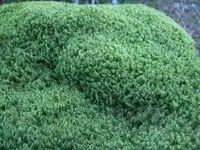
Jagged Germanderwort (Riccardia chamedryfolia) is a small, creeping liverwort often used in aquariums, terrariums, and high-humidity displays. It forms dense, finely branched mats with a jagged, fern-like look.

In nature, it grows on rocks, wood, or moist soil in shaded, humid forest environments, often along streams. Its compact growth and slow to moderate pace make it manageable but slightly demanding.

Stable moisture, clean water, and low to moderate light are important for healthy growth. Understanding how to care for Jagged Germanderwort helps prevent melting, algae problems, and dieback in enclosed setups.

Main Plant Requirements

Care Difficulty

Hard Care

Light Preference

Partial Shade

Water Requirements

Keep Soil Moist

Temperature Preference

Tropical / Frost Sensitive

Hardiness Zone

Unknown

Soil Texture

Peaty, Organic-rich

Soil pH

Acidic (5.5–6.5)

Soil Drainage

Waterlogged tolerant

Fertilization

Light (every 4–6 weeks)

Get Personalized Care Plan

Scan your plant to receive care tips personalized for your specific plant

Available on iOS and Android

How to Care for the Jagged Germanderwort

Riccardia chamedryfolia grows best in low to moderate, filtered light that mimics shaded stream banks or forest floors.

  • Provide bright, indirect light or deep shade with dappled sun, ideally 0–2 hours of very soft morning sun and no direct afternoon sun, to prevent frond bleaching and drying.
  • Place Jagged Germanderwort where it receives consistent ambient light; strong midday or afternoon sun, especially behind glass, can scorch tissues within hours.
  • In summer, shield from intense sun with shade cloth or placement under overhangs; in winter, move slightly closer to windows or skylights to compensate for shorter days.

This liverwort prefers constantly moist conditions and suffers quickly if allowed to dry out.

  • Maintain evenly moist substrate; never let the top surface dry completely, and rewater as soon as the surface looks dull, lighter in color, or feels just barely damp to the touch.
  • Use soft, low-mineral water if possible and apply gently so the delicate mat is not disturbed; good drainage below prevents stagnant water and foul odor, signs of oversaturation.
  • In warm seasons, monitor daily for edges turning pale or crisp, which indicates underwatering, while mushy, dark patches with a musty smell suggest overwatering or poor aeration.
  • ,

This species prefers cool to mild temperatures similar to a shaded woodland or cool-water aquarium edge.

  • Aim for 65–75°F (18–24°C) for steady growth; short exposures down to about 55°F (13°C) are usually tolerated if the plant stays moist and shaded.
  • Avoid frost entirely, as tissue damage occurs near 32°F (0°C); in outdoor setups, protect from overnight cold snaps with relocation or insulating covers.
  • Heat above 80°F (27°C) can cause stress, thinning, and browning, so increase humidity, shade, and air movement during hot spells to keep the plant cooler and hydrated.

This moss-like liverwort needs high, stable humidity to keep fronds dense and hydrated.

  • Aim for 70–90% humidity; growth slows and tips dry out below 60%.
  • In drier rooms, fronds curl, brown at the edges, and feel papery from desiccation stress.
  • Increase humidity with a closed or semi-closed terrarium, tight-fitting aquarium lid, or by placing the culture over shallow water with strong airflow to prevent stagnation around Jagged Germanderwort.

This species grows best attached to hardscape or in very fine, consistently moist, organic-rich substrate.

  • Use a soft, fibrous mix such as milled sphagnum with fine aquarium gravel or sand to provide structure and moisture retention.
  • Keep the substrate constantly moist but never waterlogged; excess standing water encourages rot in delicate tissue.
  • Target slightly acidic to neutral conditions around pH 5.5–7.0, which support healthy cell function and nutrient uptake in Riccardia chamedryfolia.
  • Avoid dense, clay-based or heavily fertilized mixes that compact, restrict oxygen, and promote algae overgrowth on the thallus.

This plant is highly suitable for container culture, especially in closed or semi-closed setups.

  • Use shallow, wide containers so the spreading mats can attach to stones or wood without shading themselves out.
  • Position hardscape features so water flows gently over or near the plant, avoiding direct jets that can dislodge small fragments.
  • Choose glass or clear plastic containers that limit evaporation and maintain stable moisture while still allowing observation of growth.

Riccardia chamedryfolia is a slow-growing liverwort that needs only very light feeding in cultivation.

  • Use a very dilute balanced liquid fertilizer (around 1/8–1/4 strength) labeled safe for aquatics or mosses.
  • Apply during active growth only, about every 4–6 weeks, and skip doses if growth already looks dense and healthy.
  • Avoid slow-release granules and rich compost, which can burn delicate tissues and encourage algae.
  • In winter or dormancy, stop feeding Jagged Germanderwort and focus on stable moisture, light, and water quality.

Pruning Riccardia chamedryfolia focuses on light trimming to maintain compact, healthy mats.

  • Trim during active growth, removing brown, decaying, or algae-covered fronds with fine scissors or aquascaping shears.
  • Clip back overly thick or shaded patches to improve water flow and light penetration across the mat.
  • Shape edges carefully to keep dense, low cushions rather than tall, uneven clumps.
  • Remove small sections at a time to avoid shocking the colony and to monitor recovery.

Riccardia chamedryfolia is usually attached to hardscape rather than potted, so transplanting means reattaching small portions.

  • Transplant when mats detach, stagnate in growth, or become overly shaded and thin in the center.
  • Best timing is during stable, warm conditions with steady lighting and water parameters, often in spring or early indoor growing season.
  • Gently tease apart small clumps and tie or glue them thinly onto rock, wood, or mesh to limit rot and improve water contact.
  • Minimize air exposure and temperature swings during handling, then keep water clean and low in nutrients to reduce stress.

Propagation of Riccardia chamedryfolia relies on dividing and reattaching small pieces of the mat.

  • Use healthy, bright green tips and side branches, avoiding brown or slimy sections.
  • Divide the mat into tiny tufts and spread them thinly on rock, wood, or mesh for faster coverage.
  • Perform division during active growth under stable light, CO2, and water conditions.
  • Keep good water movement and very clean water so new growth anchors and spreads without being overgrown by algae.

This species is mostly grown submerged or in controlled indoor setups, so winter care centers on temperature stability rather than outdoor protection.

  • Maintain water or air temperatures in the typical tropical range, avoiding drops below about 60°F.
  • For outdoor tubs or tanks, move containers indoors before first frost and acclimate gradually to indoor conditions.
  • Ensure lighting, CO2 (if used), and photoperiod stay stable through winter to prevent dieback.

Care Tips

Anchor To Hardscape

Tie or gently press the thallus onto rock, wood, or mesh using fishing line or plant glue so it forms a low, attached mat instead of drifting or breaking apart in the current.

Control Algae Competition

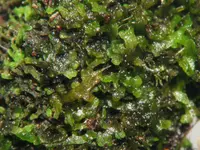
Keep light and nutrients balanced and physically brush or siphon algae from the moss surface, because even a thin algae film will quickly smother the fine fronds and stop new growth.

Trim For Density

Use sharp aquascaping scissors to lightly shear the top 0.5–1 cm every 4–6 weeks to encourage dense lateral branching and prevent the colony from shading out its own lower layers.

Manage Water Flow

Position the plant in gentle, indirect water flow so debris is carried away but the tissue does not flap strongly, which reduces mechanical stress and breakage.

Quarantine And Rinse

Before adding new portions, quarantine them for 1–2 weeks and rinse thoroughly to reduce the risk of planaria, snails, and algae contamination, which simplifies long-term Riccardia chamedryfolia care in a display tank.

Common Pests and Diseases

Algae overgrowth

Symptoms include dark green slimy layers forming over the moss cushions, blocking light and trapping debris. This often appears in high‑light, nutrient‑rich aquaria with low water movement.

Solution

Reduce light intensity or duration to 6–8 hours, improve water circulation, and lower excess nutrients through smaller feedings and more frequent water changes. Manually remove algae with a soft brush or siphon from the Riccardia surface, and use fast‑growing stem plants or floating plants to compete for nutrients if algae keeps returning.

Blue‑green algae

This disease involves sheets or patches of dark, sometimes bluish, slimy growth that spread quickly over the fronds and hardscape. The growth has a strong, earthy or musty odor and can smother the plant.

Solution

Increase water changes, improve filtration and flow, and reduce organic waste buildup such as uneaten food and detritus trapped in the Riccardia. Manually peel or siphon off affected mats and, if needed, implement a blackout period of 3–4 days while maintaining good aeration to weaken cyanobacteria, combined with careful long‑term nutrient balancing.

Black beard algae

This pest appears as short, dark gray to black tufts on the margins of the thallus, giving the plant a rough, bearded look. Growth tends to worsen in unstable CO₂ conditions and fluctuating nutrients.

Solution

Stabilize CO₂ levels, avoid sudden changes in fertilization, and keep moderate consistent light. Gently trim or remove heavily infested portions of Riccardia, manually brush off tufts during water changes, and improve flow around the cushions so detritus does not accumulate on the plant surface.

Filamentous hair algae

This pest forms fine, green threads that tangle through the dense cushions and trap debris, reducing light penetration and gas exchange. In low‑flow corners, the algae can mat over and stunt new growth.

Solution

Manually twirl and lift out threads with a toothbrush or tweezers during water changes and increase flow to Riccardia patches by adjusting filter outlets. Balance light and nutrients by avoiding overfeeding, maintaining regular water changes, and keeping light at moderate levels appropriate for Riccardia chamedryfolia care.

Fungal biofilm

This disease presents as whitish, translucent, or slightly fuzzy films or tufts on newly attached Riccardia or on the wood/rocks it is tied to. Growth often follows the introduction of fresh hardscape or decaying organic material and can shade the plant if dense.

Solution

Increase mechanical filtration, siphon off visible biofilm during water changes, and improve flow across the affected cushions. Remove any decaying plant matter or food trapped in the moss, and allow time for the aquarium’s microbial community to stabilize, as healthy competition often suppresses these fungi and associated microorganisms.

Interesting Facts

True thalloid liverwort

This species forms a flattened, highly branched thallus rather than true leaves and stems, placing it among the so‑called thalloid liverworts that show a very simple but efficient body plan for low, shaded habitats.

Natural stream specialist

In the wild it often colonizes submerged or splash-zone rock and wood in cool, clean forest streams, tolerating steady current and frequent submersion that would dislodge many mosses and larger plants.

Miniature three‑dimensional mats

Its repeatedly forked, very fine branches create dense, cushion‑like mats with high surface area, providing microhabitats and shelter for small aquatic invertebrates and biofilm communities in both nature and aquaria.

Botan icon

Did you know?

This liverwort can regenerate new growth from very small fragments of its thallus, so even tiny pieces carried by flowing water can establish new colonies on suitable submerged wood or rock surfaces.

FAQs about Jagged Germanderwort

Growth is slow to moderate. New fronds or pads appear gradually over several weeks, forming a dense mat over months rather than days. Stable moisture, gentle water flow, and steady nutrients noticeably speed growth compared with fluctuating conditions.

Grow Healthy Plants with Botan Care

Keep your plants happy and healthy with plant identification, disease detection, and easy care guidance.

Botan plant care app — identify plants on mobile

Explore More Plants