


Use Decaying Wood
Establish the colony on well-rotted, fungus-free hardwood branches or chips, partially buried and kept consistently moist, to provide the stable, nutrient-rich substrate this saprophytic fungus needs to fruit reliably.

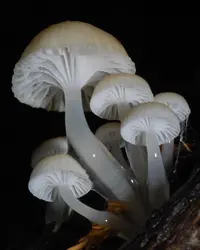
Austral dripping bonnet, Roridomyces austrororidus, is a small saprophytic mushroom that grows on decaying wood, leaf litter, and other forest debris. It is not a foliage houseplant but a fungus that appears seasonally in moist habitats. Caps are usually pale to tan, often with a slimy or glistening surface, and carried on slender stems that can form loose clusters. In nature it occurs mainly in cool, damp forests of Australasia and nearby regions. Because it depends on consistently high humidity, cool temperatures, and a steady supply of rotting organic material, it is difficult to keep in typical home conditions. Those who wish to care for Austral Dripping Bonnet usually need a controlled terrarium or lab-style setup rather than standard pot culture.

Care Difficulty
Hard Care

Light Preference
Shade

Water Requirements
Keep Soil Moist

Temperature Preference
Cool Climate

Hardiness Zone
Unknown

Soil Texture
Loamy, Peaty, Organic-rich

Soil pH
Strongly acidic (4.5–5.5), Acidic (5.5–6.5)

Soil Drainage
Moist but well-drained

Fertilization
Minimal (feed rarely)
Scan your plant to receive care tips personalized for your specific plant
Available on iOS and Android
This small saprophytic mushroom prefers low, forest-like light rather than direct sun exposure.
This fungus thrives in consistently moist, not waterlogged, organic substrates such as rotting wood and deep leaf litter.
This species fruits best in cool, moist conditions typical of shaded forest floors.
This saprophytic fungus prefers consistently moist, high-humidity conditions that mimic a damp forest floor.
Roridomyces austrororidus grows on decaying wood, so it needs a wood-based, consistently moist substrate rather than standard potting soil.
This species can be grown in containers only as a niche cultivation project that mimics a damp woodland microhabitat.
This small saprophytic fungus naturally grows on decaying wood and does not benefit from added fertilizer in cultivation.
Roridomyces austrororidus does not require pruning, as each mushroom is a short-lived fruiting body arising from buried wood or woody debris.
Transplanting focuses on moving the colonized wood substrate rather than the fungus itself.
Propagation of Roridomyces austrororidus is specialized and not typically attempted by home growers.
This wood-inhabiting fungus is generally cold tolerant in its native outdoor range and needs no special winter care.

Plant Health Check
Not sure what's wrong with your plant? Check your plant's health inside the app.
Its cap and upper stem are covered with conspicuous, clear to amber slime droplets, a feature that inspired the common name Austral dripping bonnet. These droplets are thought to help retain moisture on the fruiting body in exposed, drying conditions.
This species commonly fruits on well-decayed wood and litter of southern beech (Nothofagus) in wet forests of southeastern Australia and New Zealand. It often appears in clusters on very rotten, mossy logs where the original wood structure is barely visible.
The caps are tiny, usually only a few millimeters across, and can appear almost translucent when fresh and moist. Their pale cream to ochre coloration and delicate size make them easy to overlook without careful ground-level observation.

The species was originally described in the genus Mycena and later transferred to Roridomyces based on its distinctive slimy cap and stem droplets, illustrating how microscopic and macroscopic characters together can change a fungus’s taxonomic placement.
This fungus grows best outdoors in cool, humid, shaded forest conditions on decaying wood or very rotted plant debris. Indoor cultivation is challenging because maintaining constant moisture, fresh air exchange, and sterile conditions is technically demanding.
Keep your plants happy and healthy with plant identification, disease detection, and easy care guidance.

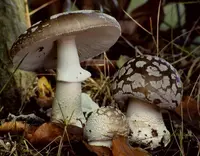
European False Blusher
Amanita excelsa
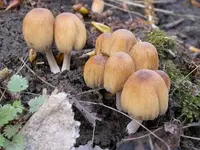
mica cap
Coprinellus micaceus
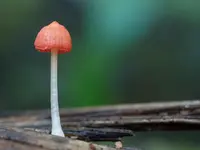
Scarlet Bonnet
Atheniella adonis
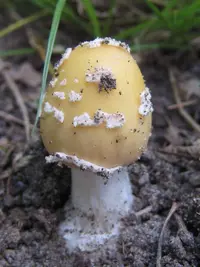
Great Funnel-Veil Amanita
Amanita velatipes
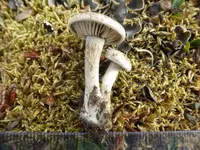
Atractosporocybe inornata
Atractosporocybe inornata
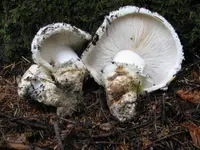
American matsutake
Tricholoma magnivelare
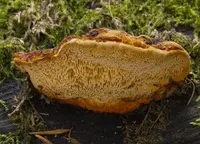
Anise Mazegill
Gloeophyllum odoratum
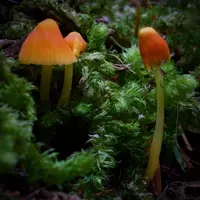
tangerine bonnet
Atheniella aurantiidisca