Sucker Management
Thin out root suckers annually, keeping only well-placed shoots 20–30 cm apart, so the thicket stays healthy and accessible instead of becoming an impenetrable hedge.

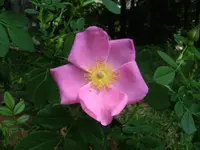
Virginia rose, Rosa virginiana, is a hardy deciduous shrub rose native to eastern North America. It typically forms dense thickets with upright stems and a bushy, rounded habit.
Plants carry single pink flowers in early to midsummer, followed by bright red hips that often persist into winter. Stems are armed with prickles, and foliage turns attractive shades of red or purple in fall.
This species usually thrives in full sun and tolerates a range of soils, including poorer, sandy sites, as long as drainage is good. Its toughness and disease resistance make it relatively straightforward to care for Virginia rose in many garden settings.

Care Difficulty
Easy Care

Light Preference
Full Sun

Water Requirements
Moderate Water

Temperature Preference
Cold Hardy

Hardiness Zone
3–8

Soil Texture
Sandy, Loamy, Clay

Soil pH
Acidic (5.5–6.5), Slightly acidic (6.5–7.0)

Soil Drainage
Moist but well-drained

Fertilization
Minimal (feed rarely)
Scan your plant to receive care tips personalized for your specific plant
Available on iOS and Android
This hardy shrub rose performs best with strong outdoor light exposure.
Rosa virginiana prefers evenly moist but not saturated soil once established outdoors.
This species rose is naturally cold hardy and also manages moderate summer heat when soil moisture is stable.
This species is adapted to outdoor conditions and does not need special humidity control.
This species prefers moderately fertile, well-structured mineral soil with reliable drainage.
This species can be grown in containers outdoors if the pot is large and stable.
This rugged native shrub needs minimal feeding, but light nutrients support flowering and overall Rosa virginiana plant care in poor soils.
Thoughtful pruning keeps Rosa virginiana healthy, manageable, and floriferous.
This species is usually grown in the ground, so care focuses on thoughtful transplanting rather than frequent repotting.
Rosa virginiana can be propagated by suckers, cuttings, or seed, depending on the desired genetic uniformity and timeframe.
This rose is cold hardy across much of its native range and usually needs only modest winter care in the landscape.

Plant Health Check
Not sure what's wrong with your plant? Check your plant's health inside the app.
This species is naturally common along the Atlantic coast of eastern North America, where it tolerates salty winds and sandy, nutrient-poor soils better than many other wild roses.
Its dense, thorny thickets provide nesting sites for small birds, while the vitamin C–rich hips are an important autumn and winter food source for songbirds and small mammals.
Unlike many shrub roses, this species often develops striking red to purple fall foliage that appears at the same time as its bright red hips, giving a strong seasonal color contrast.

Rosa virginiana is one of the key wild rose species used in breeding hardy landscape roses for cold climates, contributing genes for winter hardiness and disease resistance in many modern cultivars.
Poor flowering often comes from too much shade, excessive nitrogen fertilizer, or heavy pruning at the wrong time that removes flower buds. Ensure full sun, moderate feeding, and prune right after flowering, not in early spring.
Keep your plants happy and healthy with plant identification, disease detection, and easy care guidance.