Wind exposure management
Site plants where they receive good air flow but are protected from strong, drying winds, using a fence or shrub screen on the windward side if needed to reduce cane desiccation and blossom damage.

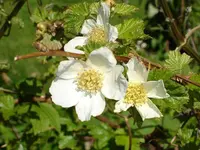
Delicious raspberry, Rubus deliciosus, is a deciduous shrub valued more for its large white flowers than for its modest, dry fruits. It forms a rounded, bushy shape with textured leaves and showy, single blooms that resemble simple roses.
This species is native to the Rocky Mountains in the western United States, where it grows on slopes and open woodland edges. It is generally considered manageable for gardeners if given sun, well-drained soil, and moderate moisture.
Its cold hardiness and tolerance of lean, rocky soils make it suitable for low-maintenance landscapes. Those learning how to care for delicious raspberry mainly need to focus on providing enough light and avoiding waterlogged conditions.

Care Difficulty
Moderate Care

Light Preference
Full Sun

Water Requirements
Moderate Water

Temperature Preference
Cold Hardy

Hardiness Zone
4–8

Soil Texture
Sandy, Loamy, Rocky

Soil pH
Slightly acidic (6.5–7.0), Neutral (7.0)

Soil Drainage
Well-drained

Fertilization
Minimal (feed rarely)
Scan your plant to receive care tips personalized for your specific plant
Available on iOS and Android
This shrub prefers bright outdoor conditions with moderate direct sun exposure for best flowering.
Rubus deliciosus prefers evenly moist, well-drained soil rather than extremes of dryness or saturation.
This species is adapted to cool to temperate outdoor climates and tolerates significant winter cold.
Humidity is not a major factor for Rubus deliciosus, which adapts well to typical outdoor air conditions.
Rubus deliciosus prefers a loose, moisture-retentive but free-draining loam for reliable establishment and flowering.
This species can be grown in containers if the pot provides enough depth and weight for its shrubby growth.
This shrub performs well in average garden soil and benefits from light feeding rather than heavy fertilization.
Pruning helps maintain Rubus deliciosus as a compact, flowering shrub and removes unproductive wood.
This species is usually grown in the ground, so focus on thoughtful transplanting rather than frequent repotting.
Rubus deliciosus is commonly propagated by softwood cuttings, layering, or seed for new landscape plants.
This shrub is generally cold hardy in many temperate regions and needs only modest winter care.

Plant Health Check
Not sure what's wrong with your plant? Check your plant's health inside the app.
This species is naturally restricted to the Rocky Mountain foothills of Colorado, where it grows on dry, rocky slopes and open woodland edges rather than in moist forest understories like many other Rubus species.
It produces unusually large, pure white, saucer-shaped flowers up to about 5 cm across, which is considerably bigger than the flowers of most related brambles and gives it strong ornamental value in cool climates.
Unlike many raspberries and blackberries, this species has slender, mostly smooth stems with very sparse or no prickles, which makes handling and pruning much easier than typical bramble species.

Despite being a raspberry relative, this shrub is primarily valued as an ornamental flowering plant in gardens and arboreta, and cultivated selections such as Rubus deliciosus 'April Snow' have been developed specifically for their showy, early-season white blooms rather than for fruit production.
Yes, the white flowers are ornamental, but the brown, dry fruits are technically edible yet not tasty. They are usually left for wildlife rather than harvested for human use or cooking.
Keep your plants happy and healthy with plant identification, disease detection, and easy care guidance.