Black Eyed Susan Care (Rudbeckia fulgida var. sullivantii 'Goldsturm')

Also known as: Sullivant’s Coneflower
Black Eyed Susan

About Black Eyed Susan

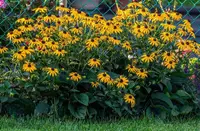
Black eyed Susan (Rudbeckia fulgida var. sullivantii 'Goldsturm') is a hardy, clump-forming perennial grown mainly for its bright, daisy-like summer flowers. It belongs to the Asteraceae family, the same group as asters and sunflowers.

Plants carry sturdy, upright stems with golden-yellow petals and a dark central cone, creating strong color blocks in borders and meadows. Foliage is medium green and forms a leafy base that returns each year in suitable climates.

This selection originates from North American prairie and open meadow habitats, so it adapts well to many garden conditions. It generally prefers full sun, moderate moisture, and well-drained soil, and many gardeners find it straightforward to learn how to care for Black Eyed Susan.

Main Plant Requirements

Care Difficulty

Easy Care

Light Preference

Full Sun

Water Requirements

Moderate Water

Temperature Preference

Cold Hardy

Hardiness Zone

3–9

Soil Texture

Sandy, Loamy, Clay

Soil pH

Acidic (5.5–6.5), Slightly acidic (6.5–7.0)

Soil Drainage

Moist but well-drained

Fertilization

Minimal (feed rarely)

Get Personalized Care Plan

Scan your plant to receive care tips personalized for your specific plant

Available on iOS and Android

How to Care for the Black Eyed Susan

This perennial thrives in full sun but tolerates some light shade, especially in hotter regions.

  • Aim for 6–8 hours of direct sun daily, with at least 4–6 hours of strong morning sun for best flowering and sturdy stems.
  • It tolerates light afternoon shade, which can reduce heat stress and leaf scorch in hot summers without severely reducing bloom.
  • In deep or prolonged shade, Black Eyed Susan produces fewer flowers, taller and weaker stems, and may flop or lean toward brighter areas.

This plant prefers evenly moist but not soggy soil, especially during establishment and peak summer growth.

  • Water when the top 3–5 cm of soil feels dry, soaking the root zone deeply rather than using light, frequent sprinkling.
  • During the first growing season, monitor rainfall and irrigate after 3–5 dry days; once established, it tolerates short dry periods if soil is well-drained.
  • Yellowing lower leaves and limp, pale foliage can indicate overwatering, while dull, drooping leaves and dry, crumbly soil suggest underwatering for Rudbeckia fulgida var. sullivantii 'Goldsturm'.

This hardy perennial handles a wide temperature range but grows best in moderate summer conditions.

  • Optimal growth occurs around 65–80°F (18–27°C), supporting strong stems, abundant blooms, and steady root development.
  • The plant is cold-hardy in many temperate climates, with dormant crowns tolerating winter lows well below 0°F (-18°C) when soil-drained and mulched.
  • Summer heat up to about 90–95°F (32–35°C) is tolerated if soil moisture is maintained; in prolonged heat waves, afternoon shade and mulch help reduce stress and leaf scorch.

Humidity is rarely a concern for this species in typical outdoor conditions.

This perennial prefers moderately fertile, well-drained, loamy ground that stays evenly moist but not saturated.

  • Use a loam-based soil with 30–40% compost to provide structure and steady nutrients.
  • Ensure drainage by incorporating coarse sand or fine gravel, especially in heavier clay sites.
  • Aim for a slightly acidic to neutral pH around 6.0–7.0 for reliable growth of Rudbeckia fulgida var. sullivantii 'Goldsturm'.
  • Avoid compacted or waterlogged areas; loosen the top 20–25 cm to improve aeration before planting.

This species grows reliably in containers outdoors if given sufficient root volume and drainage.

  • Choose a pot at least 30–35 cm wide and deep so the spreading root system does not dry out too quickly.
  • Select a heavier material such as ceramic or thick-walled terracotta to stabilize the tall, flowering stems in wind.
  • Raise the container on feet or bricks so drainage holes stay clear and excess water can escape freely after heavy rain.

Rudbeckia fulgida var. sullivantii 'Goldsturm' needs only modest feeding in average garden soil.

  • In spring, apply a thin layer of compost or a balanced slow-release fertilizer (around 10-10-10) over the root zone.
  • Feed once at the start of the growing season; avoid repeated high-nitrogen products that cause floppy growth.
  • If using liquid fertilizer, dilute to 1/2 strength and apply to moist soil to prevent root burn.
  • Stop feeding in late summer; do not fertilize dormant clumps in fall or winter.

Pruning supports dense growth and sustained flowering in Rudbeckia fulgida var. sullivantii 'Goldsturm'.

  • In midsummer, deadhead spent blooms with clean hand pruners to extend flowering and reduce self-seeding.
  • Remove dead, diseased, or storm-damaged stems whenever seen to maintain plant health.
  • In late fall or very early spring, cut back old stems to 5–10 cm above ground to tidy and stimulate new shoots.
  • Thin crowded clumps by removing a few inner stems to improve airflow and reduce mildew risk.

This perennial is usually grown in beds or borders and is moved mainly by transplanting established clumps.

  • Plan division and transplanting in early spring or early fall when temperatures are mild and soil is workable.
  • Transplant when clumps become crowded, flower less, or invade neighboring plants, typically every 3–5 years.
  • Dig up the clump with a sharp spade, then split it into sections with healthy roots and several shoots each.
  • Replant divisions at the same depth, water thoroughly, and keep soil evenly moist for 1–2 weeks to limit stress.

Rudbeckia fulgida var. sullivantii 'Goldsturm' is commonly propagated by division and sometimes by seed.

  • Divide mature clumps in early spring or early fall, lifting and splitting them into several vigorous sections.
  • Replant divisions into moist, well-drained soil, spacing 30–45 cm apart to allow future spread.
  • For seeds, sow in late fall outdoors or after a short cold stratification period indoors to improve germination.
  • Provide bright light and lightly moist soil for seedlings, then harden off before planting into garden beds.

This perennial is cold hardy in most temperate climates and usually needs minimal winter care.

  • Tolerates frost and snow once established, with roots surviving typical winter lows in many USDA zones.
  • After hard frost, either leave seed heads for wildlife or cut stems down to near ground level.
  • Apply a 5–8 cm layer of mulch around the crown to steady soil temperature and moisture.
  • Container-grown Black Eyed Susan may be moved to a sheltered, unheated area to avoid repeated freeze-thaw cycles.

Care Tips

Staggered Division

Divide established clumps every 3–4 years in early spring or early fall, replanting outer, more vigorous sections and discarding congested woody centers to maintain strong flowering stands.

Flower Stalk Thinning

In early summer, selectively remove 10–20% of the weakest or most crowded flower stalks from dense clumps to improve air movement and reduce foliar disease pressure without noticeably reducing bloom display.

Powdery Mildew Management

At the first sign of powdery mildew, promptly remove and dispose of heavily affected leaves and use soaker hoses instead of overhead watering to keep foliage dry and slow disease spread.

Seed Head Handling

Leave some seed heads standing through winter to provide wildlife food and then cut them back before new growth emerges in spring to limit self-seeding into unwanted areas.

Wind and Rain Support

In exposed sites, insert low, discreet ring supports or short stakes around clumps in late spring so stems grow through them, helping the plant stay upright during heavy rain and wind while still looking natural when growing Black Eyed Susan.

Everything About Black Eyed Susan

Common Pests and Diseases

Septoria leaf spot

This disease causes small, water-soaked spots that enlarge into tan to brown lesions with darker borders, often starting on lower, older foliage in mid to late summer. Symptoms include premature yellowing and drop of affected leaves, especially in dense plantings or during wet weather.

Solution

Remove and discard heavily spotted leaves and any fallen debris to reduce spore spread, and avoid overhead watering so foliage dries quickly. Thin or divide crowded clumps to improve airflow, and if the problem recurs yearly, apply a labeled chlorothalonil or copper fungicide preventively at the first sign of spots, following all product directions.

Powdery mildew

This disease produces a white to gray, powdery coating on upper leaf surfaces, especially in late summer when days are warm and nights are cool. Symptoms include distorted or stunted leaves and reduced flowering in severe cases.

Solution

Increase air circulation by spacing plants properly and thinning nearby vegetation, and water at soil level rather than on foliage. Remove the worst-affected leaves and use a labeled sulfur or potassium bicarbonate fungicide at the first sign of powdery growth if cultural steps are not enough.

Rust

This disease appears as small yellow spots on the upper leaf surface with orange to brown pustules on the undersides, releasing dusty spores when touched. Symptoms include gradual weakening of plants and reduced vigor if infections are heavy and repeated.

Solution

Promptly remove and discard infected leaves and plant debris to lower spore levels, and avoid wetting foliage late in the day. In sites with recurring rust, choose open, sunny positions with good airflow and consider a labeled preventative fungicide such as myclobutanil on nearby susceptible perennials at the first sign of symptoms.

Aphids

These insects cluster on stems, buds, and the undersides of leaves, sucking plant sap and excreting sticky honeydew that can lead to sooty mold. Symptoms include curled or distorted new growth and the presence of ants tending the colonies.

Solution

Dislodge colonies with a strong stream of water in the morning and prune off heavily infested shoot tips. If needed, apply insecticidal soap or a light horticultural oil thoroughly to the undersides of leaves and stems, repeating as directed, and encourage natural predators such as lady beetles by avoiding broad-spectrum insecticides.

Leafhoppers

These insects are small, wedge-shaped, and very quick-moving, feeding on leaf undersides and causing pale stippling or whitish speckling on foliage. Symptoms include marginal browning and a general faded look to the leaves, especially in hot, dry weather.

Solution

Reduce grassy weeds and nearby alternate hosts, and use a firm spray of water to disrupt early populations on foliage. If damage is persistent and severe, use a labeled pyrethrin or neem-based product in the evening when pollinators are less active, directing sprays to the undersides of leaves and following all label instructions; this approach aligns with practical Black Eyed Susan care instructions for home gardens.

Interesting Facts

Clonal garden selection

This plant is not a wild species but a clonal cultivar selected in a German botanical garden in the mid-20th century for its abundant, uniform golden flowers and strong garden performance.

Extended flowering window

Compared with many other Rudbeckia forms, it typically flowers for many weeks from mid to late summer into early fall, providing a long, consistent display of nectar and pollen for insects.

Reliable sterile seed production

Although the flower heads often appear to set seed, the cultivar usually produces little to no viable seed, so it remains genetically stable and is propagated almost entirely by division in horticulture.
Botan icon

Did you know?

This cultivar received the Royal Horticultural Society’s Award of Garden Merit, reflecting decades of documented performance trials that confirmed its reliability, ornamental value, and resistance to common garden stresses under a range of conditions.

FAQs about Black Eyed Susan

Lack of flowers is usually due to too much shade, excess nitrogen fertilizer, or overcrowded, older clumps. Divide every 3–4 years, avoid high-nitrogen lawn fertilizers nearby, and ensure at least several hours of direct sun for reliable flowering.

Grow Healthy Plants with Botan Care

Keep your plants happy and healthy with plant identification, disease detection, and easy care guidance.

Botan plant care app — identify plants on mobile

Explore More Plants