Staking tall stems
Install discreet stakes or a low wire ring around clumps in late spring before stems reach full height to prevent wind lodging and keep the tall flower spikes upright and visible.

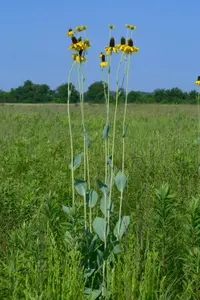
Great coneflower, Rudbeckia maxima, is a tall, clump-forming perennial in the daisy family, valued for its bold, architectural presence in sunny borders and naturalistic plantings. It produces tall, sturdy stems topped with large golden-yellow flowers and prominent dark cones above a low base of broad bluish-gray leaves.
This species is native to the south-central United States, where it grows in open prairies, fields, and moist roadsides. It is generally easy to grow, as it tolerates heat and short dry spells once established.
Plants perform best in full sun with moderately moist, well-drained soil. These traits make it straightforward to care for great coneflower in many garden settings.

Care Difficulty
Easy Care

Light Preference
Full Sun

Water Requirements
Moderate Water

Temperature Preference
Cold Hardy

Hardiness Zone
4–9

Soil Texture
Sandy, Loamy, Clay

Soil pH
Slightly acidic (6.5–7.0), Neutral (7.0)

Soil Drainage
Moist but well-drained

Fertilization
Minimal (feed rarely)
Scan your plant to receive care tips personalized for your specific plant
Available on iOS and Android
Rudbeckia maxima prefers strong outdoor light to build sturdy stems and reliable flowering.
This deep-rooted perennial prefers moderately moist but well-drained soil rather than constant wetness.
This hardy perennial tolerates a wide temperature range but performs best in moderate warmth.
Humidity is not a critical factor for Rudbeckia maxima, which thrives in typical outdoor air conditions.
Rudbeckia maxima performs best in moderately fertile, well-draining ground that does not stay waterlogged.
This tall, deep-rooted species is only moderately suitable for container growing and needs thoughtful setup for stability.
Rudbeckia maxima is a low-input perennial that benefits from light feeding on poorer soils.
Pruning helps maintain strong growth and tidy structure in Rudbeckia maxima.
This species is usually grown in the ground; focus on careful transplanting rather than frequent repotting.
Rudbeckia maxima is commonly propagated by seed and by division of mature clumps.
This tall perennial is generally cold hardy and needs minimal winter care in most temperate climates.

Plant Health Check
Not sure what's wrong with your plant? Check your plant's health inside the app.
This species is one of the tallest North American coneflowers, often reaching 5–7 ft in height, which allows its flower stalks to rise well above surrounding prairie grasses.
Its thick, glaucous (waxy) coating on the blue-gray leaves reduces water loss and heat stress, an adaptation to hot, sunny prairie and open meadow habitats.
The large, elongated central cones mature into dense seedheads that persist into winter and provide an important cold-season food source for seed-eating birds such as finches and goldfinches.

Rudbeckia maxima was historically recorded from limited regions in the south-central United States, and its striking size and foliage have led to widespread ornamental cultivation far beyond its relatively narrow native range, making it more familiar in gardens than in truly wild prairie remnants.
This species forms expanding clumps and self-seeds, but it is usually not aggressive in managed beds. Seedlings are easy to recognize and remove. In rich soil, give it space so tall stems do not crowd neighbors.
Keep your plants happy and healthy with plant identification, disease detection, and easy care guidance.